
不同溶剂荔枝果肉提取物的游离和结合酚类成分及细胞抗氧化活性比较
Comparison of the free and bound phenolic profiles and cellular antioxidant activities of litchi pulp extracts from different solvents.
作者信息
Su Dongxiao, Zhang Ruifen, Hou Fangli, Zhang Mingwei, Guo Jinxin, Huang Fei, Deng Yuanyuan, Wei Zhencheng
机构信息
Sericultural and Agri-food Research Institute, Guangdong Academy of Agricultural Sciences, Guangzhou 510610, P,R, China.
出版信息
BMC Complement Altern Med. 2014 Jan 9;14:9. doi: 10.1186/1472-6882-14-9.
BACKGROUND
The phenolic contents and antioxidant activities of fruits could be underestimated if the bound phenolic compounds are not considered. In the present study, the extraction efficiencies of various solvents were investigated in terms of the total content of the free and bound phenolic compounds, as well as the phenolic profiles and antioxidant activities of the extracts.
METHODS
Five different solvent mixtures were used to extract the free phenolic compounds from litchi pulp. Alkaline and acidic hydrolysis methods were compared for the hydrolysis of bound phenolic compounds from litchi pulp residue. The phenolic compositions of the free and bound fractions from the litchi pulp were identified using HPLC-DAD. The antioxidant activities of the litchi pulp extracts were determined by oxygen radical absorbance capacity (ORAC) and cellular antioxidant activity (CAA) assays.
RESULTS
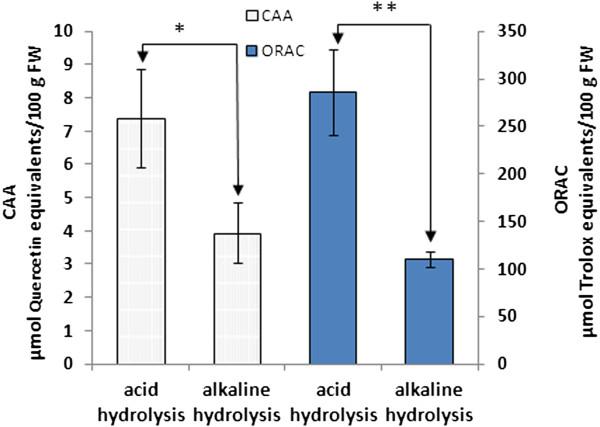
Of the solvents tested, aqueous acetone extracted the largest amount of total free phenolic compounds (210.7 mg GAE/100 g FW) from litchi pulp, followed sequentially by aqueous mixtures of methanol, ethanol and ethyl acetate, and water itself. The acid hydrolysis method released twice as many bound phenolic compounds as the alkaline hydrolysis method. Nine phenolic compounds were detected in the aqueous acetone extract. In contrast, not all of these compounds were found in the other four extracts. The classification and content of the bound phenolic compounds released by the acid hydrolysis method were higher than those achieved by the alkaline hydrolysis. The aqueous acetone extract showing the highest ORAC value (3406.9 μmol TE/100 g FW) for the free phenolic extracts. For the CAA method, however, the aqueous acetone and methanol extracts (56.7 and 55.1 μmol QE/100 g FW) showed the highest levels of activity of the five extracts tested. The ORAC and CAA values of the bound phenolic compounds obtained by acid hydrolysis were 2.6- and 1.9-fold higher than those obtained using the alkaline hydrolysis method.
CONCLUSIONS
The free and bound phenolic contents and profiles and antioxidant activities of the extracts were found to be dependent on the extraction solvent used. Litchi exhibited good cellular antioxidant activity and could be a potentially useful natural source of antioxidants.
背景
如果不考虑结合态酚类化合物,水果中的酚类物质含量和抗氧化活性可能会被低估。在本研究中,从游离态和结合态酚类化合物的总含量、提取物的酚类概况和抗氧化活性方面,研究了各种溶剂的提取效率。
方法
使用五种不同的溶剂混合物从荔枝果肉中提取游离酚类化合物。比较了碱性和酸性水解方法对荔枝果肉残渣中结合态酚类化合物的水解效果。采用高效液相色谱-二极管阵列检测器(HPLC-DAD)鉴定荔枝果肉游离态和结合态部分的酚类组成。通过氧自由基吸收能力(ORAC)和细胞抗氧化活性(CAA)测定法测定荔枝果肉提取物的抗氧化活性。
结果
在所测试的溶剂中,丙酮水溶液从荔枝果肉中提取的游离酚类化合物总量最多(210.7毫克没食子酸当量/100克鲜重),其次依次是甲醇、乙醇和乙酸乙酯的水溶液,以及水本身。酸性水解法释放的结合态酚类化合物是碱性水解法的两倍。在丙酮水溶液提取物中检测到九种酚类化合物。相比之下,在其他四种提取物中并非都能找到所有这些化合物。酸性水解法释放的结合态酚类化合物的分类和含量高于碱性水解法。丙酮水溶液提取物在游离酚类提取物中显示出最高的ORAC值(3406.9微摩尔TE/100克鲜重)。然而,对于CAA测定法,丙酮水溶液和甲醇提取物(56.7和55.1微摩尔QE/100克鲜重)在所测试的五种提取物中显示出最高的活性水平。酸性水解得到的结合态酚类化合物的ORAC和CAA值分别比碱性水解法高2.6倍和1.9倍。
结论
发现提取物中游离态和结合态酚类物质的含量、概况及抗氧化活性取决于所使用的提取溶剂。荔枝表现出良好的细胞抗氧化活性,可能是一种潜在有用的天然抗氧化剂来源。


 Zotero 插件