
优化乙醇 - 水共溶剂体系用于绿色超临界二氧化碳萃取麝香葡萄皮渣中的多酚
Optimizing Ethanol-Water Cosolvent Systems for Green Supercritical Carbon Dioxide Extraction of Muscadine Grape Pomace Polyphenols.
作者信息
Tuhanioglu Arda, Kaur Sumanjot, De Barros Gabriel Laquete, Ahmadzadeh Safoura, Threlfall Renee, Ubeyitogullari Ali
机构信息
Department of Food Science, University of Arkansas, Fayetteville, Arkansas 72704, United States.
Department of Science and Agroindustrial Technology, Faculdade de Agronomia Eliseu Maciel, Universidade Federal de Pelotas, Capão Do Leão, Rio Grande do Sul 96160-000, Brazil.
出版信息
ACS Omega. 2025 Jan 29;10(5):4860-4869. doi: 10.1021/acsomega.4c10115. eCollection 2025 Feb 11.
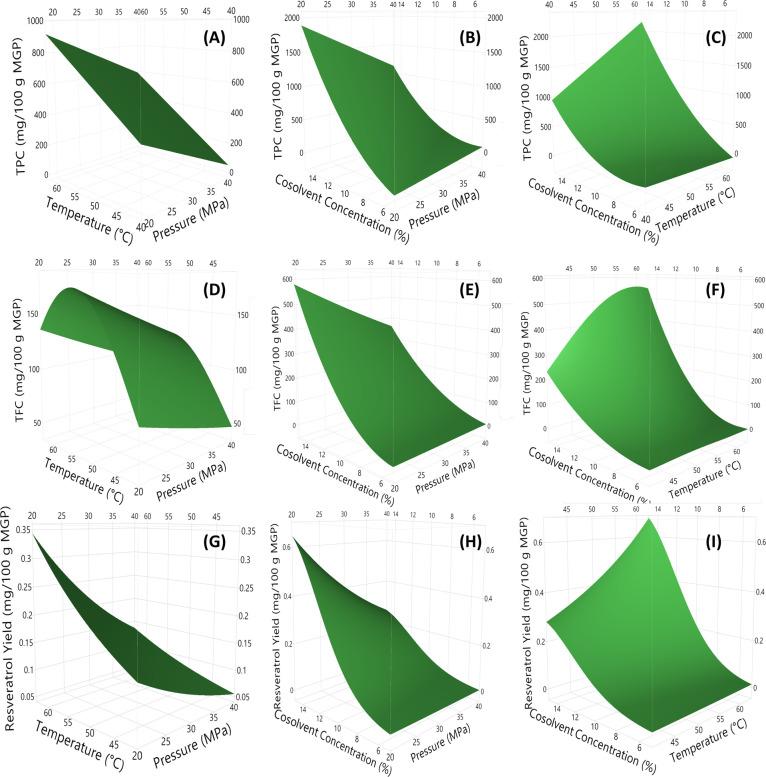
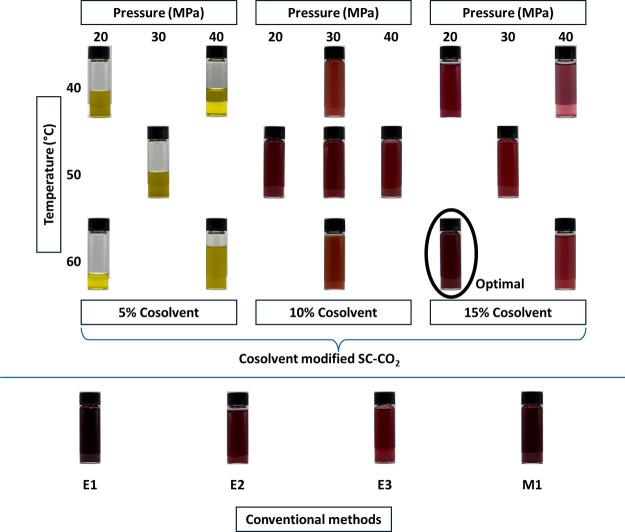
This study evaluated the ethanol-water modified (50%, v/v) supercritical carbon dioxide (SC-CO) for the extraction of polyphenols from muscadine grape ( Michgx.) pomace and compared with conventional solvent extractions (ethanol-water and HCl-methanol). The process was optimized with a central composite response surface design consisting of three levels of three independent variables: pressure (20-40 MPa), temperature (40-60 °C), and cosolvent concentration (5-15%) to maximize three responses: total phenolic content (TPC), total flavonoid content (TFC), and resveratrol yields. The optimal conditions were determined as 20 MPa, 60 °C, and 15% cosolvent concentration with TPC, TFC, and resveratrol yields of 2491 mg/100 g, 674 mg/100 g, and 1.07 mg/100 g, respectively. The surface plots indicated that a 15% cosolvent concentration maximized extraction efficiency, producing red-brown colored extracts. In contrast, a 5% cosolvent resulted in poor extractions, yielding yellow-green extracts under all conditions. The yields increased with higher temperatures (i.e., 60 °C) and lower pressures (i.e., 20 MPa). TPC and TFC obtained through cosolvent-modified SC-CO were similar to those obtained through conventional extractions. Moreover, the resveratrol yield was lower than the HCl-methanol extraction, even though it was not different from any ethanol-water extractions at any solvent-to-solute ratios. The analysis of antioxidants indicated that the ABTS values of the cosolvent-modified SC-CO extract were lower than those of the HCl-methanol extract. However, there were no significant differences in the DPPH values between the two extracts. Thus, this study optimized the sustainable technology of SC-CO extraction by employing only food-grade cosolvents-ethanol and water-as a more environmentally friendly method for isolating polyphenols from the underutilized waste product of muscadine grape pomace utilizing statistical methodologies in the extraction process.
本研究评估了乙醇 - 水改性(50%,v/v)的超临界二氧化碳(SC - CO₂)从圆叶葡萄(Michgx.)果渣中提取多酚的效果,并与传统溶剂萃取法(乙醇 - 水和盐酸 - 甲醇)进行了比较。该工艺采用中心复合响应面设计进行优化,该设计包含三个水平的三个自变量:压力(20 - 40 MPa)、温度(40 - 60 °C)和共溶剂浓度(5 - 15%),以最大化三个响应值:总酚含量(TPC)、总黄酮含量(TFC)和白藜芦醇产量。确定的最佳条件为20 MPa、60 °C和15%的共溶剂浓度,此时TPC、TFC和白藜芦醇产量分别为2491 mg/100 g、674 mg/100 g和1.07 mg/100 g。表面图表明,15%的共溶剂浓度可使萃取效率最大化,得到红棕色提取物。相比之下,5%的共溶剂导致萃取效果不佳,在所有条件下均得到黄绿色提取物。产量随着较高温度(即60 °C)和较低压力(即20 MPa)而增加。通过共溶剂改性的SC - CO₂获得的TPC和TFC与通过传统萃取获得的相似。此外,白藜芦醇产量低于盐酸 - 甲醇萃取法,尽管在任何溶剂与溶质比例下它与任何乙醇 - 水萃取法均无差异。抗氧化剂分析表明,共溶剂改性的SC - CO₂提取物的ABTS值低于盐酸 - 甲醇提取物。然而,两种提取物的DPPH值没有显著差异。因此,本研究通过仅使用食品级共溶剂——乙醇和水,采用统计方法优化了SC - CO₂萃取的可持续技术,这是一种从未充分利用的圆叶葡萄果渣废弃物中分离多酚的更环保方法。
 Zotero 插件