
具有规定热流的铁磁流体沿拉伸圆柱体的磁流体动力学边界层滑移流动与传热
MHD boundary layer slip flow and heat transfer of ferrofluid along a stretching cylinder with prescribed heat flux.
作者信息
Qasim Muhammad, Khan Zafar Hayat, Khan Waqar Ahmad, Ali Shah Inayat
机构信息
Department of Mathematics, COMSATS Institute of Information Technology, Park Road, Chak Shahzad, Islamabad, Pakistan.
School of Mathematical Sciences, Peking University, Beijing, People's Republic of China.
出版信息
PLoS One. 2014 Jan 22;9(1):e83930. doi: 10.1371/journal.pone.0083930. eCollection 2014.
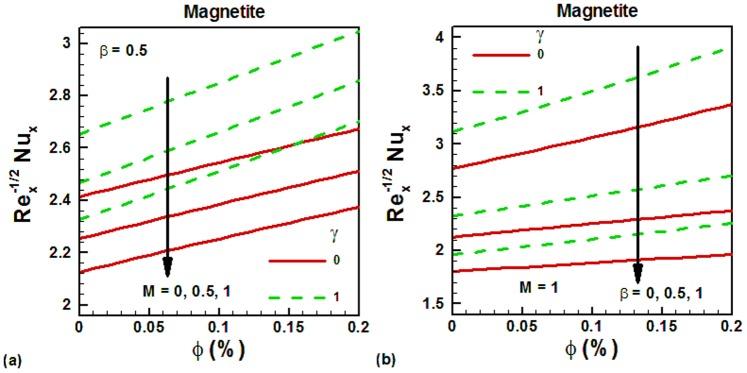
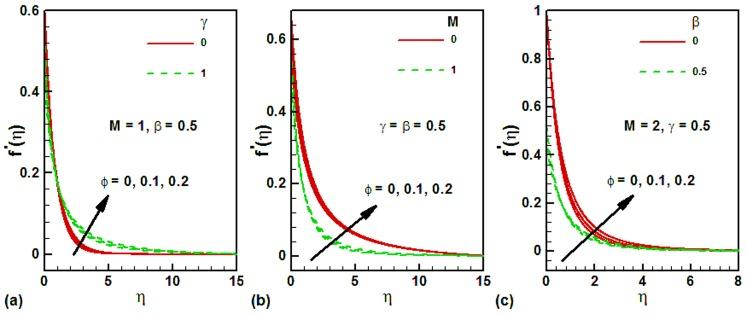
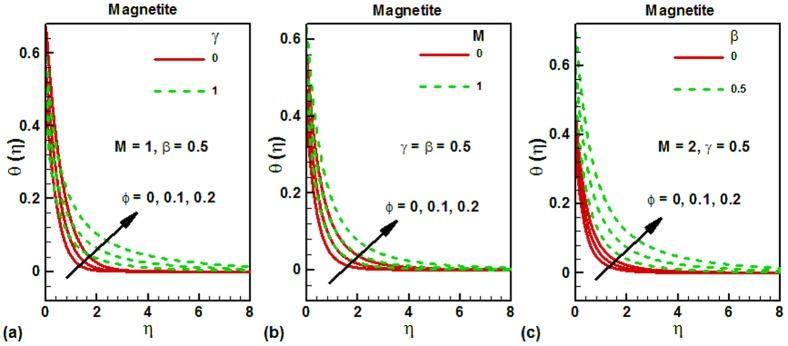
This study investigates the magnetohydrodynamic (MHD) flow of ferrofluid along a stretching cylinder. The velocity slip and prescribed surface heat flux boundary conditions are employed on the cylinder surface. Water as conventional base fluid containing nanoparticles of magnetite (Fe3O4) is used. Comparison between magnetic (Fe3O4) and non-magnetic (Al2O3) nanoparticles is also made. The governing non-linear partial differential equations are reduced to non-linear ordinary differential equations and then solved numerically using shooting method. Present results are compared with the available data in the limiting cases. The present results are found to be in an excellent agreement. It is observed that with an increase in the magnetic field strength, the percent difference in the heat transfer rate of magnetic nanoparticles with Al2O3 decreases. Surface shear stress and the heat transfer rate at the surface increase as the curvature parameter increases, i.e curvature helps to enhance the heat transfer.
本研究考察了铁磁流体沿拉伸圆柱的磁流体动力学(MHD)流动。在圆柱表面采用了速度滑移和规定表面热流边界条件。使用水作为含有磁铁矿(Fe3O4)纳米颗粒的传统基液。还对磁性(Fe3O4)和非磁性(Al2O3)纳米颗粒进行了比较。将控制非线性偏微分方程简化为非线性常微分方程,然后采用打靶法进行数值求解。将当前结果与极限情况下的现有数据进行了比较。发现当前结果具有极好的一致性。观察到随着磁场强度的增加,磁性纳米颗粒与Al2O3的传热速率百分比差异减小。表面剪切应力和表面传热速率随着曲率参数的增加而增加,即曲率有助于增强传热。


 Zotero 插件