
肿瘤中瘦素的表达与胃食管腺癌的化疗耐药和无治疗依赖性预后相关。
Tumour expression of leptin is associated with chemotherapy resistance and therapy-independent prognosis in gastro-oesophageal adenocarcinomas.
机构信息
1] Institute of Medical Sciences, School of Medicine and Dentistry, University of Aberdeen, Foresterhill Health Campus, Foresterhill, Aberdeen, Scotland AB25 2ZN, UK [2] Department of Gastroenterology, Aberdeen Royal Infirmary, Foresterhill Health Campus, Foresterhill, Aberdeen, Scotland AB25 2ZN, UK.
Institute of Medical Sciences, School of Medicine and Dentistry, University of Aberdeen, Foresterhill Health Campus, Foresterhill, Aberdeen, Scotland AB25 2ZN, UK.
出版信息
Br J Cancer. 2014 Mar 18;110(6):1525-34. doi: 10.1038/bjc.2014.45. Epub 2014 Feb 25.
BACKGROUND
Cytotoxic chemotherapy remains the main systemic therapy for gastro-oesophageal adenocarcinoma, but resistance to chemotherapy is common, resulting in ineffective and often toxic treatment for patients. Predictive biomarkers for chemotherapy response would increase the probability of successful therapy, but none are currently recommended for clinical use. We used global gene expression profiling of tumour biopsies to identify novel predictive biomarkers for cytotoxic chemotherapy.
METHODS
Tumour biopsies from patients (n=14) with TNM stage IB-IV gastro-oesophageal adenocarcinomas receiving platinum-based combination chemotherapy were used as a discovery cohort and profiled with Affymetrix ST1.0 Exon Genechips. An independent cohort of patients (n=154) treated with surgery with or without neoadjuvant platinum combination chemotherapy and gastric adenocarcinoma cell lines (n=22) were used for qualification of gene expression profiling results by immunohistochemistry. A cisplatin-resistant gastric cancer cell line, AGS Cis5, and the oesophageal adenocarcinoma cell line, OE33, were used for in vitro validation investigations.
RESULTS
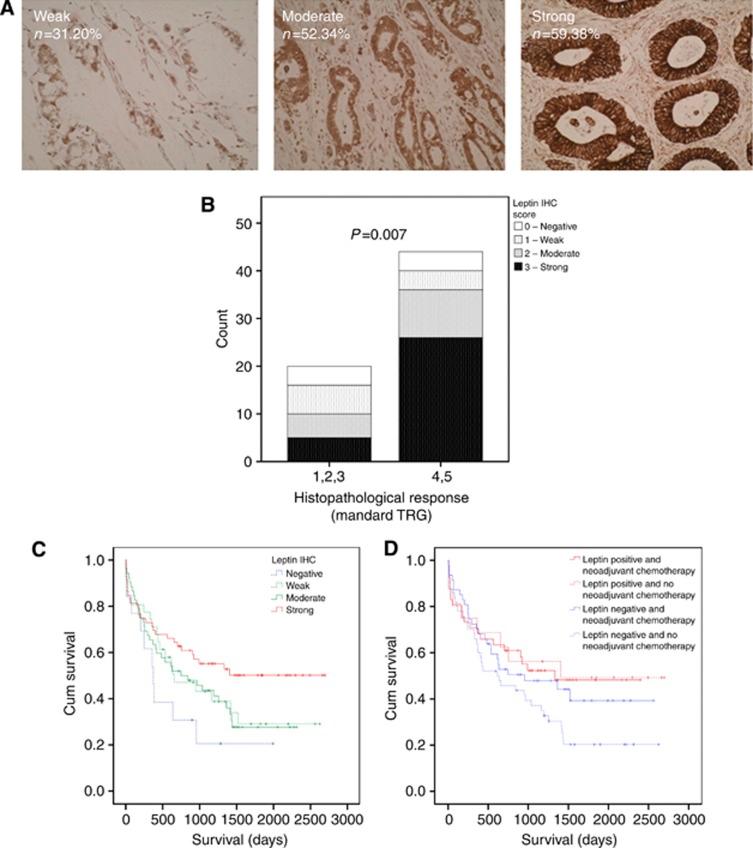
We identified 520 genes with differential expression (Mann-Whitney U, P<0.020) between radiological responding and nonresponding patients. Gene enrichment analysis (DAVID v6.7) was used on this list of 520 genes to identify pathways associated with response and identified the adipocytokine signalling pathway, with higher leptin mRNA associated with lack of radiological response (P=0.011). Similarly, in the independent cohort (n=154), higher leptin protein expression by immunohistochemistry in the tumour cells was associated with lack of histopathological response (P=0.007). Higher leptin protein expression by immunohistochemistry was also associated with improved survival in the absence of neoadjuvant chemotherapy, and patients with low leptin protein-expressing tumours had improved survival when treated by neoadjuvant chemotherapy (P for interaction=0.038). In the gastric adenocarcinoma cell lines, higher leptin protein expression was associated with resistance to cisplatin (P=0.008), but not to oxaliplatin (P=0.988) or 5fluorouracil (P=0.636). The leptin receptor antagonist SHLA increased the sensitivity of AGS Cis5 and OE33 cell lines to cisplatin.
CONCLUSIONS
In gastro-oesophageal adenocarcinomas, tumour leptin expression is associated with chemoresistance but a better therapy-independent prognosis. Tumour leptin expression determined by immunohistochemistry has potential utility as a predictive marker of resistance to cytotoxic chemotherapy, and a prognostic marker independent of therapy in gastro-oesophageal adenocarcinoma. Leptin antagonists have been developed for clinical use and leptin and its associated pathways may also provide much needed novel therapeutic targets for gastro-oesophageal adenocarcinoma.
背景
细胞毒性化疗仍然是治疗胃食管腺癌的主要全身治疗方法,但对化疗的耐药性很常见,导致患者的治疗无效且通常有毒。预测化疗反应的生物标志物将增加成功治疗的可能性,但目前尚无推荐用于临床的生物标志物。我们使用肿瘤活检的全基因组表达谱来鉴定用于细胞毒性化疗的新型预测生物标志物。
方法
使用接受基于铂的联合化疗的 TNM 分期 IB-IV 胃食管腺癌患者(n=14)的肿瘤活检作为发现队列,并使用 Affymetrix ST1.0 Exon Genechips 进行分析。使用接受手术治疗加或不加新辅助铂联合化疗的患者(n=154)和胃腺癌细胞系(n=22)的独立队列通过免疫组织化学验证基因表达谱结果。使用顺铂耐药的胃癌细胞系 AGS Cis5 和食管腺癌细胞系 OE33 进行体外验证研究。
结果
我们在影像学反应和非反应患者之间鉴定出 520 个差异表达的基因(Mann-Whitney U,P<0.020)。对该 520 个基因列表进行基因富集分析(DAVID v6.7),以鉴定与反应相关的途径,并确定了脂肪细胞因子信号通路,较高的瘦素 mRNA 与影像学无反应相关(P=0.011)。同样,在独立队列(n=154)中,肿瘤细胞中较高的瘦素蛋白免疫组化表达与组织病理学无反应相关(P=0.007)。免疫组化中较高的瘦素蛋白表达也与无新辅助化疗时的生存改善相关,而新辅助化疗时肿瘤瘦素蛋白表达较低的患者的生存也得到改善(交互 P=0.038)。在胃腺癌细胞系中,较高的瘦素蛋白表达与顺铂耐药相关(P=0.008),但与奥沙利铂(P=0.988)或 5-氟尿嘧啶(P=0.636)耐药无关。瘦素受体拮抗剂 SHLA 增加了 AGS Cis5 和 OE33 细胞系对顺铂的敏感性。
结论
在胃食管腺癌中,肿瘤瘦素表达与化疗耐药相关,但与独立于治疗的更好预后相关。免疫组化确定的肿瘤瘦素表达具有作为细胞毒性化疗耐药预测标志物的潜在效用,并且是胃食管腺癌中独立于治疗的预后标志物。已经开发出用于临床的瘦素拮抗剂,瘦素及其相关途径也可能为胃食管腺癌提供急需的新型治疗靶点。


 Zotero 插件