
鞘氨醇激酶1和鞘氨醇-1-磷酸裂解酶对细胞内鞘氨醇-1-磷酸的调节决定了食管癌的化疗耐药性。
Regulation of cellular sphingosine-1-phosphate by sphingosine kinase 1 and sphingosine-1-phopshate lyase determines chemotherapy resistance in gastroesophageal cancer.
作者信息
Matula Kasia, Collie-Duguid Elaina, Murray Graeme, Parikh Khyati, Grabsch Heike, Tan Patrick, Lalwani Salina, Garau Roberta, Ong Yuhan, Bain Gillian, Smith Asa-Dahle, Urquhart Gordon, Bielawski Jacek, Finnegan Michael, Petty Russell
机构信息
School of Medicine and Dentistry, University of Aberdeen, Aberdeen Royal Infirmary, Foresterhill Healthcare Campus, Foresterhill, Aberdeen, AB25 2ZG, Scotland, UK.
Department of Pathology, University of Aberdeen, Aberdeen Royal Infirmary, Foresterhill Healthcare Campus, Foresterhill, Aberdeen, AB25 2ZG, Scotland, UK.
出版信息
BMC Cancer. 2015 Oct 22;15:762. doi: 10.1186/s12885-015-1718-7.
BACKGROUND
Resistance to chemotherapy is common in gastroesophageal cancer. Mechanisms of resistance are incompletely characterised and there are no predictive biomarkers in clinical practice for cytotoxic drugs. We used new cell line models to characterise novel chemotherapy resistance mechanisms and validated them in tumour specimens to identify new targets and biomarkers for gastroesophageal cancer.
METHODS
Cell lines were selected for resistance to oxaliplatin, cisplatin and docetaxel and gene expression examined using Affymetrix Exon 1.0 ST arrays. Leads were validated by qRT-PCR and HPLC of tumour metabolites. Protein expression and pharmacological inhibition of lead target SPHK1 was evaluated in independent cell lines, and by immunohistochemistry in gastroesophageal cancer patients.
RESULTS
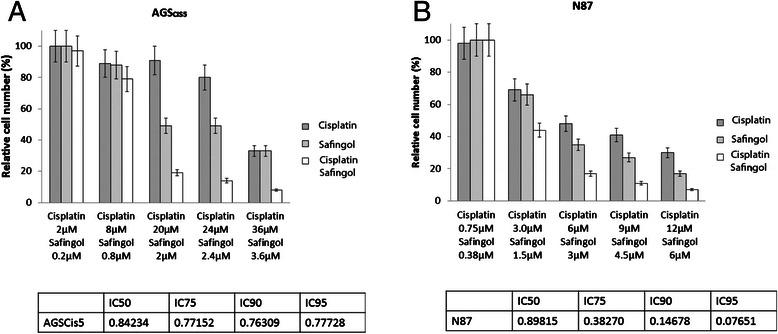
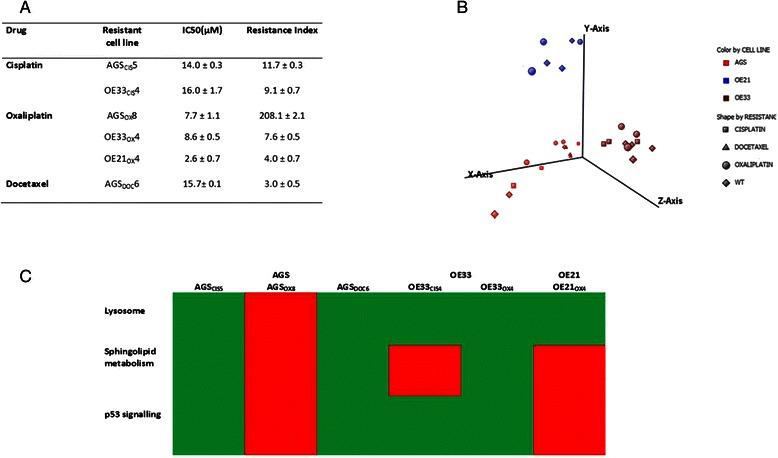
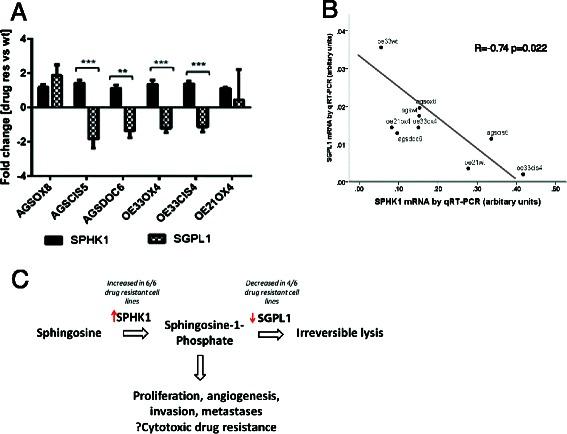
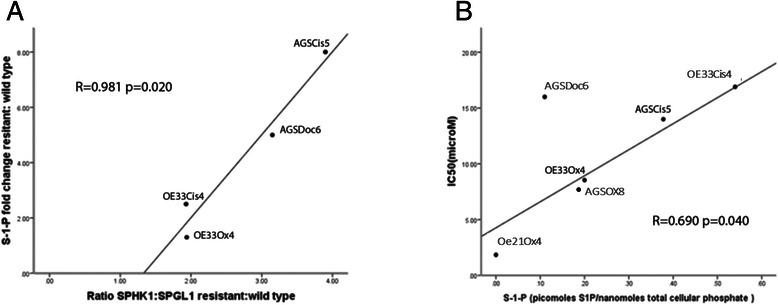
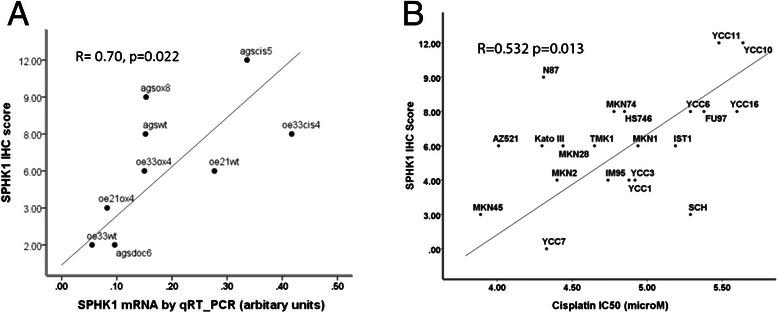
Genes with differential expression in drug resistant cell lines compared to the parental cell line they were derived from, were identified for each drug resistant cell line. Biological pathway analysis of these gene lists, identified over-represented pathways, and only 3 pathways - lysosome, sphingolipid metabolism and p53 signalling- were identified as over-represented in these lists for all three cytotoxic drugs investigated. The majority of genes differentially expressed in chemoresistant cell lines from these pathways, were involved in metabolism of glycosphingolipids and sphingolipids in lysosomal compartments suggesting that sphingolipids might be important mediators of cytotoxic drug resistance in gastroeosphageal cancers . On further investigation, we found that drug resistance (IC50) was correlated with increased sphingosine kinase 1(SPHK1) mRNA and also with decreased sphingosine-1-phosphate lysase 1(SGPL1) mRNA. SPHK1 and SGPL1 gene expression were inversely correlated. SPHK1:SGPL1 ratio correlated with increased cellular sphingosine-1-phosphate (S1P), and S1P correlated with drug resistance (IC50). High SPHK1 protein correlated with resistance to cisplatin (IC50) in an independent gastric cancer cell line panel and with survival of patients treated with chemotherapy prior to surgery but not in patients treated with surgery alone. Safingol a SPHK1 inhibitor, was cytotoxic as a single agent and acted synergistically with cisplatin in gastric cancer cell lines.
CONCLUSION
Agents that inhibit SPHK1 or S1P could overcome cytotoxic drug resistance in gastroesophageal cancer. There are several agents in early phase human trials including Safingol that could be combined with chemotherapy or used in patients progressing after chemotherapy.
背景
化疗耐药在胃食管癌中很常见。耐药机制尚未完全明确,临床实践中也没有细胞毒性药物的预测生物标志物。我们使用新的细胞系模型来表征新的化疗耐药机制,并在肿瘤标本中进行验证,以确定胃食管癌的新靶点和生物标志物。
方法
选择对奥沙利铂、顺铂和多西他赛耐药的细胞系,使用Affymetrix Exon 1.0 ST芯片检测基因表达。通过qRT-PCR和肿瘤代谢产物的HPLC对线索进行验证。在独立细胞系中评估铅靶标SPHK1的蛋白表达和药理抑制作用,并在胃食管癌患者中通过免疫组化进行评估。
结果
对于每个耐药细胞系,确定了与它们所源自的亲本细胞系相比在耐药细胞系中差异表达的基因。对这些基因列表进行生物通路分析,确定了过度富集的通路,在所研究的所有三种细胞毒性药物的这些列表中,只有3条通路——溶酶体、鞘脂代谢和p53信号通路——被确定为过度富集。这些通路中在化疗耐药细胞系中差异表达的大多数基因,都参与了溶酶体区室中糖鞘脂和鞘脂的代谢,这表明鞘脂可能是胃食管癌中细胞毒性药物耐药的重要介质。进一步研究发现,耐药性(IC50)与鞘氨醇激酶1(SPHK1)mRNA增加以及鞘氨醇-1-磷酸裂解酶1(SGPL1)mRNA减少相关。SPHK1和SGPL1基因表达呈负相关。SPHK1:SGPL1比值与细胞内鞘氨醇-1-磷酸(S1P)增加相关,且S1P与耐药性(IC50)相关。在一个独立的胃癌细胞系组中,高SPHK1蛋白与对顺铂的耐药性(IC50)相关,并且与术前接受化疗的患者的生存相关,但与仅接受手术治疗的患者无关。SPHK1抑制剂沙芬戈作为单一药物具有细胞毒性,并且在胃癌细胞系中与顺铂协同作用。
结论
抑制SPHK1或S1P的药物可以克服胃食管癌中的细胞毒性药物耐药性。在早期人体试验中有几种药物,包括沙芬戈,可以与化疗联合使用或用于化疗后病情进展的患者。

 Zotero 插件