
用于大肠杆菌中蛋白质溶解性、纯化及免疫原性的融合标签:新型Fh8系统
Fusion tags for protein solubility, purification and immunogenicity in Escherichia coli: the novel Fh8 system.
作者信息
Costa Sofia, Almeida André, Castro António, Domingues Lucília
机构信息
Institute for Biotechnology and Bioengineering, Centre of Biological Engineering, University of Minho Braga, Portugal ; Instituto Nacional de Saúde Dr. Ricardo Jorge Porto, Portugal.
Hitag Biotechnology, Lad., Biocant, Parque Technologico de Cantanhede Cantanhede, Portugal.
出版信息
Front Microbiol. 2014 Feb 19;5:63. doi: 10.3389/fmicb.2014.00063. eCollection 2014.
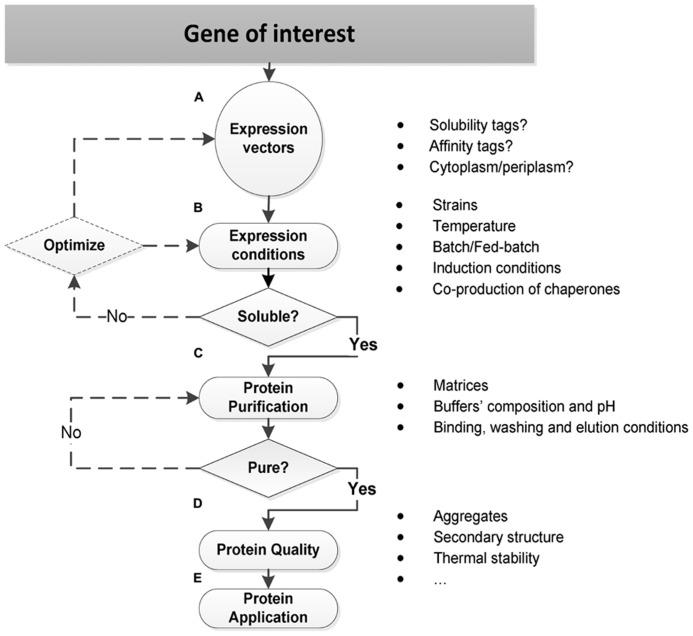
Proteins are now widely produced in diverse microbial cell factories. The Escherichia coli is still the dominant host for recombinant protein production but, as a bacterial cell, it also has its issues: the aggregation of foreign proteins into insoluble inclusion bodies is perhaps the main limiting factor of the E. coli expression system. Conversely, E. coli benefits of cost, ease of use and scale make it essential to design new approaches directed for improved recombinant protein production in this host cell. With the aid of genetic and protein engineering novel tailored-made strategies can be designed to suit user or process requirements. Gene fusion technology has been widely used for the improvement of soluble protein production and/or purification in E. coli, and for increasing peptide's immunogenicity as well. New fusion partners are constantly emerging and complementing the traditional solutions, as for instance, the Fh8 fusion tag that has been recently studied and ranked among the best solubility enhancer partners. In this review, we provide an overview of current strategies to improve recombinant protein production in E. coli, including the key factors for successful protein production, highlighting soluble protein production, and a comprehensive summary of the latest available and traditionally used gene fusion technologies. A special emphasis is given to the recently discovered Fh8 fusion system that can be used for soluble protein production, purification, and immunogenicity in E. coli. The number of existing fusion tags will probably increase in the next few years, and efforts should be taken to better understand how fusion tags act in E. coli. This knowledge will undoubtedly drive the development of new tailored-made tools for protein production in this bacterial system.
蛋白质现在广泛在各种微生物细胞工厂中生产。大肠杆菌仍然是重组蛋白生产的主要宿主,但作为一种细菌细胞,它也有自身的问题:外源蛋白聚集成不溶性包涵体可能是大肠杆菌表达系统的主要限制因素。相反,大肠杆菌在成本、易用性和规模方面的优势使其有必要设计新方法来提高在这种宿主细胞中的重组蛋白产量。借助基因工程和蛋白质工程,可以设计出新型的定制策略以满足用户或工艺要求。基因融合技术已被广泛用于提高大肠杆菌中可溶性蛋白的产量和/或纯化,以及增强肽的免疫原性。新的融合伙伴不断涌现并补充传统解决方案,例如最近研究的Fh8融合标签,它已被列为最佳的溶解度增强伙伴之一。在本综述中,我们概述了目前提高大肠杆菌中重组蛋白产量的策略,包括成功生产蛋白的关键因素,重点介绍可溶性蛋白的生产,并全面总结最新可用的和传统使用的基因融合技术。特别强调了最近发现的Fh8融合系统,它可用于大肠杆菌中可溶性蛋白的生产、纯化和免疫原性。在未来几年中,现有融合标签的数量可能会增加,应该努力更好地了解融合标签在大肠杆菌中的作用机制。这些知识无疑将推动在这个细菌系统中开发新的定制化蛋白质生产工具。

 Zotero 插件