
抑制APE1/Ref-1氧化还原活性可使人类视网膜色素上皮细胞免受氧化应激影响,并减少脉络膜新生血管形成。
Inhibition of APE1/Ref-1 redox activity rescues human retinal pigment epithelial cells from oxidative stress and reduces choroidal neovascularization.
作者信息
Li Y, Liu X, Zhou T, Kelley M R, Edwards P, Gao H, Qiao X
机构信息
Department of Ophthalmology, Henry Ford Health System, 1 Ford Place 5D, Detroit, MI, United States ; Department of Ophthalmology, Xijing Hospital, Fourth Military Medical University, Xi׳an, Shanxi, People׳s Republic of China.
Department of Ophthalmology, Henry Ford Health System, 1 Ford Place 5D, Detroit, MI, United States.
出版信息
Redox Biol. 2014 Feb 21;2:485-94. doi: 10.1016/j.redox.2014.01.023. eCollection 2014.
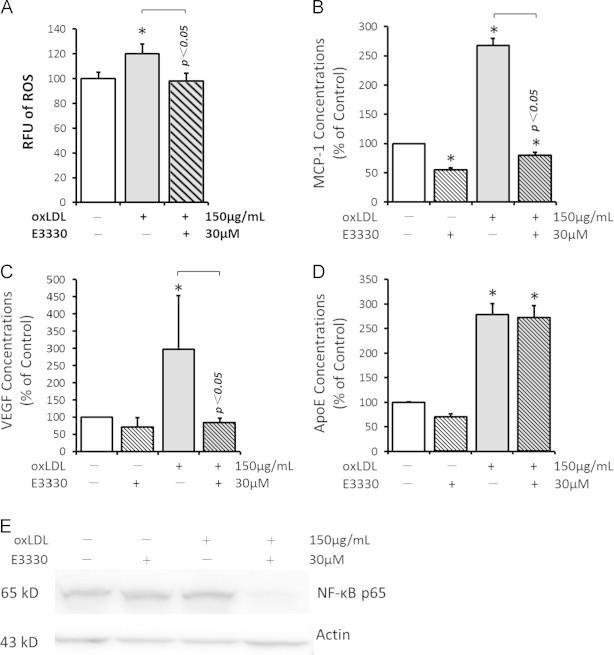
The effectiveness of current treatment for age related macular degeneration (AMD) by targeting one molecule is limited due to its multifactorial nature and heterogeneous pathologies. Treatment strategy to target multiple signaling pathways or pathological components in AMD pathogenesis is under investigation for better clinical outcome. Inhibition of the redox function of apurinic endonuclease 1/redox factor-1 (APE1) was found to suppress endothelial angiogenesis and promote neuronal cell recovery, thereby may serve as a potential treatment for AMD. In the current study, we for the first time have found that a specific inhibitor of APE1 redox function by a small molecule compound E3330 regulates retinal pigment epithelium (RPEs) cell response to oxidative stress. E3330 significantly blocked sub-lethal doses of oxidized low density lipoprotein (oxLDL) induced proliferation decline and senescence advancement of RPEs. At the same time, E3330 remarkably decreased the accumulation of intracellular reactive oxygen species (ROS) and down-regulated the productions of monocyte chemoattractant protein-1 (MCP-1) and vascular endothelial growth factor (VEGF), as well as attenuated the level of nuclear factor-κB (NF-κB) p65 in RPEs. A panel of stress and toxicity responsive transcription factors that were significantly upregulated by oxLDL was restored by E3330, including Nrf2/Nrf1, p53, NF-κB, HIF1, CBF/NF-Y/YY1, and MTF-1. Further, a single intravitreal injection of E3330 effectively reduced the progression of laser-induced choroidal neovascularization (CNV) in mouse eyes. These data revealed that E3330 effectively rescued RPEs from oxidative stress induced senescence and dysfunctions in multiple aspects in vitro, and attenuated laser-induced damages to RPE-Bruch׳s membrane complex in vivo. Together with its previously established anti-angiogenic and neuroprotection benefits, E3330 is implicated for potential use for AMD treatment.
由于年龄相关性黄斑变性(AMD)具有多因素性质和异质性病理,目前通过靶向单一分子治疗AMD的效果有限。针对AMD发病机制中的多个信号通路或病理成分的治疗策略正在研究中,以期获得更好的临床疗效。已发现抑制脱嘌呤嘧啶内切酶1/氧化还原因子-1(APE1)的氧化还原功能可抑制内皮细胞血管生成并促进神经元细胞恢复,因此可能成为治疗AMD的潜在方法。在本研究中,我们首次发现小分子化合物E3330作为APE1氧化还原功能的特异性抑制剂,可调节视网膜色素上皮(RPE)细胞对氧化应激的反应。E3330显著阻断亚致死剂量的氧化型低密度脂蛋白(oxLDL)诱导的RPE细胞增殖下降和衰老进程。同时,E3330显著降低细胞内活性氧(ROS)的积累,下调单核细胞趋化蛋白-1(MCP-1)和血管内皮生长因子(VEGF)的产生,并减弱RPE细胞中核因子-κB(NF-κB)p65的水平。E33缓解了oxLDL显著上调的一组应激和毒性反应转录因子,包括Nrf2/Nrf1、p53、NF-κB, HIF1、CBF/NF-Y/YY和MTF-1。此外,单次玻璃体内注射E3330可有效减轻小鼠眼睛激光诱导的脉络膜新生血管(CNV)的进展。这些数据表明,E3330在体外可有效使RPE细胞从氧化应激诱导的衰老和多方面功能障碍中恢复,并在体内减轻激光对RPE-布鲁赫膜复合体的损伤。连同其先前确立的抗血管生成和神经保护作用,E3330有望用于AMD治疗。



 Zotero 插件