
脂肪肝可预测中年人群发生心血管事件的风险:一项基于人群的队列研究。
Fatty liver predicts the risk for cardiovascular events in middle-aged population: a population-based cohort study.
作者信息
Pisto Pauliina, Santaniemi Merja, Bloigu Risto, Ukkola Olavi, Kesäniemi Y Antero
机构信息
Department of Internal Medicine and Biocenter Oulu, Institute of Clinical Medicine, University of Oulu, and Clinical Research Center, Oulu University Hospital, Oulu, Finland.
出版信息
BMJ Open. 2014 Mar 20;4(3):e004973. doi: 10.1136/bmjopen-2014-004973.
OBJECTIVE
We investigated if the differences in liver fat content would predict the development of non-fatal and fatal atherosclerotic endpoints (coronary heart disease and stroke).
DESIGN, SETTING AND PARTICIPANTS: Our study group is a population-based, randomly recruited cohort (Oulu Project Elucidating Risk of Atherosclerosis, OPERA), initiated in 1991. The cohort consisted of 988 middle-aged Finnish participants.
INTERVENTION
Total mortality and hospital events were followed up to 2009 based on the registry of the National Institute for Health and Welfare and the National death registry.
MAIN OUTCOME MEASURE
The severity of hepatic steatosis was measured by ultrasound and divided into three groups (0-2). Cox regression analysis was used in the statistical analysis.
RESULTS
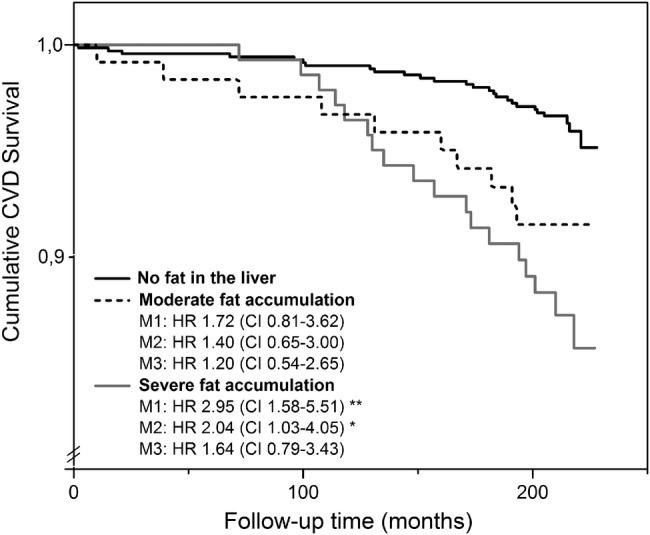
In the follow-up of years 1991-2009, 13.5% of the participants with non-fatty liver, 24.2% of participants having moderate liver fat content and 29.2% of the participants having severe fatty liver experienced a cardiovascular event during the follow-up time (p<0.001). Severe liver fat content predicted the risk for future risk of cardiovascular event even when adjusted for age, gender and study group (HR 1.92, CI 1.32 to 2.80, p<0.01). When further adjustments for smoking, alcohol consumption, low-density lipoprotein-cholesterol, body mass index and systolic blood pressure were conducted, the risk still remained statistically significant (HR 1.74, CI 1.16 to 2.63, p<0.01). Statistical significance disappeared with further adjustment for QUICKI.
CONCLUSIONS
Liver fat content increases the risk of future cardiovascular disease event in long-term follow-up but it is seems to be dependent on insulin sensitivity.
目的
我们研究了肝脏脂肪含量的差异是否能预测非致死性和致死性动脉粥样硬化终点事件(冠心病和中风)的发生。
设计、地点和参与者:我们的研究组是一个基于人群的随机招募队列(奥卢动脉粥样硬化风险研究项目,OPERA),始于1991年。该队列由988名中年芬兰参与者组成。
干预措施
根据国家健康与福利研究所的登记册和国家死亡登记册,对总死亡率和住院事件进行随访至2009年。
主要观察指标
通过超声测量肝脂肪变性的严重程度,并分为三组(0 - 2级)。统计分析采用Cox回归分析。
结果
在1991 - 2009年的随访中,非脂肪肝参与者中有13.5%、肝脏脂肪含量中等的参与者中有24.2%、肝脏脂肪含量严重的参与者中有29.2%在随访期间发生了心血管事件(p<0.001)。即使在对年龄、性别和研究组进行调整后,严重的肝脏脂肪含量仍可预测未来发生心血管事件的风险(风险比1.92,置信区间1.32至2.80,p<0.01)。当进一步对吸烟、饮酒、低密度脂蛋白胆固醇、体重指数和收缩压进行调整后,该风险在统计学上仍具有显著性(风险比1.74,置信区间1.16至2.63,p<0.01)。在进一步对定量胰岛素敏感性检查指数(QUICKI)进行调整后,统计学显著性消失。
结论
在长期随访中,肝脏脂肪含量会增加未来发生心血管疾病事件的风险,但这似乎取决于胰岛素敏感性。
 Zotero 插件