
2013 - 2014年冬季墨西哥甲型H1N1流感大流行相关的严重发病率和死亡率:年龄分布的逐渐变化及严重程度
Substantial Morbidity and Mortality Associated with Pandemic A/H1N1 Influenza in Mexico, Winter 2013-2014: Gradual Age Shift and Severity.
作者信息
Dávila Javier, Chowell Gerardo, Borja-Aburto Víctor H, Viboud Cécile, Grajales Muñiz Concepciòn, Miller Mark
机构信息
Dirección de Prestaciones Médicas, Instituto Mexicano del Seguro Social, Mexico City, México.
Division of Epidemiology and Population Studies, Fogarty International Center, National Institutes of Health, Bethesda, Maryland, USA; Mathematical, Computational & Modeling Sciences Center, School of Human Evolution and Social Change, Arizona State University, Tempe, Arizona, USA.
出版信息
PLoS Curr. 2014 Mar 26;6:ecurrents.outbreaks.a855a92f19db1d90ca955f5e908d6631. doi: 10.1371/currents.outbreaks.a855a92f19db1d90ca955f5e908d6631.
BACKGROUND
A recrudescent wave of pandemic influenza A/H1N1 is underway in Mexico in winter 2013-14, following a mild 2012-13 A/H3N2 influenza season. Mexico previously experienced several waves of pandemic A/H1N1 activity in spring, summer and fall 2009 and winter 2011-2012, with a gradual shift of influenza-related hospitalizations and deaths towards older ages. Here we describe changes in the epidemiology of the 2013-14 A/H1N1 influenza outbreak, relative to previous seasons dominated by the A/H1N1 pandemic virus. The analysis is intended to guide public health intervention strategies in near real time.
METHODS
We analyzed demographic and geographic data on hospitalizations with severe acute respiratory infection (SARI), laboratory-confirmed A/H1N1 influenza hospitalizations, and inpatient deaths, from a large prospective surveillance system maintained by the Mexican Social Security medical system during 01-October 2013 to 31-Jan 2014. We characterized the age and regional patterns of influenza activity relative to the preceding 2011-2012 A/H1N1 influenza epidemic. We also estimated the reproduction number (R) based on the growth rate of daily case incidence by date of symptoms onset.
RESULTS
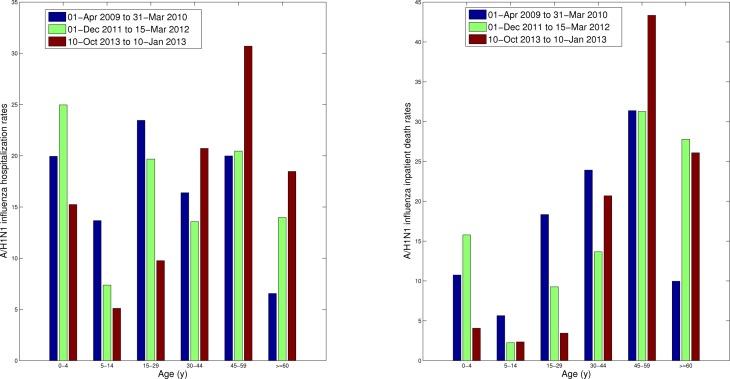
A total of 7,886 SARI hospitalizations and 529 inpatient-deaths (3.2%) were reported between 01-October 2013 and 31-January 2014 (resulting in 3.2 laboratory-confirmed A/H1N1 hospitalizations per 100,00 and 0.52 laboratory-confirmed A/H1N1-positive deaths per 100,000). The progression of daily SARI hospitalizations in 2013-14 exceeded that observed during the 2011-2012 A/H1N1 epidemic. The mean age of laboratory-confirmed A/H1N1 patients in 2013-14 was 41.1 y (SD=20.3) for hospitalizations and 49.2 y (SD=16.7) for deaths. Rates of laboratory-confirmed A/H1N1 hospitalizations and deaths were significantly higher among individuals aged 30-59 y and lower among younger age groups for the ongoing 2013-2014 epidemic, compared to the 2011-12 A/H1N1 epidemic (Chi-square test, P<0.001). The reproduction number of the winter 2013-14 wave in central Mexico was estimated at 1.3-1.4 which is slightly higher than that reported for the 2011-2012 A/H1N1 epidemic.
CONCLUSIONS
We have documented a substantial and ongoing increase in the number of A/H1N1-related hospitalizations and deaths during the period October 2013-January 2014 and a proportionate shift of severe disease to middle aged adults, relative to the preceding A/H1N1 2011-2012 epidemic in Mexico. In the absence of clear antigenic drift in globally circulating A/H1N1 viruses in the post-pandemic period, the gradual change in the age distribution of A/H1N1 infections observed in Mexico suggests a slow build-up of immunity among younger populations, reminiscent of the age profile of past pandemics.
背景
在经历了2012 - 2013年温和的A/H3N2流感季节后,2013 - 2014年冬季墨西哥正在经历甲型H1N1流感大流行的复发浪潮。墨西哥此前在2009年春、夏、秋季以及2011 - 2012年冬季经历了几波甲型H1N1流感大流行,流感相关的住院和死亡病例逐渐向老年人转移。在此,我们描述2013 - 2014年甲型H1N1流感疫情的流行病学变化,与之前以甲型H1N1大流行病毒为主导的季节相比。该分析旨在近乎实时地指导公共卫生干预策略。
方法
我们分析了墨西哥社会保障医疗系统维护的大型前瞻性监测系统在2013年10月1日至2014年1月31日期间关于严重急性呼吸道感染(SARI)住院、实验室确诊的甲型H1N1流感住院以及住院死亡的人口统计学和地理数据。我们描述了相对于之前2011 - 2012年甲型H1N1流感疫情的流感活动的年龄和区域模式。我们还根据症状出现日期的每日病例发病率增长率估计了繁殖数(R)。
结果
在2013年10月1日至2014年1月31日期间共报告了7886例SARI住院病例和529例住院死亡病例(3.2%)(相当于每10万人中有3.2例实验室确诊的甲型H1N1流感住院病例和每10万人中有0.52例实验室确诊的甲型H1N1阳性死亡病例)。2013 - 2014年每日SARI住院病例的进展超过了2011 - 2012年甲型H1N1流感疫情期间观察到的情况。2013 - 2014年实验室确诊的甲型H1N1患者住院的平均年龄为41.1岁(标准差 = 20.3),死亡患者的平均年龄为49.2岁(标准差 = 16.7)。与2011 - 2012年甲型H1N1流感疫情相比,在当前2013 - 2014年疫情中,30 - 59岁人群中实验室确诊的甲型H1N1流感住院和死亡发生率显著更高,而在较年轻年龄组中则较低(卡方检验,P < 0.001)。2013 - 2014年冬季墨西哥中部疫情的繁殖数估计为1.3 - 1.4,略高于2011 - 2012年甲型H1N1流感疫情报告的数值。
结论
我们记录了2013年10月至2014年1月期间甲型H1N1相关住院和死亡病例数量持续大幅增加,并且与墨西哥之前2011 - 2012年甲型H1N1流感疫情相比,严重疾病比例向中年成年人转移。在大流行后全球传播的甲型H1N1病毒没有明显抗原漂移的情况下,墨西哥观察到的甲型H1N1感染年龄分布的逐渐变化表明年轻人群中免疫力在缓慢增强,这让人想起过去大流行的年龄特征。


 Zotero 插件