
将社会资本理论、社会认知理论和技术接受模型整合起来,探索远程医疗系统的行为模型。
Integrating social capital theory, social cognitive theory, and the technology acceptance model to explore a behavioral model of telehealth systems.
机构信息
Department of Health Administration, Tzu Chi College of Technology, 880, Section 2, Chien-Kuo Road, Hualien 970, Taiwan.
出版信息
Int J Environ Res Public Health. 2014 May 7;11(5):4905-25. doi: 10.3390/ijerph110504905.
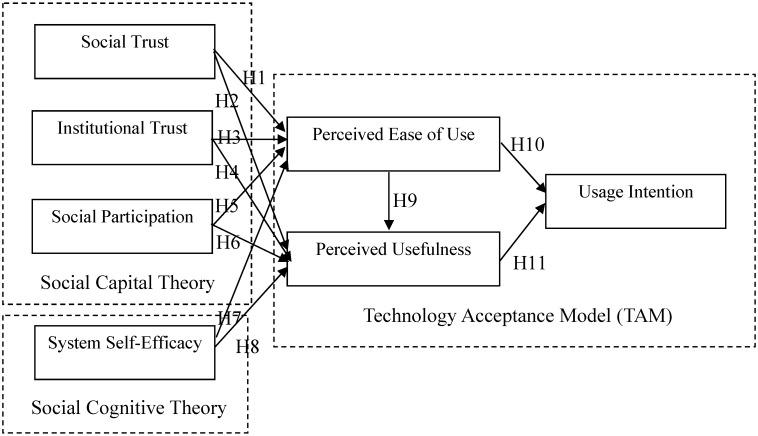
Telehealth has become an increasingly applied solution to delivering health care to rural and underserved areas by remote health care professionals. This study integrated social capital theory, social cognitive theory, and the technology acceptance model (TAM) to develop a comprehensive behavioral model for analyzing the relationships among social capital factors (social capital theory), technological factors (TAM), and system self-efficacy (social cognitive theory) in telehealth. The proposed framework was validated with 365 respondents from Nantou County, located in Central Taiwan. Structural equation modeling (SEM) was used to assess the causal relationships that were hypothesized in the proposed model. The finding indicates that elderly residents generally reported positive perceptions toward the telehealth system. Generally, the findings show that social capital factors (social trust, institutional trust, and social participation) significantly positively affect the technological factors (perceived ease of use and perceived usefulness respectively), which influenced usage intention. This study also confirmed that system self-efficacy was the salient antecedent of perceived ease of use. In addition, regarding the samples, the proposed model fitted considerably well. The proposed integrative psychosocial-technological model may serve as a theoretical basis for future research and can also offer empirical foresight to practitioners and researchers in the health departments of governments, hospitals, and rural communities.
远程医疗专业人员通过远程医疗为农村和服务不足地区提供医疗服务,已成为一种越来越被广泛应用的解决方案。本研究整合了社会资本理论、社会认知理论和技术接受模型(TAM),以开发一个综合行为模型,用于分析远程医疗中的社会资本因素(社会资本理论)、技术因素(TAM)和系统自我效能(社会认知理论)之间的关系。该框架在台湾中部南投县的 365 名受访者中进行了验证。结构方程模型(SEM)用于评估所提出模型中假设的因果关系。研究结果表明,老年居民普遍对远程医疗系统持积极看法。总体而言,研究结果表明,社会资本因素(社会信任、制度信任和社会参与)显著正向影响技术因素(感知易用性和感知有用性),进而影响使用意图。本研究还证实,系统自我效能是感知易用性的重要前因。此外,就样本而言,所提出的模型拟合得相当好。该综合心理社会技术模型可以作为未来研究的理论基础,也可以为政府、医院和农村社区卫生部门的从业者和研究人员提供经验性的展望。


 Zotero 插件