
微小RNA在上皮-间质转化和转移中的作用及临床前景。
Role of microRNA in epithelial to mesenchymal transition and metastasis and clinical perspectives.
作者信息
Díaz-López Antonio, Moreno-Bueno Gema, Cano Amparo
机构信息
Departamento de Bioquímica, Facultad de Medicina, Universidad Autónoma de Madrid, Instituto de Investigaciones Biomédicas "Alberto Sols" (CSIC-UAM), IdiPAZ, Madrid, Spain.
Departamento de Bioquímica, Facultad de Medicina, Universidad Autónoma de Madrid, Instituto de Investigaciones Biomédicas "Alberto Sols" (CSIC-UAM), IdiPAZ, Madrid, Spain ; Fundación MDAnderson Internacional, Madrid, Spain.
出版信息
Cancer Manag Res. 2014 Apr 25;6:205-16. doi: 10.2147/CMAR.S38156. eCollection 2014.
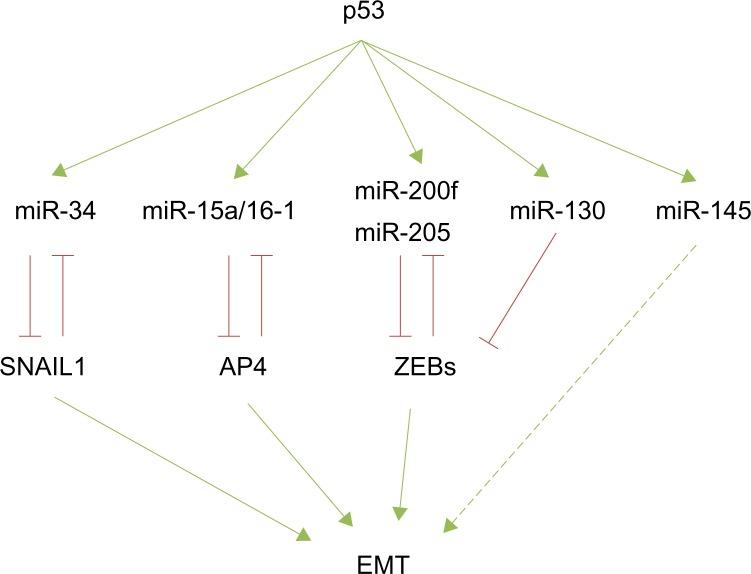
The microRNAs (miRNAs) are a class of small, 20-22 nucleotides in length, endogenously expressed noncoding RNAs that regulate multiple targets posttranscriptionally. Interestingly, miRNAs have emerged as regulators of most physiological and pathological processes, including metastatic tumor progression, in part by controlling a reversible process called epithelial-to-mesenchymal transition (EMT). The activation of EMT increases the migratory and invasive properties fundamental for tumor cell spread while activation of the reverse mesenchymal-to-epithelial transition is required for metastasis outgrowth. The EMT triggering leads to the activation of a core of transcription factors (EMT-TFs) - SNAIL1/SNAIL2, bHLH (E47, E2-2, and TWIST1/TWIST2), and ZEB1/ZEB2 - that act as E-cadherin repressors and, ultimately, coordinate EMT. Recent evidence indicates that several miRNAs regulate the expression of EMT-TFs or EMT-activating signaling pathways. Interestingly, some miRNAs and EMT-TFs form tightly interconnected negative feedback loops that control epithelial cell plasticity, providing self-reinforcing signals and robustness to maintain the epithelial or mesenchymal cell status. Among the most significant feedback loops, we focus on the ZEB/miR-200 and the SNAIL1/miR-34 networks that hold a clear impact in the regulation of the epithelial-mesenchymal state. Recent insights into the p53 modulation of the EMT-TF/miRNA loops and epigenetic regulatory mechanisms in the context of metastasis dissemination will also be discussed. Understanding the regulation of EMT by miRNAs opens new avenues for the diagnosis and prognosis of tumors and identifies potential therapeutic targets that might help to negatively impact on metastasis dissemination and increasing patient survival.
微小RNA(miRNA)是一类长度为20 - 22个核苷酸的内源性表达的小非编码RNA,它们在转录后调控多个靶标。有趣的是,miRNA已成为大多数生理和病理过程的调节因子,包括转移性肿瘤进展,部分原因是通过控制一种称为上皮-间质转化(EMT)的可逆过程。EMT的激活增加了肿瘤细胞扩散所必需的迁移和侵袭特性,而反向的间质-上皮转化的激活则是转移灶生长所必需的。EMT的触发导致一组核心转录因子(EMT-TF)——SNAIL1/SNAIL2、bHLH(E47、E2-2和TWIST1/TWIST2)以及ZEB1/ZEB2——的激活,这些转录因子作为E-钙黏蛋白的抑制因子,并最终协调EMT。最近的证据表明,几种miRNA调节EMT-TF的表达或EMT激活信号通路。有趣的是,一些miRNA和EMT-TF形成紧密相连的负反馈环,控制上皮细胞可塑性,提供自我强化信号和稳定性以维持上皮或间质细胞状态。在最重要的反馈环中,我们关注对上皮-间质状态调节有明显影响的ZEB/miR-200和SNAIL1/miR-34网络。还将讨论在转移扩散背景下p53对EMT-TF/miRNA环的调节以及表观遗传调控机制的最新见解。了解miRNA对EMT的调节为肿瘤的诊断和预后开辟了新途径,并确定了可能有助于对转移扩散产生负面影响并提高患者生存率的潜在治疗靶点。

 Zotero 插件