
神经退行性变中的蛋白质磷酸化:是友还是敌?
Protein phosphorylation in neurodegeneration: friend or foe?
作者信息
Tenreiro Sandra, Eckermann Katrin, Outeiro Tiago F
机构信息
Cell and Molecular Neuroscience Unit, Instituto de Medicina Molecular Lisboa, Portugal.
Department of Neurology, Center for Nanoscale Microscopy and Molecular Physiology of the Brain, University Medical Center Göttingen Göttingen, Germany.
出版信息
Front Mol Neurosci. 2014 May 13;7:42. doi: 10.3389/fnmol.2014.00042. eCollection 2014.
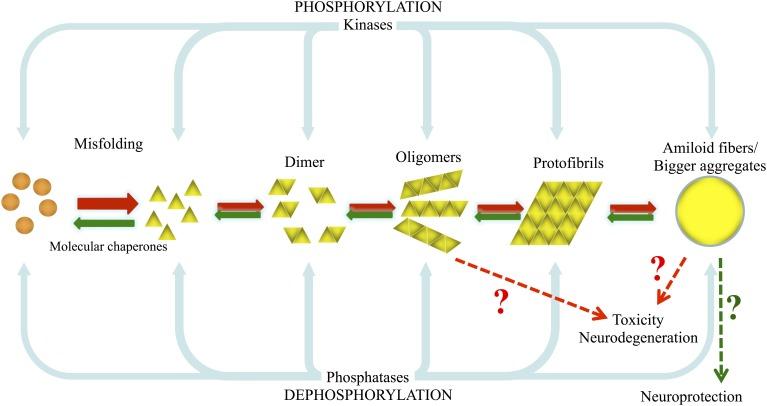
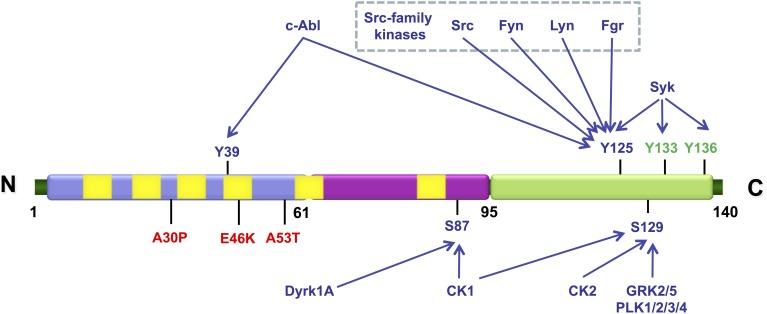
Protein misfolding and aggregation is a common hallmark in neurodegenerative disorders, including Alzheimer's disease (AD), Parkinson's disease (PD), and fronto-temporal dementia (FTD). In these disorders, the misfolding and aggregation of specific proteins occurs alongside neuronal degeneration in somewhat specific brain areas, depending on the disorder and the stage of the disease. However, we still do not fully understand the mechanisms governing protein aggregation, and whether this constitutes a protective or detrimental process. In PD, alpha-synuclein (aSyn) forms protein aggregates, known as Lewy bodies, and is phosphorylated at serine 129. Other residues have also been shown to be phosphorylated, but the significance of phosphorylation in the biology and pathophysiology of the protein is still controversial. In AD and in FTD, hyperphosphorylation of tau protein causes its misfolding and aggregation. Again, our understanding of the precise consequences of tau phosphorylation in the biology and pathophysiology of the protein is still limited. Through the use of a variety of model organisms and technical approaches, we are now gaining stronger insight into the effects of phosphorylation in the behavior of these proteins. In this review, we cover recent findings in the field and discuss how targeting phosphorylation events might be used for therapeutic intervention in these devastating diseases of the nervous system.
蛋白质错误折叠和聚集是神经退行性疾病的常见特征,包括阿尔茨海默病(AD)、帕金森病(PD)和额颞叶痴呆(FTD)。在这些疾病中,特定蛋白质的错误折叠和聚集与神经元变性在特定的脑区同时发生,这取决于疾病类型和疾病阶段。然而,我们仍然没有完全理解控制蛋白质聚集的机制,以及这一过程是保护性的还是有害的。在帕金森病中,α-突触核蛋白(aSyn)形成称为路易小体的蛋白质聚集体,并在丝氨酸129处发生磷酸化。其他残基也已被证明会发生磷酸化,但磷酸化在该蛋白质的生物学和病理生理学中的意义仍存在争议。在阿尔茨海默病和额颞叶痴呆中,tau蛋白的过度磷酸化导致其错误折叠和聚集。同样,我们对tau蛋白磷酸化在其生物学和病理生理学中的确切后果的理解仍然有限。通过使用各种模式生物和技术方法,我们现在对磷酸化对这些蛋白质行为的影响有了更深入的了解。在这篇综述中,我们涵盖了该领域的最新发现,并讨论了如何针对磷酸化事件进行干预,以治疗这些毁灭性的神经系统疾病。

 Zotero 插件