
Casposons:原核 CRISPR-Cas 免疫起源中的一种新的自我合成 DNA 转座子超家族。
Casposons: a new superfamily of self-synthesizing DNA transposons at the origin of prokaryotic CRISPR-Cas immunity.
机构信息
Institut Pasteur, Unité Biologie Moléculaire du Gène chez les Extrêmophiles, 25 rue du Docteur Roux, 75015 Paris, France.
出版信息
BMC Biol. 2014 May 19;12:36. doi: 10.1186/1741-7007-12-36.
BACKGROUND
Diverse transposable elements are abundant in genomes of cellular organisms from all three domains of life. Although transposons are often regarded as junk DNA, a growing body of evidence indicates that they are behind some of the major evolutionary innovations. With the growth in the number and diversity of sequenced genomes, previously unnoticed mobile elements continue to be discovered.
RESULTS
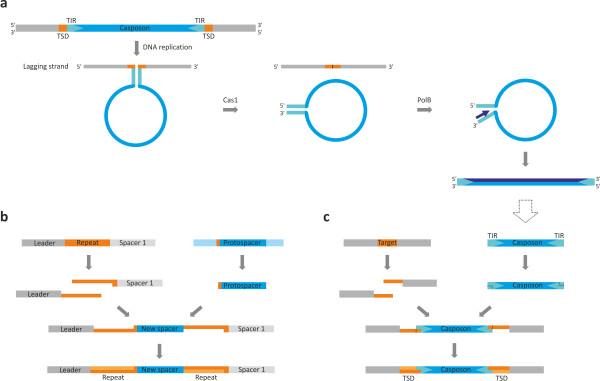
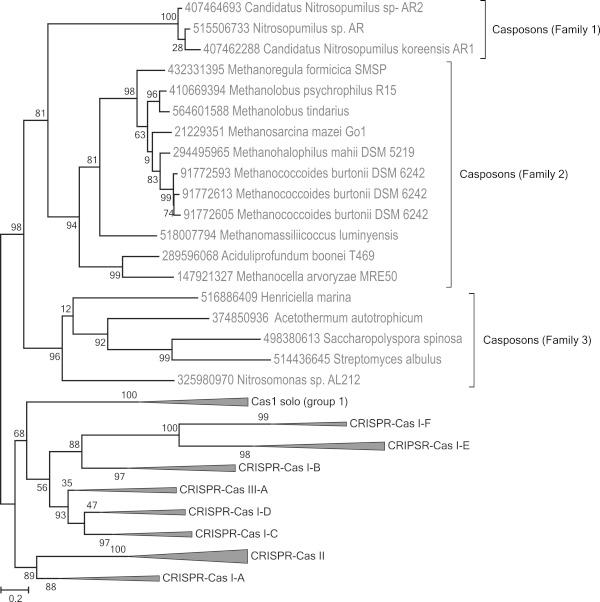
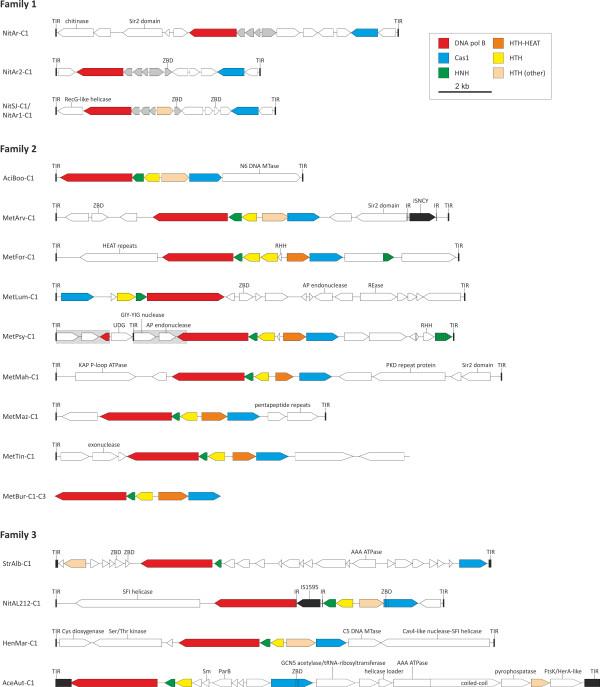
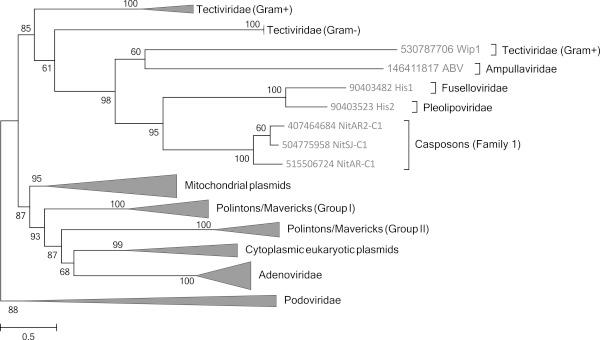
We describe a new superfamily of archaeal and bacterial mobile elements which we denote casposons because they encode Cas1 endonuclease, a key enzyme of the CRISPR-Cas adaptive immunity systems of archaea and bacteria. The casposons share several features with self-synthesizing eukaryotic DNA transposons of the Polinton/Maverick class, including terminal inverted repeats and genes for B family DNA polymerases. However, unlike any other known mobile elements, the casposons are predicted to rely on Cas1 for integration and excision, via a mechanism similar to the integration of new spacers into CRISPR loci. We identify three distinct families of casposons that differ in their gene repertoires and evolutionary provenance of the DNA polymerases. Deep branching of the casposon-encoded endonuclease in the Cas1 phylogeny suggests that casposons played a pivotal role in the emergence of CRISPR-Cas immunity.
CONCLUSIONS
The casposons are a novel superfamily of mobile elements, the first family of putative self-synthesizing transposons discovered in prokaryotes. The likely contribution of capsosons to the evolution of CRISPR-Cas parallels the involvement of the RAG1 transposase in vertebrate immunoglobulin gene rearrangement, suggesting that recruitment of endonucleases from mobile elements as ready-made tools for genome manipulation is a general route of evolution of adaptive immunity.
背景
从生命的三个域的所有细胞生物的基因组中都存在丰富的不同转座元件。虽然转座子通常被认为是垃圾 DNA,但越来越多的证据表明它们是一些主要进化创新的幕后黑手。随着测序基因组数量和多样性的增加,以前未被注意到的移动元件继续被发现。
结果
我们描述了一个新的古菌和细菌移动元件超家族,我们将其命名为 casposons,因为它们编码 Cas1 内切酶,这是古菌和细菌 CRISPR-Cas 适应性免疫系统的关键酶。casposons 与自主合成的真核生物 DNA 转座子 Polinton/Maverick 类具有几个共同特征,包括末端反向重复序列和 B 族 DNA 聚合酶基因。然而,与任何其他已知的移动元件不同,casposons 被预测通过类似于将新间隔子整合到 CRISPR 基因座中的机制,依赖 Cas1 进行整合和切除。我们鉴定了三种不同的 casposons 家族,它们在基因组成和 DNA 聚合酶的进化来源上有所不同。Cas1 系统发育树中 casposon 编码内切酶的深分支表明,casposons 在 CRISPR-Cas 免疫的出现中发挥了关键作用。
结论
casposons 是一种新型的移动元件超家族,是在原核生物中发现的第一个假定的自主合成转座子家族。casposons 对 CRISPR-Cas 的进化的可能贡献与 RAG1 转座酶在脊椎动物免疫球蛋白基因重排中的参与相平行,这表明从移动元件招募内切酶作为基因组操作的现成工具是适应性免疫进化的一般途径。
 Zotero 插件