
CRISPR-Cas 系统的起源与演化。
Origins and evolution of CRISPR-Cas systems.
机构信息
National Center for Biotechnology Information, National Library of Medicine , Bethesda, MD 20894 , USA.
出版信息
Philos Trans R Soc Lond B Biol Sci. 2019 May 13;374(1772):20180087. doi: 10.1098/rstb.2018.0087.
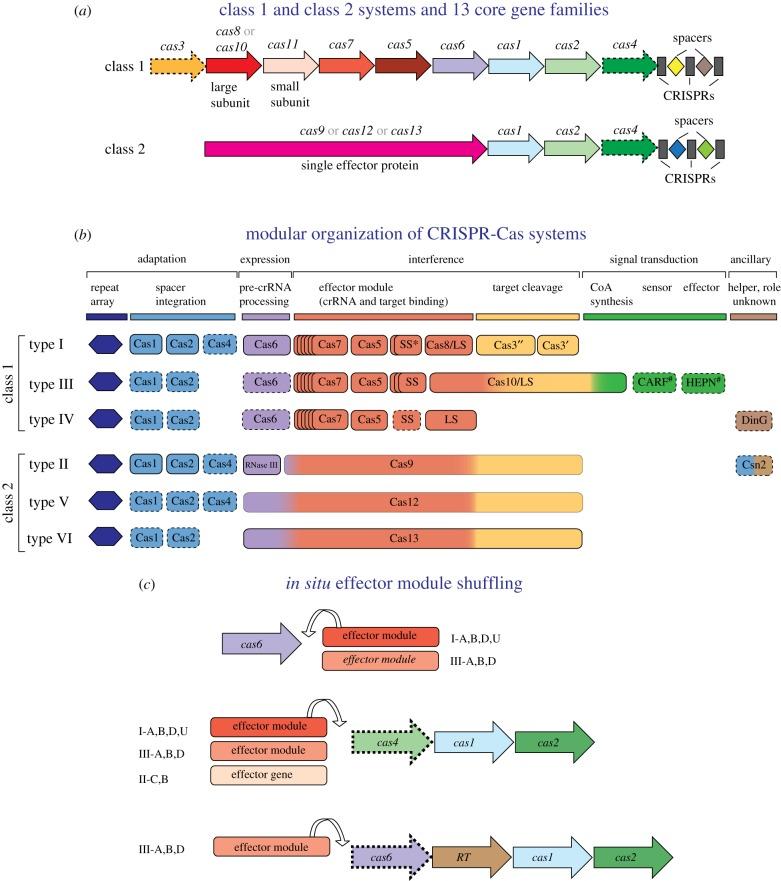
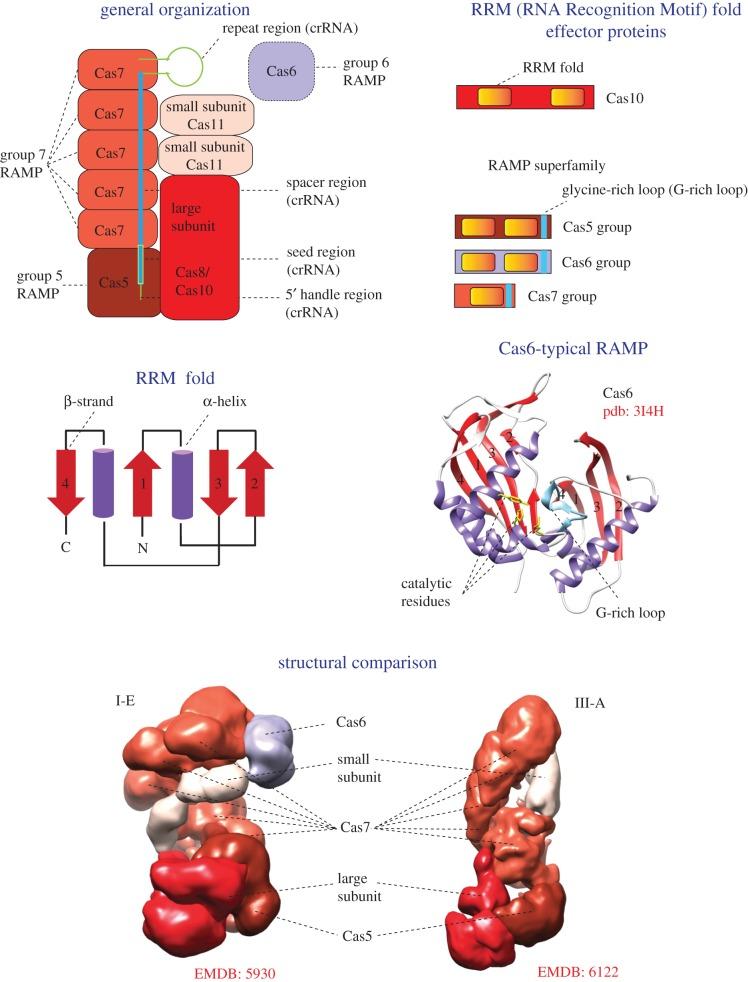
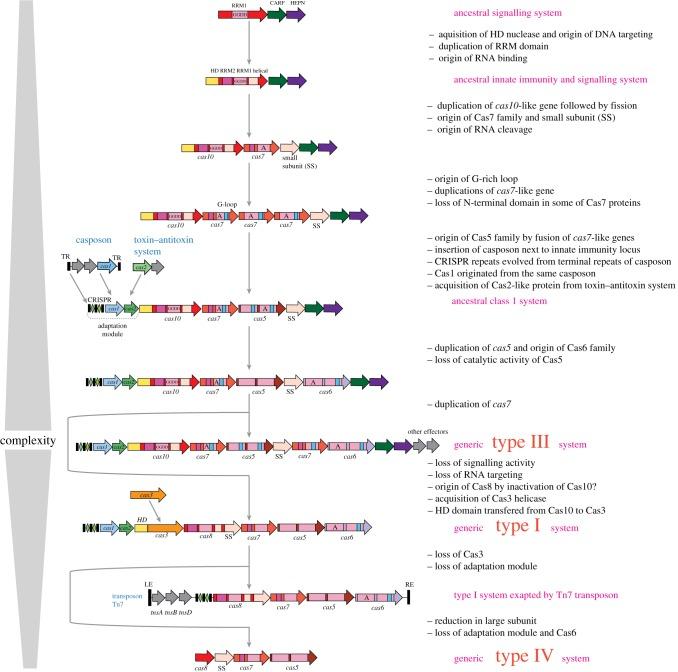
CRISPR-Cas, the bacterial and archaeal adaptive immunity systems, encompass a complex machinery that integrates fragments of foreign nucleic acids, mostly from mobile genetic elements (MGE), into CRISPR arrays embedded in microbial genomes. Transcripts of the inserted segments (spacers) are employed by CRISPR-Cas systems as guide (g)RNAs for recognition and inactivation of the cognate targets. The CRISPR-Cas systems consist of distinct adaptation and effector modules whose evolutionary trajectories appear to be at least partially independent. Comparative genome analysis reveals the origin of the adaptation module from casposons, a distinct type of transposons, which employ a homologue of Cas1 protein, the integrase responsible for the spacer incorporation into CRISPR arrays, as the transposase. The origin of the effector module(s) is far less clear. The CRISPR-Cas systems are partitioned into two classes, class 1 with multisubunit effectors, and class 2 in which the effector consists of a single, large protein. The class 2 effectors originate from nucleases encoded by different MGE, whereas the origin of the class 1 effector complexes remains murky. However, the recent discovery of a signalling pathway built into the type III systems of class 1 might offer a clue, suggesting that type III effector modules could have evolved from a signal transduction system involved in stress-induced programmed cell death. The subsequent evolution of the class 1 effector complexes through serial gene duplication and displacement, primarily of genes for proteins containing RNA recognition motif domains, can be hypothetically reconstructed. In addition to the multiple contributions of MGE to the evolution of CRISPR-Cas, the reverse flow of information is notable, namely, recruitment of minimalist variants of CRISPR-Cas systems by MGE for functions that remain to be elucidated. Here, we attempt a synthesis of the diverse threads that shed light on CRISPR-Cas origins and evolution. This article is part of a discussion meeting issue 'The ecology and evolution of prokaryotic CRISPR-Cas adaptive immune systems'.
CRISPR-Cas 是细菌和古菌的适应性免疫系统,它包含一个复杂的机制,该机制将外源核酸(主要来自移动遗传元件,MGE)的片段整合到嵌入微生物基因组中的 CRISPR 阵列中。插入片段(间隔序列)的转录本被 CRISPR-Cas 系统用作识别和失活同源靶标的指导(g)RNA。CRISPR-Cas 系统由不同的适应和效应模块组成,其进化轨迹似乎至少部分独立。比较基因组分析表明,适应模块源自 casposons,这是一种独特的转座子,它利用 Cas1 蛋白的同源物作为整合酶,负责将间隔序列整合到 CRISPR 阵列中。效应模块的起源则远不那么清楚。CRISPR-Cas 系统分为两类,一类具有多亚基效应器,另一类的效应器由单个大蛋白组成。第二类效应器起源于不同 MGE 编码的核酸酶,而第一类效应器复合物的起源仍然不清楚。然而,最近在 I 型 III 类系统中发现的信号通路为我们提供了一个线索,表明 III 类效应器模块可能是从参与应激诱导程序性细胞死亡的信号转导系统进化而来的。通过基因重复和置换(主要是 RNA 识别模体域蛋白的基因),对第一类效应器复合物的后续进化可以进行假设重建。除了 MGE 对 CRISPR-Cas 进化的多种贡献外,信息的反向流动也值得注意,即 MGE 招募 CRISPR-Cas 系统的最小变体用于仍有待阐明的功能。在这里,我们试图综合各种线索,以阐明 CRISPR-Cas 的起源和进化。本文是关于“原核 CRISPR-Cas 适应性免疫系统的生态与进化”讨论的一部分。



 Zotero 插件