
神经退行性疾病中的线粒体功能障碍:与阿尔茨海默病的相关性。
Mitochondrial dysfunctions in neurodegenerative diseases: relevance to Alzheimer's disease.
机构信息
Department of Psychiatry, First Faculty of Medicine, Charles University in Prague and General University Hospital in Prague, Ke Karlovu 11, 120 00 Prague 2, Czech Republic.
出版信息
Biomed Res Int. 2014;2014:175062. doi: 10.1155/2014/175062. Epub 2014 May 12.
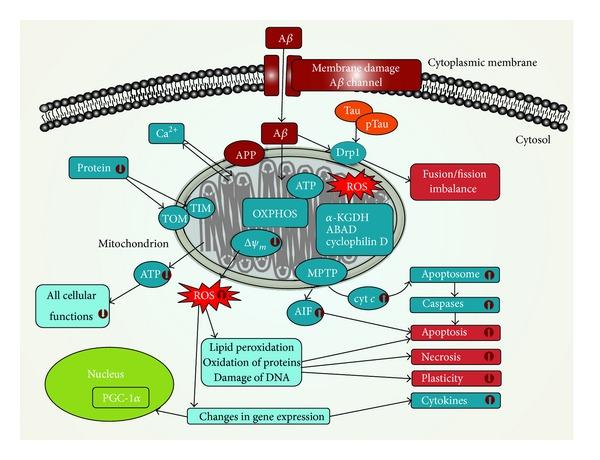
Mitochondrial dysfunctions are supposed to be responsible for many neurodegenerative diseases dominating in Alzheimer's disease (AD), Parkinson's disease (PD), and Huntington's disease (HD). A growing body of evidence suggests that defects in mitochondrial metabolism and particularly of electron transport chain may play a role in pathogenesis of AD. Structurally and functionally damaged mitochondria do not produce sufficient ATP and are more prominent in producing proapoptotic factors and reactive oxygen species (ROS), and this can be an early stage of several mitochondrial disorders, including neurodegenerative diseases. Mitochondrial dysfunctions may be caused by both mutations in mitochondrial or nuclear DNA that code mitochondrial components and by environmental causes. In the following review, common aspects of mitochondrial impairment concerned about neurodegenerative diseases are summarized including ROS production, impaired mitochondrial dynamics, and apoptosis. Also, damaged function of electron transport chain complexes and interactions between pathological proteins and mitochondria are described for AD particularly and marginally for PD and HD.
线粒体功能障碍被认为是许多神经退行性疾病的罪魁祸首,这些疾病主要包括阿尔茨海默病(AD)、帕金森病(PD)和亨廷顿病(HD)。越来越多的证据表明,线粒体代谢特别是电子传递链的缺陷可能在 AD 的发病机制中起作用。结构和功能受损的线粒体无法产生足够的 ATP,并且更倾向于产生促凋亡因子和活性氧(ROS),这可能是包括神经退行性疾病在内的几种线粒体疾病的早期阶段。线粒体功能障碍可能是由编码线粒体成分的线粒体或核 DNA 的突变以及环境因素引起的。在接下来的综述中,总结了与神经退行性疾病相关的线粒体损伤的常见方面,包括 ROS 的产生、线粒体动力学受损和细胞凋亡。此外,还描述了 AD 中电子传递链复合物的功能受损以及病理性蛋白与线粒体之间的相互作用,PD 和 HD 中也略有提及。
 Zotero 插件