
埃塞俄比亚八个农村地区孕期铁补充剂的覆盖情况、依从性及使用相关因素:一项横断面研究
Coverage, compliance and factors associated with utilization of iron supplementation during pregnancy in eight rural districts of Ethiopia: a cross-sectional study.
作者信息
Gebremedhin Samson, Samuel Aregash, Mamo Girma, Moges Tibebu, Assefa Tsehai
机构信息
School of Public and Environmental Health, Hawassa University, Hawassa, Ethiopia.
出版信息
BMC Public Health. 2014 Jun 14;14:607. doi: 10.1186/1471-2458-14-607.
BACKGROUND
Despite the efforts to reduce iron deficiency during pregnancy, information on the coverage and factors associated with utilization of iron supplements is lacking. The study is intended to assess the coverage, compliance and factors associated with the use of prenatal iron supplements in eight rural districts of Ethiopia.
METHODS
The study comprised two independent surveys conducted among pregnant women (n = 414) and women who gave birth in the preceding year of the survey (n = 1573). In both cases, respondents were selected using multistage sampling technique and data were collected via structured questionnaire. Predictors of iron supplement utilization (ranked categories of number of prenatal supplements taken) were identified using ordinal logistic regression. The outputs of the analysis are given using adjusted Odds Ratio (OR) with 95% Confidence Interval (CI).
RESULTS
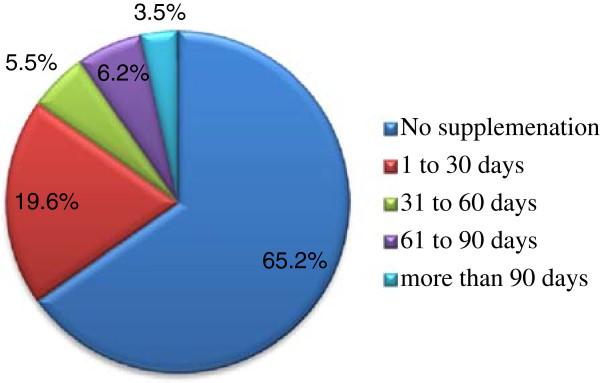
Among women who gave birth in the preceding year, 35.4% (95% CI: 31.3-39.5) were given/prescribed prenatal iron supplement during the index pregnancy and only 3.5% were supplemented for the recommended 91 or more days. Compared to women who had 4 or more ANC visits, those with 0, 1, 2 and 3 visits had 0.04, 0.33, 0.50 and 0.60 times less odds of iron supplement utilization, respectively. Women lacking comprehensive knowledge of anemia (OR = 0. 75 (95% CI: 0.57-0.97)) and those who weren't informed about the importance of iron supplementation during the pregnancy (OR = 0. 05 (95% CI: 0.04-0.07)) had significantly lower utilization. On the other hand, in pregnant women the prevalence of anemia was 33.2%. Among pregnant women who were given/prescribed supplements, the average level of compliance was 74.9% and about 25.1% had less than 70% adherence. The leading reported reasons for non-adherence were side-effects (63.3%) and forgetfulness (16.7%).
CONCLUSION
Promoting early and frequent ANC, enhancing the quality of ANC counseling and promoting the knowledge of women on anemia are essential strategies for improving the utilization of iron supplements.
背景
尽管人们努力减少孕期缺铁情况,但关于铁补充剂使用覆盖率及相关因素的信息仍很缺乏。本研究旨在评估埃塞俄比亚八个农村地区产前铁补充剂的使用覆盖率、依从性及相关因素。
方法
该研究包括对孕妇(n = 414)和在调查前一年分娩的妇女(n = 1573)进行的两项独立调查。在这两种情况下,均采用多阶段抽样技术选取受访者,并通过结构化问卷收集数据。使用有序逻辑回归确定铁补充剂使用情况(按服用产前补充剂数量的排序类别)的预测因素。分析结果以调整后的比值比(OR)及95%置信区间(CI)表示。
结果
在前一年分娩的妇女中,35.4%(95%CI:31.3 - 39.5)在本次孕期接受了/被开了产前铁补充剂,只有3.5%的人按照建议补充了91天或更长时间。与进行了4次或更多次产前检查的妇女相比,进行了0次、1次、2次和3次产前检查的妇女铁补充剂使用几率分别低0.04、0.33、0.50和0.60倍。对贫血缺乏全面了解的妇女(OR = 0.75(95%CI:0.57 - 0.97))以及在孕期未被告知铁补充重要性的妇女(OR = 0.05(95%CI:0.04 - 0.07))使用几率显著较低。另一方面,孕妇贫血患病率为33.2%。在接受了/被开了补充剂的孕妇中,平均依从率为74.9%,约25.1%的人依从率低于70%。报告的不依从的主要原因是副作用(63.3%)和遗忘(16.7%)。
结论
促进早期和频繁的产前检查、提高产前检查咨询质量以及增进妇女对贫血的了解是提高铁补充剂使用率的重要策略。


 Zotero 插件