
对结核分枝杆菌与巨噬细胞之间战斗的见解。
Insights into battles between Mycobacterium tuberculosis and macrophages.
作者信息
Xu Guanghua, Wang Jing, Gao George Fu, Liu Cui Hua
机构信息
CAS key Laboratory of Pathogenic Microbiology and Immunology, Institute of Microbiology, Chinese Academy of Sciences, Beijing, 100101, China.
出版信息
Protein Cell. 2014 Oct;5(10):728-36. doi: 10.1007/s13238-014-0077-5. Epub 2014 Jun 18.
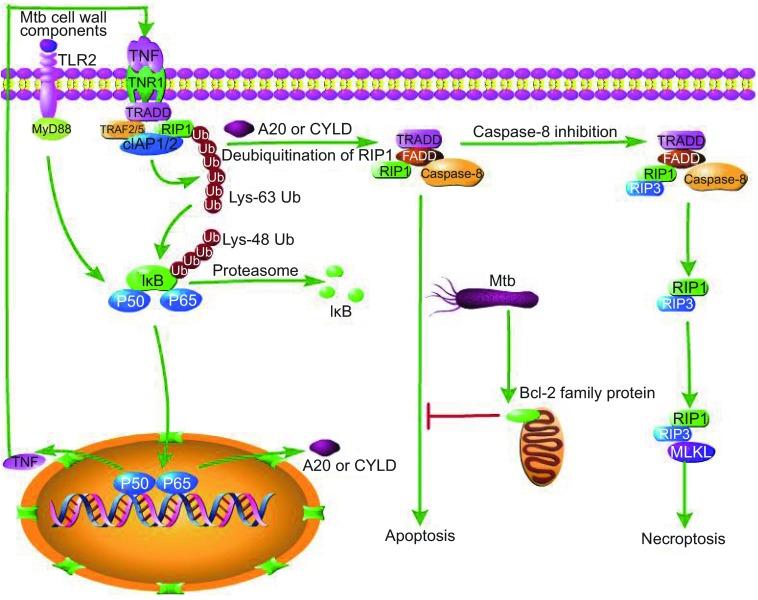
As the first line of immune defense for Mycobacterium tuberculosis (Mtb), macrophages also provide a major habitat for Mtb to reside in the host for years. The battles between Mtb and macrophages have been constant since ancient times. Triggered upon Mtb infection, multiple cellular pathways in macrophages are activated to initiate a tailored immune response toward the invading pathogen and regulate the cellular fates of the host as well. Toll-like receptors (TLRs) expressed on macrophages can recognize pathogen-associated-molecular patterns (PAMPs) on Mtb and mediate the production of immune-regulatory cytokines such as tumor necrosis factor (TNF) and type I Interferons (IFNs). In addition, Vitamin D receptor (VDR) and Vitamin D-1-hydroxylase are up-regulated in Mtb-infected macrophages, by which Vitamin D participates in innate immune responses. The signaling pathways that involve TNF, type I IFNs and Vitamin D are inter-connected, which play critical roles in the regulation of necroptosis, apoptosis, and autophagy of the infected macrophages. This review article summarizes current knowledge about the interactions between Mtb and macrophages, focusing on cellular fates of the Mtb-infected macrophages and the regulatory molecules and cellular pathways involved in those processes.
作为结核分枝杆菌(Mtb)免疫防御的第一道防线,巨噬细胞也是Mtb在宿主体内长期生存的主要栖息地。自古以来,Mtb与巨噬细胞之间的战斗就从未停止。Mtb感染后,巨噬细胞中的多种细胞途径被激活,以启动针对入侵病原体的定制免疫反应,并调节宿主的细胞命运。巨噬细胞上表达的Toll样受体(TLRs)可以识别Mtb上的病原体相关分子模式(PAMPs),并介导免疫调节细胞因子如肿瘤坏死因子(TNF)和I型干扰素(IFNs)的产生。此外,维生素D受体(VDR)和维生素D-1-羟化酶在Mtb感染的巨噬细胞中上调,维生素D通过它们参与先天免疫反应。涉及TNF、I型IFNs和维生素D的信号通路相互连接,在调节被感染巨噬细胞的坏死性凋亡、凋亡和自噬中起关键作用。这篇综述文章总结了目前关于Mtb与巨噬细胞相互作用的知识,重点关注Mtb感染巨噬细胞的细胞命运以及参与这些过程的调节分子和细胞途径。



 Zotero 插件