
东南亚儿童和男性内脏利什曼病米替福新治疗失败情况。
Failure of miltefosine treatment for visceral leishmaniasis in children and men in South-East Asia.
作者信息
Ostyn Bart, Hasker Epco, Dorlo Thomas P C, Rijal Suman, Sundar Shyam, Dujardin Jean-Claude, Boelaert Marleen
机构信息
Department of Public Health, Institute of Tropical Medicine, Antwerp, Belgium.
Division of Pharmaco-epidemiology and Clinical Pharmacology, Utrecht University, Utrecht, The Netherlands.
出版信息
PLoS One. 2014 Jun 18;9(6):e100220. doi: 10.1371/journal.pone.0100220. eCollection 2014.
BACKGROUND
High frequency of relapse in miltefosine-treated visceral leishmaniasis (VL) patients in India and Nepal followed up for twelve months.
OBJECTIVE
To identify epidemiological and clinical risk factors for relapse of VL in patients recently treated with standard dosing of miltefosine in India and Nepal.
DESIGN
Prospective observational study in three Primary Health Centers and one reference center in Muzaffarpur district, Bihar, India; and two zonal hospitals and a university hospital in South-east Nepal; records of all consenting patients diagnosed with VL and treated with miltefosine according to the current treatment guidelines of the Kala azar elimination program between 2009 and 2011.
RESULTS
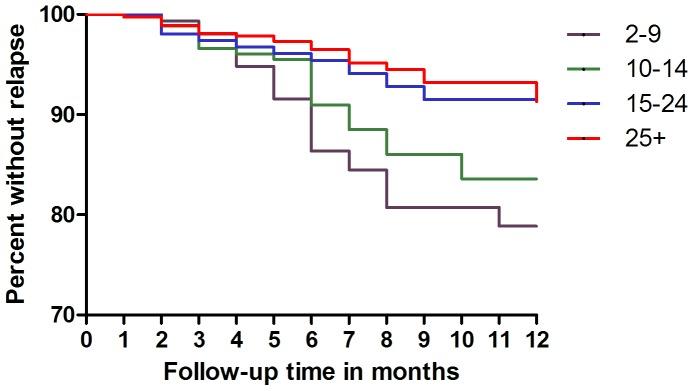
We compared the clinical records of 78 cases of relapse with those of 775 patients who had no record of subsequent relapse. Relapse was 2 times more common amongst male patients (IRR 2.14, 95% CI 1.27-3.61), and 2 to 3 times more frequent in the age groups below 15 compared to the over 25 year olds (age 10 to 14: IRR 2.53; 95% CI 1.37-4.65 and Age 2 to 9: IRR 3.19; 95% CI 1.77-5.77). History of earlier VL episodes, or specific clinical features at time of diagnosis such as duration of symptoms or spleen size were no predictors of relapse.
CONCLUSIONS
Young age and male gender were associated with increased risk of VL relapse after miltefosine, suggesting that the mechanism of relapse is mainly host-related i.e. immunological factors and/or drug exposure (pharmacokinetics). The observed decrease in efficacy of miltefosine may be explained by the inclusion of younger patients compared to the earlier clinical trials, rather than by a decreased susceptibility of the parasite to miltefosine. Our findings highlight the importance of proper clinical trials in children, including pharmacokinetics, to determine the safety, efficacy, drug exposure and therapeutic response of new drugs in this age group.
背景
在印度和尼泊尔,接受米替福新治疗的内脏利什曼病(VL)患者随访12个月时复发率较高。
目的
确定在印度和尼泊尔近期接受标准剂量米替福新治疗的VL患者复发的流行病学和临床危险因素。
设计
在印度比哈尔邦穆扎法尔布尔区的三个初级卫生中心和一个参考中心,以及尼泊尔东南部的两家地区医院和一家大学医院开展前瞻性观察研究;记录2009年至2011年间所有根据黑热病消除计划现行治疗指南确诊为VL并接受米替福新治疗的同意参与研究的患者的情况。
结果
我们将78例复发患者的临床记录与775例无后续复发记录的患者的临床记录进行了比较。男性患者复发更为常见,是女性患者的2倍(发病率比值比[IRR] 2.14,95%置信区间[CI] 1.27 - 3.61),与25岁以上年龄组相比,15岁以下年龄组的复发频率高2至3倍(10至14岁:IRR 2.53;95% CI 1.37 - 4.65;2至9岁:IRR 3.19;95% CI 1.77 - 5.77)。既往VL发作史或诊断时的特定临床特征,如症状持续时间或脾脏大小,均不能预测复发情况。
结论
年龄小和男性与米替福新治疗后VL复发风险增加有关,这表明复发机制主要与宿主相关,即免疫因素和/或药物暴露(药代动力学)。米替福新疗效下降可能是因为与早期临床试验相比纳入了更年轻的患者,而非寄生虫对米替福新的敏感性降低。我们的研究结果凸显了在儿童中开展适当临床试验(包括药代动力学研究)以确定新药在该年龄组的安全性、疗效、药物暴露和治疗反应的重要性。

 Zotero 插件