
多聚泛素链连接拓扑结构从潜在的结合景观中选择功能。
PolyUbiquitin chain linkage topology selects the functions from the underlying binding landscape.
机构信息
State Key Laboratory of Electroanalytical Chemistry, Changchun Institute of Applied Chemistry, Chinese Academy of Sciences, Changchun, Jilin, P.R. China.
State Key Laboratory of Magnetic Resonance and Atomic and Molecular Physics, Wuhan Institute of Physics and Mathematics, Chinese Academy of Sciences, Wuhan, Hubei, China.
出版信息
PLoS Comput Biol. 2014 Jul 3;10(7):e1003691. doi: 10.1371/journal.pcbi.1003691. eCollection 2014 Jul.
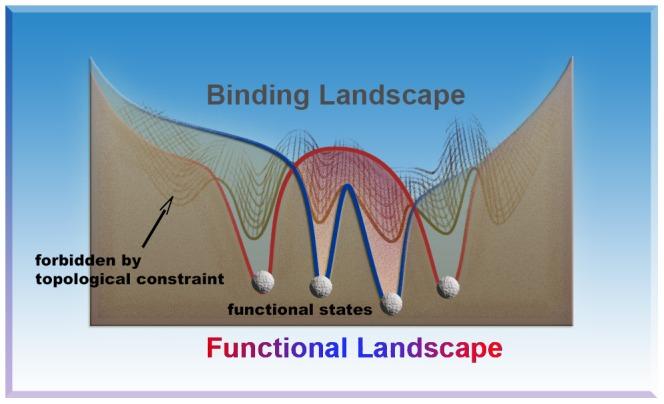
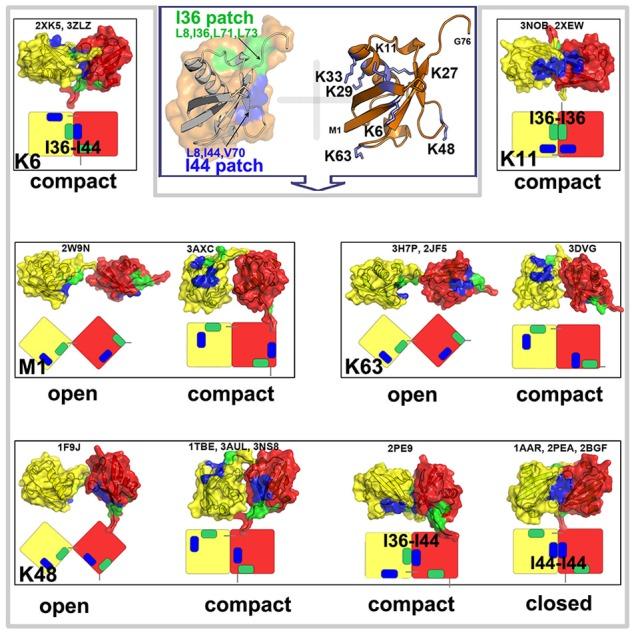
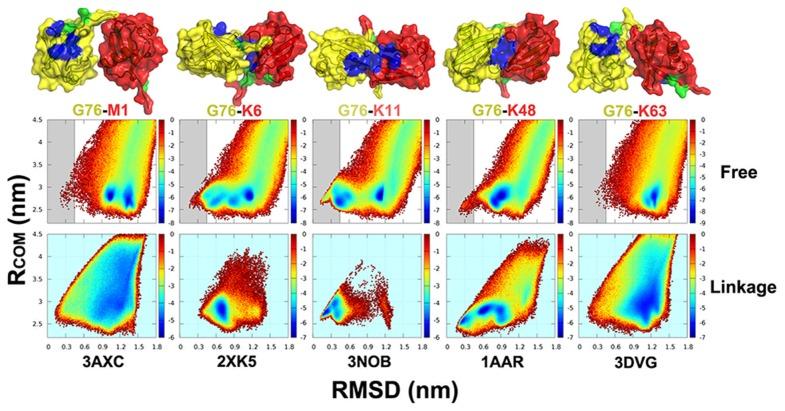
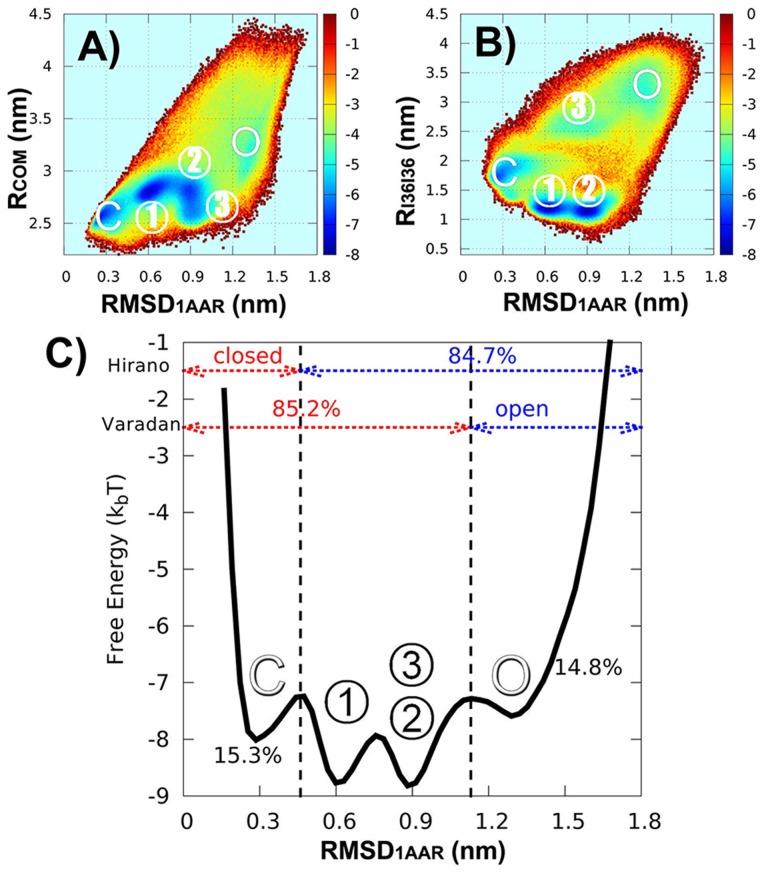
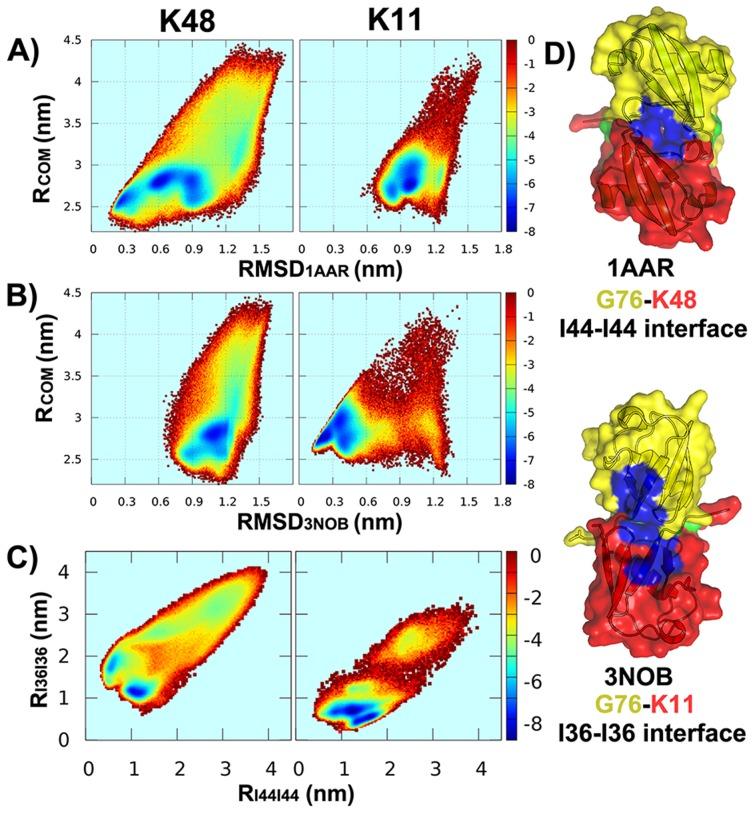
Ubiquitin (Ub) can generate versatile molecular signals and lead to different celluar fates. The functional poly-valence of Ub is believed to be resulted from its ability to form distinct polymerized chains with eight linkage types. To provide a full picture of ubiquitin code, we explore the binding landscape of two free Ub monomers and also the functional landscapes of of all eight linkage types by theoretical modeling. Remarkably, we found that most of the compact structures of covalently connected dimeric Ub chains (diUbs) pre-exist on the binding landscape. These compact functional states were subsequently validated by corresponding linkage models. This leads to the proposal that the folding architecture of Ub monomer has encoded all functional states into its binding landscape, which is further selected by different topologies of polymeric Ub chains. Moreover, our results revealed that covalent linkage leads to symmetry breaking of interfacial interactions. We further propose that topological constraint not only limits the conformational space for effective switching between functional states, but also selects the local interactions for realizing the corresponding biological function. Therefore, the topological constraint provides a way for breaking the binding symmetry and reaching the functional specificity. The simulation results also provide several predictions that qualitatively and quantitatively consistent with experiments. Importantly, the K48 linkage model successfully predicted intermediate states. The resulting multi-state energy landscape was further employed to reconcile the seemingly contradictory experimental data on the conformational equilibrium of K48-diUb. Our results further suggest that hydrophobic interactions are dominant in the functional landscapes of K6-, K11-, K33- and K48 diUbs, while electrostatic interactions play a more important role in the functional landscapes of K27, K29, K63 and linear linkages.
泛素 (Ub) 可以产生多种分子信号,并导致不同的细胞命运。Ub 的功能多价性被认为是由于其形成具有八种连接类型的不同聚合链的能力。为了提供泛素密码的全貌,我们通过理论建模探索了两个游离 Ub 单体的结合景观以及所有八种连接类型的功能景观。值得注意的是,我们发现共价连接的二聚 Ub 链 (diUbs) 的大多数紧凑结构预先存在于结合景观中。这些紧凑的功能状态随后通过相应的连接模型得到了验证。这导致了这样的假设,即 Ub 单体的折叠结构已经将所有功能状态编码到其结合景观中,然后由聚合 Ub 链的不同拓扑结构进行选择。此外,我们的结果表明,共价连接导致界面相互作用的对称破缺。我们进一步提出,拓扑约束不仅限制了在功能状态之间进行有效切换的构象空间,而且还选择了实现相应生物学功能的局部相互作用。因此,拓扑约束为打破结合对称性和达到功能特异性提供了一种方法。模拟结果还提供了一些预测,这些预测在定性和定量上与实验结果一致。重要的是,K48 连接模型成功预测了中间状态。所得的多态能量景观进一步用于协调 K48-diUb 构象平衡的看似矛盾的实验数据。我们的结果进一步表明,疏水相互作用在 K6-、K11-、K33-和 K48 diUbs 的功能景观中占主导地位,而静电相互作用在 K27、K29、K63 和线性连接的功能景观中起着更重要的作用。



 Zotero 插件