
YASARA View-适用于所有设备的分子图形学,从智能手机到工作站。
YASARA View - molecular graphics for all devices - from smartphones to workstations.
机构信息
Centre for Molecular and Biomolecular Informatics, NCMLS, Radboud University Nijmegen Medical Centre, 6500 HB Nijmegen, the Netherlands.
出版信息
Bioinformatics. 2014 Oct 15;30(20):2981-2. doi: 10.1093/bioinformatics/btu426. Epub 2014 Jul 4.
SUMMARY
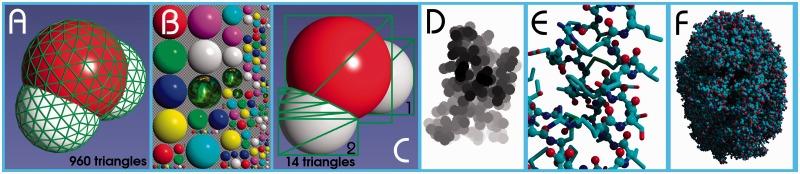
Today's graphics processing units (GPUs) compose the scene from individual triangles. As about 320 triangles are needed to approximate a single sphere-an atom-in a convincing way, visualizing larger proteins with atomic details requires tens of millions of triangles, far too many for smooth interactive frame rates. We describe a new approach to solve this 'molecular graphics problem', which shares the work between GPU and multiple CPU cores, generates high-quality results with perfectly round spheres, shadows and ambient lighting and requires only OpenGL 1.0 functionality, without any pixel shader Z-buffer access (a feature which is missing in most mobile devices).
AVAILABILITY AND IMPLEMENTATION
YASARA View, a molecular modeling program built around the visualization algorithm described here, is freely available (including commercial use) for Linux, MacOS, Windows and Android (Intel) from www.YASARA.org.
CONTACT
SUPPLEMENTARY INFORMATION
Supplementary data are available at Bioinformatics online.
摘要
目前的图形处理单元 (GPU) 由单个三角形组成场景。由于要以令人信服的方式近似单个球体(即一个原子),大约需要 320 个三角形,因此要使用原子细节可视化更大的蛋白质则需要数千万个三角形,这远远超过了流畅的交互式帧率所需的数量。我们描述了一种解决这个“分子图形问题”的新方法,该方法在 GPU 和多个 CPU 核心之间共享工作,生成具有完美圆形球体、阴影和环境照明的高质量结果,并且仅需要 OpenGL 1.0 功能,而无需任何像素着色器 Z 缓冲区访问(大多数移动设备都缺少此功能)。
可用性和实现
基于此处描述的可视化算法构建的分子建模程序 YASARA View 可从 www.YASARA.org 免费获得(包括商业用途),适用于 Linux、MacOS、Windows 和 Android(Intel)。
联系人
补充信息
补充数据可在 Bioinformatics 在线获得。
 Zotero 插件