
生物分子巨结构的组装与 Vulkan 图形 API 的可视化。
Assembly of Biomolecular Gigastructures and Visualization with the Vulkan Graphics API.
机构信息
YASARA Biosciences GmbH, Wagramer Str. 25/3/45, 1220 Vienna, Austria.
Center for Physiology and Pharmacology, Institute of Pharmacology, Medical University of Vienna, Waehringerstr. 13A, 1090 Vienna, Austria.
出版信息
J Chem Inf Model. 2021 Oct 25;61(10):5293-5303. doi: 10.1021/acs.jcim.1c00743. Epub 2021 Sep 16.
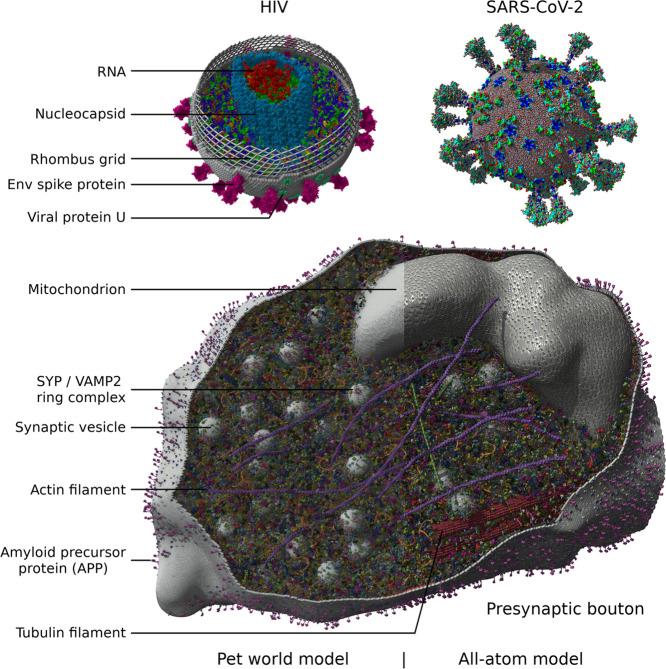
Building and displaying all-atom models of biomolecular structures with millions or billions of atoms, like virus particles or cells, remain a challenge due to the sheer size of the data, the required levels of automated building, and the visualization limits of today's graphics hardware. Based on concepts introduced with the CellPack program, we report new algorithms to create such large-scale models using an intermediate coarse-grained "pet representation" of biomolecules with 1/10th the normal size. Pet atoms are placed such that they optimally trace the surface of the original molecule with just ∼1/50th the original atom number and are joined with covalent bonds. Molecular dynamics simulations of pet molecules allow for efficient packing optimization, as well as the generation of realistic DNA/RNA conformations. This pet world can be expanded back to the all-atom representation to be explored and visualized with full details. Essential for the efficient interactive visualization of gigastructures is the use of multiple levels of detail (LODs), where distant molecules are drawn with a heavily reduced polygon count. We present a grid-based algorithm to create such LODs for all common molecular graphics styles (including ball-and-sticks, ribbons, and cartoons) that do not require monochrome molecules to hide LOD transitions. As a practical application, we built all-atom models of SARS-CoV-2, HIV, and an entire presynaptic bouton with 1 μm diameter and 3.6 billion atoms, using modular building blocks to significantly reduce GPU memory requirements through instancing. We employ the Vulkan graphics API to maximize performance on consumer grade hardware and describe how to use the mmCIF format to efficiently store such giant models. An implementation is available as part of the YASARA molecular modeling and simulation program from www.YASARA.org. The free YASARA View program can be used to explore the presented models, which can be downloaded from www.YASARA.org/petworld, a Creative Commons platform for sharing giant biomolecular structures.
构建和展示具有数百万或数十亿个原子的生物分子结构的全原子模型,例如病毒颗粒或细胞,仍然是一个挑战,这是由于数据的巨大规模、所需的自动化构建水平以及当今图形硬件的可视化限制所致。基于 CellPack 程序中引入的概念,我们报告了新的算法,使用具有正常尺寸 1/10 的中间粗粒度“宠物表示”来创建这种大规模模型。宠物原子被放置,以便它们以大约原始原子数的 1/50 的原始原子数最佳地追踪原始分子的表面,并通过共价键连接。宠物分子的分子动力学模拟允许进行有效的包装优化,以及生成真实的 DNA/RNA 构象。这个宠物世界可以扩展到全原子表示,以进行详细的探索和可视化。高效交互可视化千兆结构的关键是使用多个细节级别 (LOD),其中远距离分子以大大减少的多边形计数绘制。我们提出了一种基于网格的算法,用于为所有常见的分子图形样式(包括球棒、带状和卡通)创建这样的 LOD,而不需要单色分子来隐藏 LOD 过渡。作为实际应用,我们使用模块化构建块构建了全原子 SARS-CoV-2、HIV 和直径为 1 μm 且具有 36 亿个原子的整个突触小泡模型,从而显著降低了 GPU 内存要求通过实例化。我们使用 Vulkan 图形 API 在消费级硬件上最大限度地提高性能,并描述如何使用 mmCIF 格式来有效地存储这种巨大的模型。作为 YASARA 分子建模和模拟程序的一部分,可从 www.YASARA.org 获得实现。免费的 YASARA View 程序可用于探索所展示的模型,这些模型可以从 www.YASARA.org/petworld 下载,这是一个用于共享巨型生物分子结构的 Creative Commons 平台。




 Zotero 插件