
人类基因组变异对基因表达的顺式和反式效应。
Cis and trans effects of human genomic variants on gene expression.
作者信息
Bryois Julien, Buil Alfonso, Evans David M, Kemp John P, Montgomery Stephen B, Conrad Donald F, Ho Karen M, Ring Susan, Hurles Matthew, Deloukas Panos, Davey Smith George, Dermitzakis Emmanouil T
机构信息
Department of Genetic Medicine and Development, University of Geneva Medical School, Geneva, Switzerland; Institute of Genetics and Genomics in Geneva (iGE3), Geneva, Switzerland; Swiss Institute of Bioinformatics (SIB), Geneva, Switzerland.
MRC Integrative Epidemiology Unit, University of Bristol, Bristol, United Kingdom; School of Social and Community Medicine, University of Bristol, Bristol, United Kingdom; University of Queensland Diamantina Institute, Translational Research Institute, Brisbane, Queensland, Australia.
出版信息
PLoS Genet. 2014 Jul 10;10(7):e1004461. doi: 10.1371/journal.pgen.1004461. eCollection 2014 Jul.
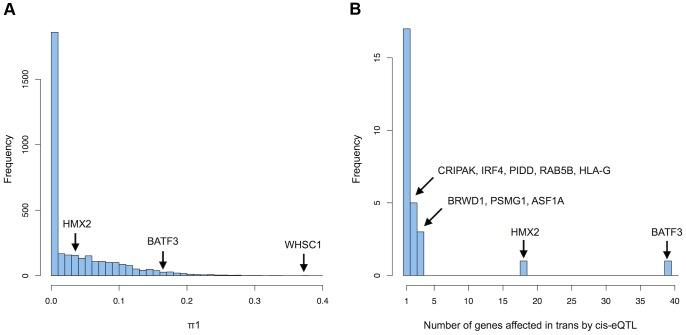
Gene expression is a heritable cellular phenotype that defines the function of a cell and can lead to diseases in case of misregulation. In order to detect genetic variations affecting gene expression, we performed association analysis of single nucleotide polymorphisms (SNPs) and copy number variants (CNVs) with gene expression measured in 869 lymphoblastoid cell lines of the Avon Longitudinal Study of Parents and Children (ALSPAC) cohort in cis and in trans. We discovered that 3,534 genes (false discovery rate (FDR) = 5%) are affected by an expression quantitative trait locus (eQTL) in cis and 48 genes are affected in trans. We observed that CNVs are more likely to be eQTLs than SNPs. In addition, we found that variants associated to complex traits and diseases are enriched for trans-eQTLs and that trans-eQTLs are enriched for cis-eQTLs. As a variant affecting both a gene in cis and in trans suggests that the cis gene is functionally linked to the trans gene expression, we looked specifically for trans effects of cis-eQTLs. We discovered that 26 cis-eQTLs are associated to 92 genes in trans with the cis-eQTLs of the transcriptions factors BATF3 and HMX2 affecting the most genes. We then explored if the variation of the level of expression of the cis genes were causally affecting the level of expression of the trans genes and discovered several causal relationships between variation in the level of expression of the cis gene and variation of the level of expression of the trans gene. This analysis shows that a large sample size allows the discovery of secondary effects of human variations on gene expression that can be used to construct short directed gene regulatory networks.
基因表达是一种可遗传的细胞表型,它定义了细胞的功能,若调控失调可能导致疾病。为了检测影响基因表达的遗传变异,我们对单核苷酸多态性(SNP)和拷贝数变异(CNV)与在雅芳亲子纵向研究(ALSPAC)队列的869个淋巴母细胞系中测量的基因表达进行了顺式和反式关联分析。我们发现3534个基因(错误发现率(FDR)=5%)受顺式表达数量性状位点(eQTL)影响,48个基因受反式影响。我们观察到CNV比SNP更有可能是eQTL。此外,我们发现与复杂性状和疾病相关的变异在反式eQTL中富集,并且反式eQTL在顺式eQTL中富集。由于一个变异同时影响顺式和反式的一个基因表明顺式基因在功能上与反式基因表达相关联,我们专门研究了顺式eQTL的反式效应。我们发现26个顺式eQTL与92个反式基因相关,其中转录因子BATF3和HMX2的顺式eQTL影响的基因最多。然后我们探究了顺式基因表达水平的变化是否因果性地影响反式基因的表达水平,并发现了顺式基因表达水平变化与反式基因表达水平变化之间的几种因果关系。该分析表明,大样本量能够发现人类变异对基因表达的次级效应,这些效应可用于构建短的定向基因调控网络。


 Zotero 插件