
[18F]氟脱氧葡萄糖正电子发射断层扫描有助于鉴别激素受体阳性乳腺癌中预后不良的患者。
[18F]-fluorodeoxyglucose positron emission tomography can contribute to discriminate patients with poor prognosis in hormone receptor-positive breast cancer.
作者信息
Ahn Sung Gwe, Lee Minkyung, Jeon Tae Joo, Han Kyunghwa, Lee Hak Min, Lee Seung Ah, Ryu Young Hoon, Son Eun Ju, Jeong Joon
机构信息
Department of Surgery, Gangnam Severance Hospital, Yonsei University College of Medicine, Seoul, Korea.
Department of Nuclear Medicine, Gangnam Severance Hospital, Yonsei University College of Medicine, Seoul, Korea.
出版信息
PLoS One. 2014 Aug 28;9(8):e105905. doi: 10.1371/journal.pone.0105905. eCollection 2014.
BACKGROUND
Patients with hormone receptor-positive breast cancer typically show favorable survival. However, identifying individuals at high risk of recurrence among these patients is a crucial issue. We tested the hypothesis that [18F]-fluorodeoxyglucose positron emission tomography (FDG-PET) scans can help predict prognosis in patients with hormone receptor-positive breast cancer.
METHODS
Between April 2004 and December 2008, 305 patients with hormone receptor-positive breast cancer who underwent FGD-PET were enrolled. Patients with luminal B subtype were identified by positivity for human epidermal growth factor receptor-2 (HER2) or high Ki67 (≥14%) according to criteria recently recommended by the St. Gallen panelists. The cut-off value of SUVmax was defined using the time-dependent receiver operator characteristic curve for recurrence-free survival (RFS).
RESULTS
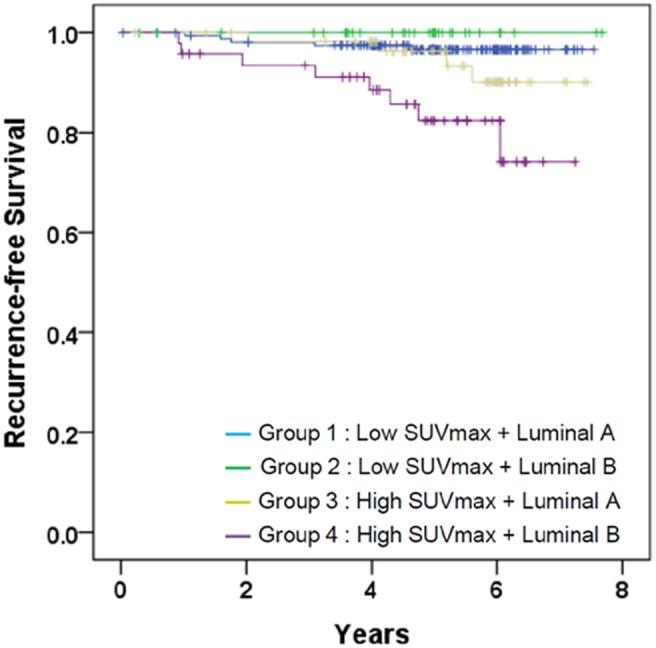
At a median follow up of 6.23 years, continuous SUVmax was a significant prognostic factor with a hazard ratio (HR) of 1.21 (p = 0.021). The cut-off value of SUVmax was defined as 4. Patients with luminal B subtype (n = 82) or high SUVmax (n = 107) showed a reduced RFS (p = 0.031 and 0.002, respectively). In multivariate analysis for RFS, SUVmax carried independent prognostic significance (p = 0.012) whereas classification with immunohistochemical markers did not (p = 0.274). The Harell c-index was 0.729. High SUVmax was significantly associated with larger tumor size, positive nodes, HER2 positivity, high Ki67 (≥14%), high tumor grade, and luminal B subtype.
CONCLUSIONS
Among patients with hormone receptor-positive breast cancer, FDG-PET can help discriminate patients at high risk of tumor relapse.
背景
激素受体阳性乳腺癌患者通常具有较好的生存率。然而,在这些患者中识别出复发高危个体是一个关键问题。我们检验了以下假设:[18F] - 氟脱氧葡萄糖正电子发射断层扫描(FDG - PET)有助于预测激素受体阳性乳腺癌患者的预后。
方法
2004年4月至2008年12月期间,纳入305例接受FDG - PET检查的激素受体阳性乳腺癌患者。根据圣加伦专家小组最近推荐的标准,通过人表皮生长因子受体2(HER2)阳性或高Ki67(≥14%)确定管腔B亚型患者。使用无复发生存期(RFS)的时间依赖性受试者工作特征曲线确定SUVmax的临界值。
结果
中位随访6.23年时,连续的SUVmax是一个显著的预后因素,风险比(HR)为1.21(p = 0.021)。SUVmax的临界值定义为4。管腔B亚型患者(n = 82)或SUVmax高的患者(n = 107)的RFS降低(分别为p = 0.031和0.002)。在RFS的多因素分析中,SUVmax具有独立的预后意义(p = 0.012),而免疫组化标志物分类则不具有(p = 0.274)。哈雷尔c指数为0.729。高SUVmax与更大的肿瘤大小、阳性淋巴结、HER2阳性、高Ki67(≥14%)、高肿瘤分级和管腔B亚型显著相关。
结论
在激素受体阳性乳腺癌患者中,FDG - PET有助于鉴别肿瘤复发高危患者。


 Zotero 插件