
在一例染色体和荧光原位杂交(FISH)结果正常的骨髓增生异常综合征(MDS)病例中,5号染色体亚显微缺失涉及肿瘤抑制基因(CTNNA1、HSPA9),以及与TET2和EZH2突变相关的杂合性拷贝中性缺失。
Submicroscopic deletion of 5q involving tumor suppressor genes (CTNNA1, HSPA9) and copy neutral loss of heterozygosity associated with TET2 and EZH2 mutations in a case of MDS with normal chromosome and FISH results.
作者信息
Hemmat Morteza, Chen Weina, Anguiano Arturo, Naggar Mohammed El, Racke Frederick K, Jones Dan, Wang Yongbao, Strom Charles M, Chang Karl, Boyar Fatih Z
机构信息
Cytogenetics Department, Quest Diagnostics Nichols Institute, 33608 Ortega Hwy, 92675 San Juan Capistrano, CA, USA.
University of Texas southwestern Medical Center, 5323 Harry Hines Blvd, 75235 Dallas, TX, USA.
出版信息
Mol Cytogenet. 2014 May 27;7:35. doi: 10.1186/1755-8166-7-35. eCollection 2014.
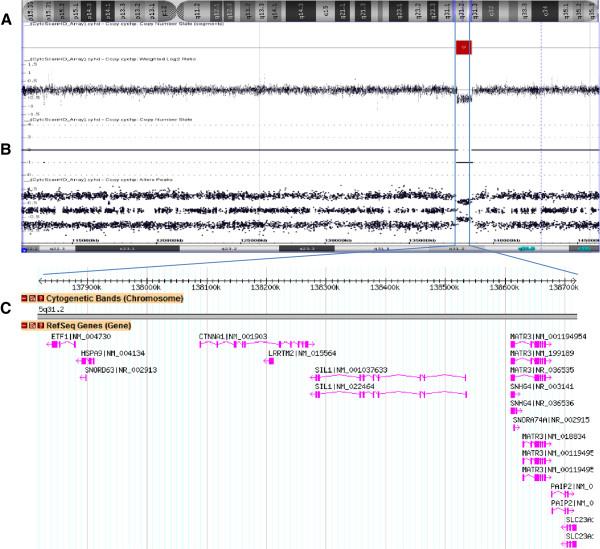
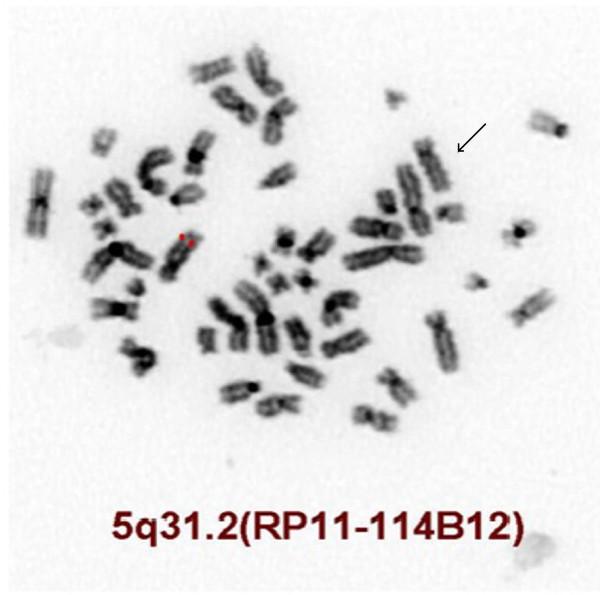
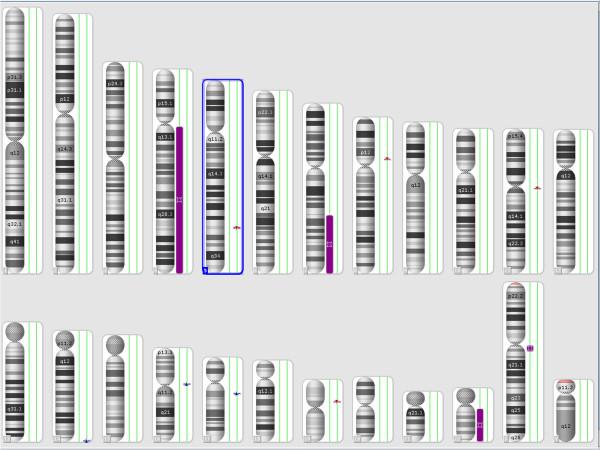
Advances in genome-wide molecular cytogenetics allow identification of novel submicroscopic DNA copy number alterations (aCNAs) and copy-neutral loss of heterozygosity (cnLOH) resulting in homozygosity for known gene mutations in myeloid neoplasms. We describe the use of an oligo-SNP array for genomic profiling of aCNA and cnLOH, together with sequence analysis of recurrently mutated genes, in a patient with myelodysplastic syndrome (MDS) presenting with normal karyotype and FISH results. Oligo-SNP array analysis revealed a hemizygous deletion of 896 kb at chromosome 5q31.2, representing the smallest 5q deletion reported to date. The deletion involved multiple genes, including two tumor suppressor candidate genes (CTNNA1 and HSPA9) that are associated with MDS/AML. The SNP-array study also detected 3 segments of somatic cnLOH: one involved the entire long arm of chromosome 4; the second involved the distal half of the long arm of chromosome 7, and the third encompassed the entire chromosome 22 (UPD 22). Sequence analysis revealed mutations in TET2 (4q), EZH2 (7q), ASXL1 (20q11.21), and RUNX1 (21q22.3). Coincidently, TET2 and EZH2 were located at segments of cnLOH resulting in their homozygosity. Loss of heterozygosity affecting these two chromosomes and mutations in TET2 and EZH2 are indicative of a myelodysplastic syndrome with a poor prognosis. Deletion of the tumor suppressor genes CTNNA1 and HSPA9 is also likely to contribute to a poor prognosis. Furthermore, the original cnLOHs in multiple chromosomes and additional cnLOH 14q in the follow-up study suggest genetic evolution of the disease and poor prognosis. This study attests to the fact that some patients with a myelodysplastic syndrome who exhibit a normal karyotype may have underlying genetic abnormalities detectable by chromosomal microarray and/or targeted mutation analyses.
全基因组分子细胞遗传学的进展使得在髓系肿瘤中能够识别新的亚微观DNA拷贝数改变(aCNA)和杂合性拷贝中性缺失(cnLOH),从而导致已知基因突变的纯合性。我们描述了在一名核型和荧光原位杂交(FISH)结果正常的骨髓增生异常综合征(MDS)患者中,使用寡核苷酸单核苷酸多态性(oligo-SNP)阵列对aCNA和cnLOH进行基因组分析,以及对反复突变基因进行序列分析的情况。寡核苷酸单核苷酸多态性阵列分析显示,5号染色体q31.2处存在896 kb的半合子缺失,这是迄今为止报道的最小的5q缺失。该缺失涉及多个基因,包括两个与MDS/AML相关的肿瘤抑制候选基因(CTNNA1和HSPA9)。单核苷酸多态性阵列研究还检测到3个体细胞cnLOH片段:一个涉及4号染色体的整个长臂;第二个涉及7号染色体长臂的远端一半,第三个包含整个22号染色体(22号染色体单亲二倍体)。序列分析显示TET2(4q)、EZH2(7q)、ASXL1(20q11.21)和RUNX1(21q22.3)存在突变。巧合的是,TET2和EZH2位于cnLOH片段,导致它们纯合。影响这两条染色体的杂合性缺失以及TET2和EZH2的突变表明预后不良的骨髓增生异常综合征。肿瘤抑制基因CTNNA1和HSPA9的缺失也可能导致预后不良。此外,最初多个染色体中的cnLOH以及后续研究中额外的14q cnLOH提示疾病的基因进化和预后不良。这项研究证明了这样一个事实,即一些核型正常的骨髓增生异常综合征患者可能存在可通过染色体微阵列和/或靶向突变分析检测到的潜在基因异常。


 Zotero 插件