
氯胺酮联合使用可减轻大鼠对吗啡的耐受性,并导致两种药物在大鼠脑内的浓度升高。
Ketamine coadministration attenuates morphine tolerance and leads to increased brain concentrations of both drugs in the rat.
作者信息
Lilius T O, Jokinen V, Neuvonen M S, Niemi M, Kalso E A, Rauhala P V
机构信息
Institute of Biomedicine, Pharmacology, University of Helsinki, Finland.
Haartman Institute, Department of Clinical Pharmacology, University of Helsinki, Finland.
出版信息
Br J Pharmacol. 2015 Jun;172(11):2799-813. doi: 10.1111/bph.12974.
BACKGROUND AND PURPOSE
The effects of ketamine in attenuating morphine tolerance have been suggested to result from a pharmacodynamic interaction. We studied whether ketamine might increase brain morphine concentrations in acute coadministration, in morphine tolerance and morphine withdrawal.
EXPERIMENTAL APPROACH
Morphine minipumps (6 mg·day(-1) ) induced tolerance during 5 days in Sprague-Dawley rats, after which s.c. ketamine (10 mg·kg(-1) ) was administered. Tail flick, hot plate and rotarod tests were used for behavioural testing. Serum levels and whole tissue brain and liver concentrations of morphine, morphine-3-glucuronide, ketamine and norketamine were measured using HPLC-tandem mass spectrometry.
KEY RESULTS
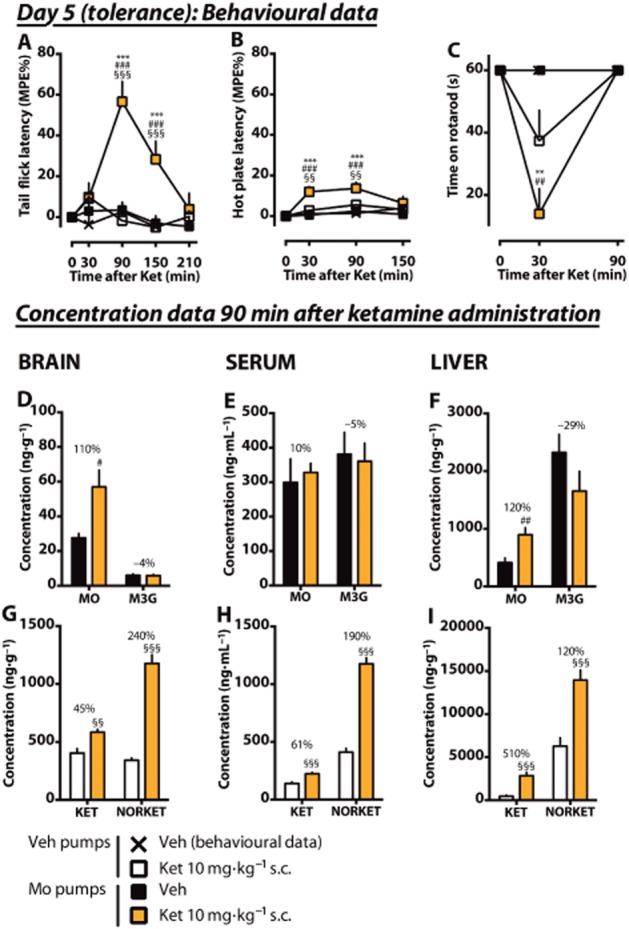
In morphine-naïve rats, ketamine caused no antinociception whereas in morphine-tolerant rats there was significant antinociception (57% maximum possible effect in the tail flick test 90 min after administration) lasting up to 150 min. In the brain of morphine-tolerant ketamine-treated rats, the morphine, ketamine and norketamine concentrations were 2.1-, 1.4- and 3.4-fold, respectively, compared with the rats treated with morphine or ketamine only. In the liver of morphine-tolerant ketamine-treated rats, ketamine concentration was sixfold compared with morphine-naïve rats. After a 2 day morphine withdrawal period, smaller but parallel concentration changes were observed. In acute coadministration, ketamine increased the brain morphine concentration by 20%, but no increase in ketamine concentrations or increased antinociception was observed.
CONCLUSIONS AND IMPLICATIONS
The ability of ketamine to induce antinociception in rats made tolerant to morphine may also be due to increased brain concentrations of morphine, ketamine and norketamine. The relevance of these findings needs to be assessed in humans.
背景与目的
已有研究表明,氯胺酮减轻吗啡耐受性的作用源于药效学相互作用。我们研究了氯胺酮在急性联合用药、吗啡耐受和吗啡戒断过程中是否会提高脑内吗啡浓度。
实验方法
在Sprague-Dawley大鼠中,吗啡微型泵(6mg·天⁻¹)在5天内诱导产生耐受性,之后皮下注射氯胺酮(10mg·kg⁻¹)。采用甩尾、热板和转棒试验进行行为测试。使用高效液相色谱-串联质谱法测定血清水平以及脑和肝脏组织中吗啡、吗啡-3-葡萄糖醛酸苷、氯胺酮和去甲氯胺酮的浓度。
主要结果
在未用过吗啡的大鼠中,氯胺酮未产生镇痛作用,而在吗啡耐受的大鼠中,有显著的镇痛作用(给药90分钟后甩尾试验中最大可能效应为57%),持续长达150分钟。在吗啡耐受且经氯胺酮处理的大鼠脑中,吗啡、氯胺酮和去甲氯胺酮的浓度分别是仅用吗啡或氯胺酮处理大鼠的2.1倍、1.4倍和3.4倍。在吗啡耐受且经氯胺酮处理的大鼠肝脏中,氯胺酮浓度是未用过吗啡大鼠的6倍。在2天的吗啡戒断期后,观察到较小但平行的浓度变化。在急性联合用药时,氯胺酮使脑内吗啡浓度增加了20%,但未观察到氯胺酮浓度增加或镇痛作用增强。
结论与启示
氯胺酮在对吗啡产生耐受的大鼠中诱导镇痛的能力可能也归因于脑内吗啡、氯胺酮和去甲氯胺酮浓度的增加。这些发现的相关性需要在人体中进行评估。



 Zotero 插件