
苯并咪唑与Pygo植物同源结构域(PHD)指的组蛋白结合口袋的竞争性结合。
Competitive binding of a benzimidazole to the histone-binding pocket of the Pygo PHD finger.
作者信息
Miller Thomas C R, Rutherford Trevor J, Birchall Kristian, Chugh Jasveen, Fiedler Marc, Bienz Mariann
机构信息
MRC Laboratory of Molecular Biology , Francis Crick Avenue, Cambridge CB2 0QH, United Kingdom.
出版信息
ACS Chem Biol. 2014 Dec 19;9(12):2864-74. doi: 10.1021/cb500585s. Epub 2014 Oct 24.
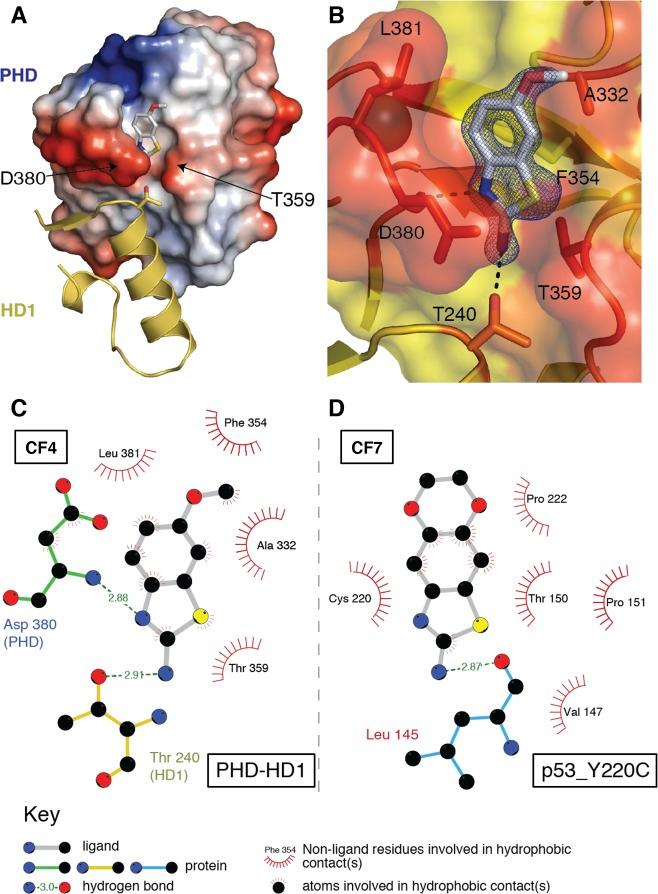
The Pygo-BCL9 complex is a chromatin reader, facilitating β-catenin-mediated oncogenesis, and is thus emerging as a potential therapeutic target for cancer. Its function relies on two ligand-binding surfaces of Pygo's PHD finger that anchor the histone H3 tail methylated at lysine 4 (H3K4me) with assistance from the BCL9 HD1 domain. Here, we report the first use of fragment-based screening by NMR to identify small molecules that block protein-protein interactions by a PHD finger. This led to the discovery of a set of benzothiazoles that bind to a cleft emanating from the PHD-HD1 interface, as defined by X-ray crystallography. Furthermore, we discovered a benzimidazole that docks into the H3K4me specificity pocket and displaces the native H3K4me peptide from the PHD finger. Our study demonstrates the ligandability of the Pygo-BCL9 complex and uncovers a privileged scaffold as a template for future development of lead inhibitors of oncogenesis.
Pygo-BCL9复合物是一种染色质阅读器,可促进β-连环蛋白介导的肿瘤发生,因此正成为癌症潜在的治疗靶点。其功能依赖于Pygo的植物同源结构域(PHD)指的两个配体结合表面,这两个表面在BCL9的HD1结构域的协助下锚定赖氨酸4位点甲基化的组蛋白H3尾巴(H3K4me)。在此,我们报道首次通过核磁共振(NMR)基于片段的筛选来鉴定通过PHD指阻断蛋白质-蛋白质相互作用的小分子。这导致发现了一组苯并噻唑,它们结合到由X射线晶体学确定的源自PHD-HD1界面的裂缝中。此外,我们发现了一种苯并咪唑,它对接进入H3K4me特异性口袋并从PHD指取代天然的H3K4me肽。我们的研究证明了Pygo-BCL9复合物的可配体性,并揭示了一种有优势的骨架作为未来肿瘤发生先导抑制剂开发的模板。



 Zotero 插件