
基于生活方式的心血管疾病预防预测模型:健康心脏评分
Lifestyle-based prediction model for the prevention of CVD: the Healthy Heart Score.
作者信息
Chiuve Stephanie E, Cook Nancy R, Shay Christina M, Rexrode Kathryn M, Albert Christine M, Manson JoAnn E, Willett Walter C, Rimm Eric B
机构信息
Department of Nutrition, Harvard School of Public Health, Boston, MA (S.E.C., W.C.W., E.B.R.) Center for Arrhythmia Prevention, Department of Medicine, Brigham and Women's Hospital and Harvard Medical School, Boston, MA (S.E.C., C.M.A.) Division of Preventive Medicine, Department of Medicine, Brigham and Women's Hospital and Harvard Medical School, Boston, MA (S.E.C., N.R.C., K.M.R., C.M.A., J.A.E.M.).
Department of Epidemiology, Harvard School of Public Health, Boston, MA (N.R.C., J.A.E.M., W.C.W., E.B.R.) Division of Preventive Medicine, Department of Medicine, Brigham and Women's Hospital and Harvard Medical School, Boston, MA (S.E.C., N.R.C., K.M.R., C.M.A., J.A.E.M.).
出版信息
J Am Heart Assoc. 2014 Nov 14;3(6):e000954. doi: 10.1161/JAHA.114.000954.
BACKGROUND
Clinical practice focuses on the primary prevention of cardiovascular (CV) disease (CVD) through the modification and pharmacological treatment of elevated risk factors. Prediction models based on established risk factors are available for use in the primary prevention setting. However, the prevention of risk factor development through healthy lifestyle behaviors, or primordial prevention, is of paramount importance to achieve optimal population-wide CV health and minimize long-term CVD risk.
METHODS AND RESULTS
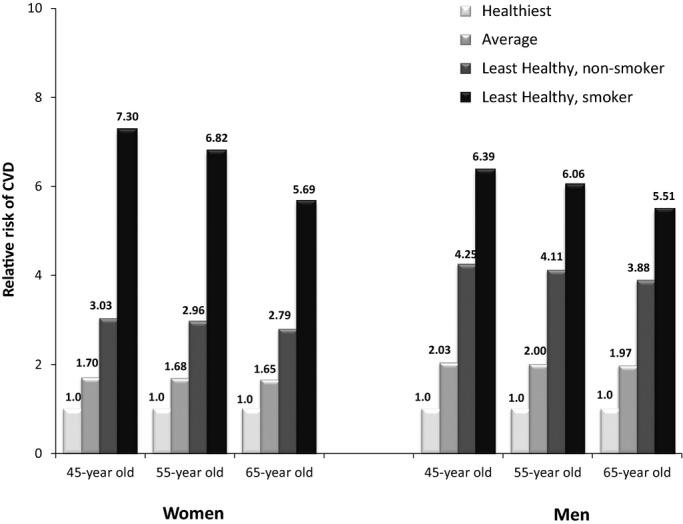
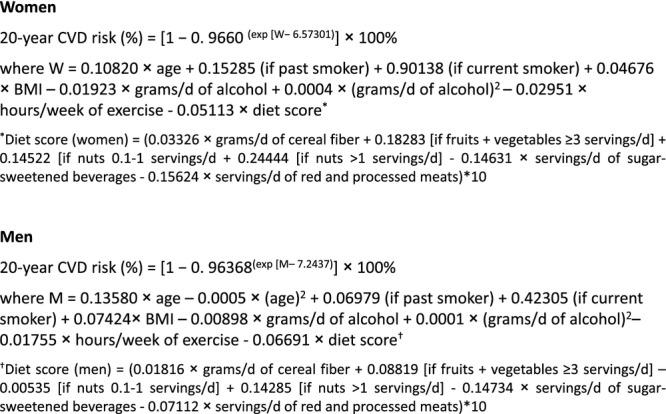
We developed a lifestyle-based CVD prediction model among 61 025 women in the Nurses' Health Study and 34 478 men in the Health Professionals Follow-up Study, who were free of chronic disease in 1986 and followed for ≤24 years. Lifestyle factors were assessed by questionnaires in 1986. In the derivation step, we used the Bayes Information Criterion to create parsimonious 20-year risk prediction models among a random two thirds of participants in each cohort separately. The scores were validated in the remaining one third of participants in each cohort. Over 24 years, there were 3775 cases of CVD in women and 3506 cases in men. The Healthy Heart Score included age, smoking, body mass index, exercise, alcohol, and a composite diet score. In the validation cohort, the risk score demonstrated good discrimination (Harrell's C-index, 0.72; 95% confidence interval [CI], 0.71, 0.74 [women]; 0.77; 95% CI, 0.76, 0.79 [men]), fit, and calibration, particularly among individuals without baseline hypertension or hypercholesterolemia.
CONCLUSIONS
The Healthy Heart Score accurately identifies individuals at elevated risk for CVD and may serve as an important clinical and public health screening tool for the primordial prevention of CVD.
背景
临床实践侧重于通过改善和药物治疗升高的危险因素来对心血管疾病(CVD)进行一级预防。基于既定危险因素的预测模型可用于一级预防。然而,通过健康的生活方式行为预防危险因素的发展,即原始预防,对于实现最佳的全人群心血管健康和最小化长期CVD风险至关重要。
方法与结果
我们在护士健康研究中的61025名女性和健康专业人员随访研究中的34478名男性中开发了一种基于生活方式的CVD预测模型,这些人在1986年无慢性病且随访时间≤24年。1986年通过问卷调查评估生活方式因素。在推导步骤中,我们使用贝叶斯信息准则分别在每个队列中随机抽取的三分之二参与者中创建简约的20年风险预测模型。这些分数在每个队列中其余的三分之一参与者中进行验证。在24年期间,女性中有3775例CVD病例,男性中有3506例。健康心脏评分包括年龄、吸烟、体重指数、运动、饮酒和综合饮食评分。在验证队列中,风险评分显示出良好的区分度(Harrell氏C指数,0.72;95%置信区间[CI],0.71,0.74[女性];0.77;95%CI,0.76,0.79[男性])、拟合度和校准度,尤其是在没有基线高血压或高胆固醇血症的个体中。
结论
健康心脏评分能够准确识别CVD风险升高的个体,可作为CVD原始预防的重要临床和公共卫生筛查工具。

 Zotero 插件