
家庭中的半挥发性有机化合物:基于经验和理论因素的高效系统暴露测量策略。
Semivolatile organic compounds in homes: strategies for efficient and systematic exposure measurement based on empirical and theoretical factors.
作者信息
Dodson Robin E, Camann David E, Morello-Frosch Rachel, Brody Julia G, Rudel Ruthann A
机构信息
Silent Spring Institute , 29 Crafts Street, Newton, Massachusetts 02458, United States.
出版信息
Environ Sci Technol. 2015 Jan 6;49(1):113-22. doi: 10.1021/es502988r. Epub 2014 Dec 9.
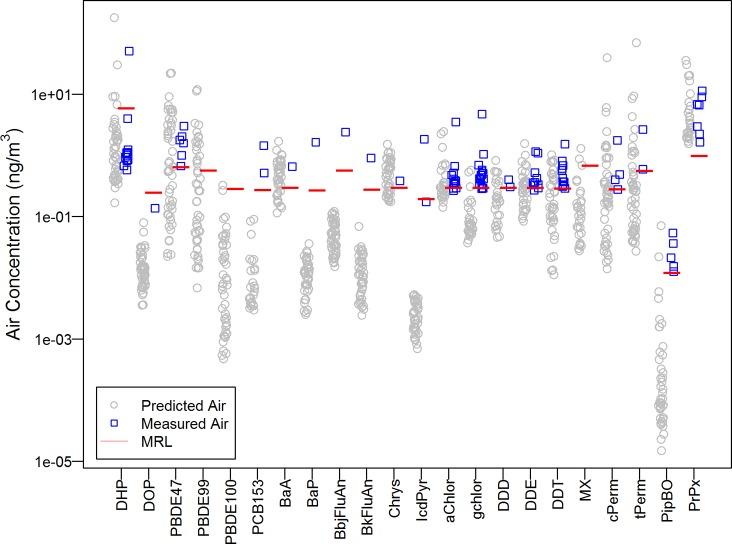
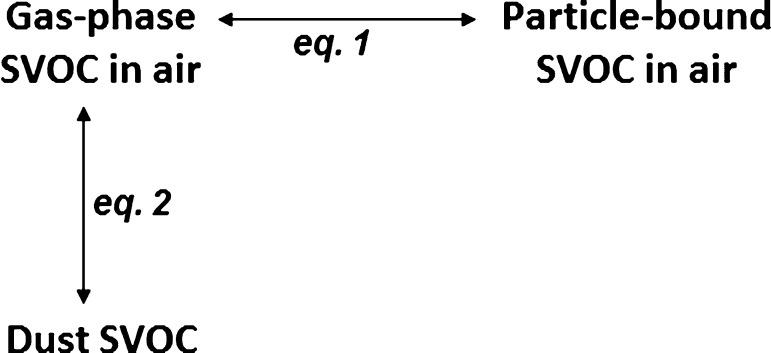
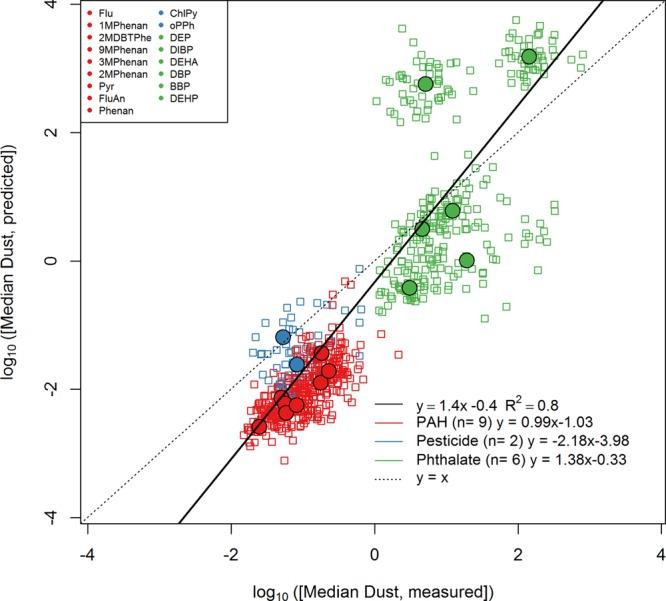
Residential exposure can dominate total exposure for commercial chemicals of health concern; however, despite the importance of consumer exposures, methods for estimating household exposures remain limited. We collected house dust and indoor air samples in 49 California homes and analyzed for 76 semivolatile organic compounds (SVOCs)--phthalates, polybrominated diphenyl ethers (PBDEs), polychlorinated biphenyls (PCBs), polycyclic aromatic hydrocarbons (PAHs), and pesticides. Sixty chemicals were detected in either dust or air and here we report 58 SVOCs detected in dust for the first time. In dust, phthalates (bis(2-ethylhexyl) phthalate, benzyl butyl phthalate, di-n-butyl phthalate) and flame retardants (PBDE 99, PBDE 47) were detected at the highest concentrations relative to other chemicals at the 95th percentile, while phthalates were highest at the median. Because SVOCs are found in both gas and condensed phases and redistribute from their original source over time, partitioning models can clarify their fate indoors. We use empirical data to validate air-dust partitioning models and use these results, combined with experience in SVOC exposure assessment, to recommend residential exposure measurement strategies. We can predict dust concentrations reasonably well from measured air concentrations (R(2) = 0.80). Partitioning models and knowledge of chemical Koa elucidate exposure pathways and suggest priorities for chemical regulation. These findings also inform study design by allowing researchers to select sampling approaches optimized for their chemicals of interest and study goals. While surface wipes are commonly used in epidemiology studies because of ease of implementation, passive air sampling may be more standardized between homes and also relatively simple to deploy. Validation of passive air sampling methods for SVOCs is a priority.
对于具有健康风险的商用化学品而言,居住环境暴露可能在总暴露中占主导地位;然而,尽管消费者暴露十分重要,但估算家庭暴露的方法仍然有限。我们在加利福尼亚州的49户家庭中采集了室内灰尘和空气样本,并对76种半挥发性有机化合物(SVOCs)进行了分析,这些化合物包括邻苯二甲酸盐、多溴二苯醚(PBDEs)、多氯联苯(PCBs)、多环芳烃(PAHs)和农药。在灰尘或空气中检测到了60种化学物质,在此我们首次报告在灰尘中检测到的58种SVOCs。在灰尘中,相对于其他化学物质,邻苯二甲酸盐(邻苯二甲酸二(2-乙基己基)酯、邻苯二甲酸苄基丁酯、邻苯二甲酸二正丁酯)和阻燃剂(PBDE 99、PBDE 47)在第95百分位数时的浓度最高,而邻苯二甲酸盐在中位数时浓度最高。由于SVOCs存在于气相和凝聚相中,并且会随着时间从其原始来源重新分布,因此分配模型可以阐明它们在室内的归宿。我们使用经验数据来验证空气-灰尘分配模型,并结合这些结果以及SVOC暴露评估经验,推荐住宅暴露测量策略。我们可以根据测得的空气浓度较好地预测灰尘浓度(R² = 0.80)。分配模型和化学物质的气固分配系数知识阐明了暴露途径,并为化学物质监管提出了优先事项。这些发现还为研究设计提供了参考,使研究人员能够选择针对其感兴趣的化学物质和研究目标进行优化的采样方法。虽然表面擦拭法由于易于实施而常用于流行病学研究,但被动空气采样在不同家庭之间可能更具标准化,并且部署也相对简单。验证SVOCs的被动空气采样方法是当务之急。
 Zotero 插件