
南非两个农业地区尘土中人类接触农药的情况。
Human Exposure to Pesticides in Dust from Two Agricultural Sites in South Africa.
作者信息
Degrendele Céline, Prokeš Roman, Šenk Petr, Jílková Simona Rozárka, Kohoutek Jiří, Melymuk Lisa, Přibylová Petra, Dalvie Mohamed Aqiel, Röösli Martin, Klánová Jana, Fuhrimann Samuel
机构信息
RECETOX, Faculty of Science, Masaryk University, 625 00 Brno, Czech Republic.
Aix-Marseille University, CNRS, LCE, 13003 Marseille, France.
出版信息
Toxics. 2022 Oct 21;10(10):629. doi: 10.3390/toxics10100629.
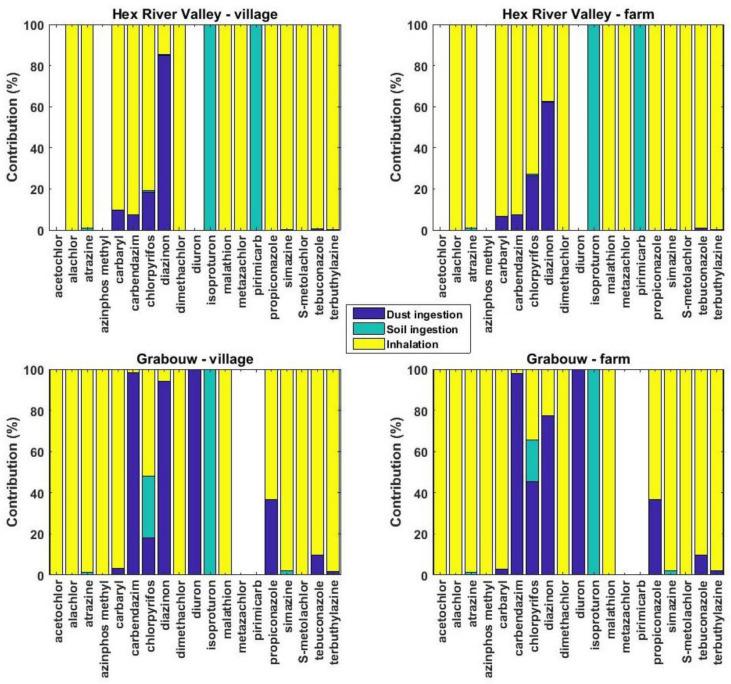
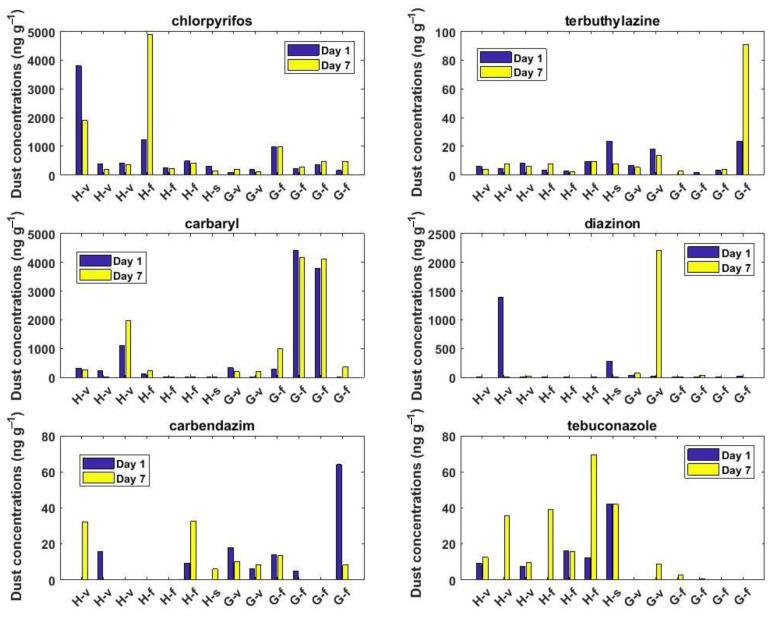
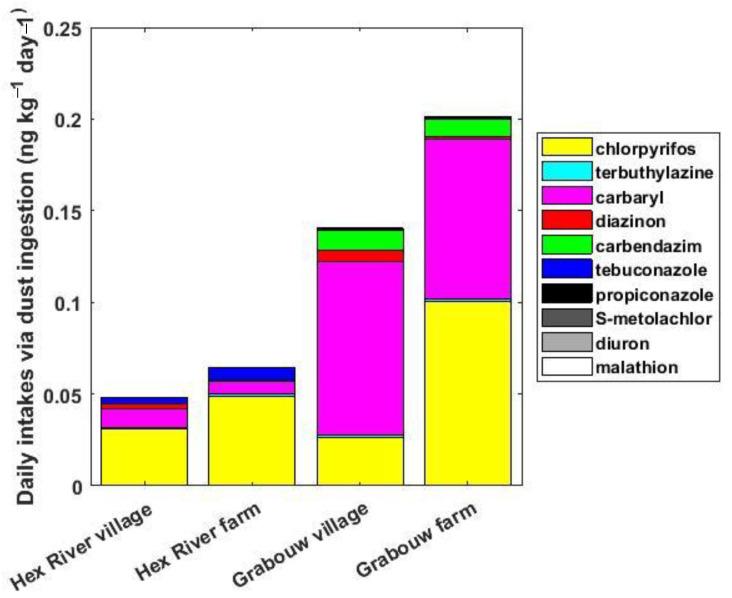
Over the last decades, concern has arisen worldwide about the negative impacts of pesticides on the environment and human health. Exposure via dust ingestion is important for many chemicals but poorly characterized for pesticides, particularly in Africa. We investigated the spatial and temporal variations of 30 pesticides in dust and estimated the human exposure via dust ingestion, which was compared to inhalation and soil ingestion. Indoor dust samples were collected from thirty-eight households and two schools located in two agricultural regions in South Africa and were analyzed using high-performance liquid chromatography coupled to tandem mass spectrometry. We found 10 pesticides in dust, with chlorpyrifos, terbuthylazine, carbaryl, diazinon, carbendazim, and tebuconazole quantified in >50% of the samples. Over seven days, no significant temporal variations in the dust levels of individual pesticides were found. Significant spatial variations were observed for some pesticides, highlighting the importance of proximity to agricultural fields or of indoor pesticide use. For five out of the nineteen pesticides quantified in dust, air, or soil (i.e., carbendazim, chlorpyrifos, diazinon, diuron and propiconazole), human intake via dust ingestion was important (>10%) compared to inhalation or soil ingestion. Dust ingestion should therefore be considered in future human exposure assessment to pesticides.
在过去几十年里,全球范围内人们对农药对环境和人类健康的负面影响日益担忧。通过摄入灰尘接触许多化学物质很重要,但对于农药而言,这方面的特征描述却很欠缺,在非洲尤其如此。我们调查了灰尘中30种农药的时空变化,并估算了通过摄入灰尘对人类的暴露量,还将其与吸入和摄入土壤的情况进行了比较。从南非两个农业地区的38户家庭和两所学校采集了室内灰尘样本,并使用高效液相色谱-串联质谱法进行分析。我们在灰尘中发现了10种农药,其中毒死蜱、特丁津、西维因、二嗪农、多菌灵和戊唑醇在超过50%的样本中被定量检测到。在七天时间里,未发现单一农药的灰尘含量有显著的时间变化。一些农药存在显著的空间变化,这凸显了靠近农田或室内使用农药的重要性。对于在灰尘、空气或土壤中定量检测到的19种农药中的5种(即多菌灵、毒死蜱、二嗪农、敌草隆和丙环唑),与吸入或摄入土壤相比,通过摄入灰尘对人类的摄入量很重要(>10%)。因此,在未来对农药的人类暴露评估中应考虑摄入灰尘的情况。



 Zotero 插件