
人体定量感觉模型对吗啡镇痛的敏感性。
Sensitivity of quantitative sensory models to morphine analgesia in humans.
机构信息
Mech-Sense, Department of Gastroenterology and Hepatology, Aalborg University Hospital, Aalborg, Denmark ; Department of Drug Design and Pharmacology, Faculty of Health and Medical Sciences, University of Copenhagen, Copenhagen, Denmark.
Department of Drug Design and Pharmacology, Faculty of Health and Medical Sciences, University of Copenhagen, Copenhagen, Denmark.
出版信息
J Pain Res. 2014 Dec 9;7:717-26. doi: 10.2147/JPR.S73044. eCollection 2014.
INTRODUCTION
Opioid analgesia can be explored with quantitative sensory testing, but most investigations have used models of phasic pain, and such brief stimuli may be limited in the ability to faithfully simulate natural and clinical painful experiences. Therefore, identification of appropriate experimental pain models is critical for our understanding of opioid effects with the potential to improve treatment.
OBJECTIVES
The aim was to explore and compare various pain models to morphine analgesia in healthy volunteers.
METHODS
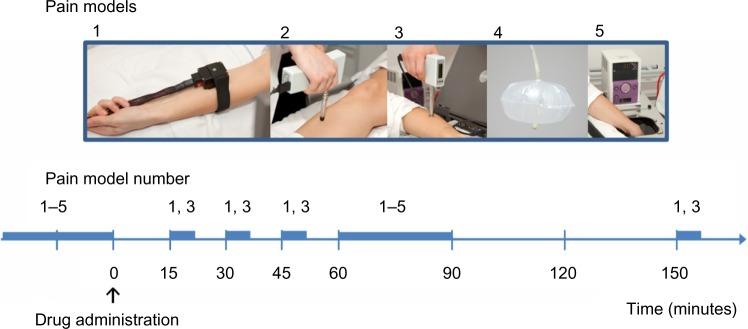
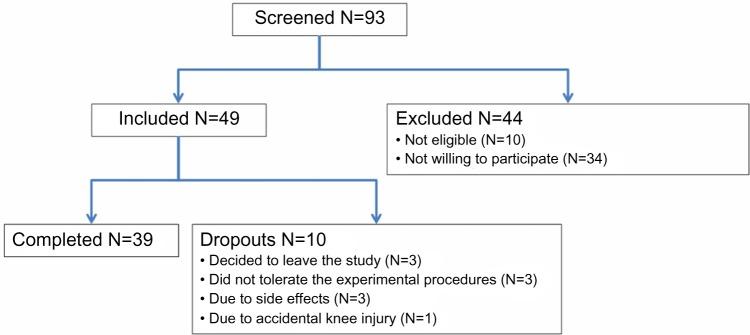
The study was a double-blind, randomized, two-way crossover study. Thirty-nine healthy participants were included and received morphine 30 mg (2 mg/mL) as oral solution or placebo. To cover both tonic and phasic stimulations, a comprehensive multi-modal, multi-tissue pain-testing program was performed.
RESULTS
Tonic experimental pain models were sensitive to morphine analgesia compared to placebo: muscle pressure (F=4.87, P=0.03), bone pressure (F=3.98, P=0.05), rectal pressure (F=4.25, P=0.04), and the cold pressor test (F=25.3, P<0.001). Compared to placebo, morphine increased tolerance to muscle stimulation by 14.07%; bone stimulation by 9.72%; rectal mechanical stimulation by 20.40%, and reduced pain reported during the cold pressor test by 9.14%. In contrast, the more phasic experimental pain models were not sensitive to morphine analgesia: skin heat, rectal electrical stimulation, or rectal heat stimulation (all P>0.05).
CONCLUSION
Pain models with deep tonic stimulation including C fiber activation and and/or endogenous pain modulation were more sensitive to morphine analgesia. To avoid false negative results in future studies, we recommend inclusion of reproducible tonic pain models in deep tissues, mimicking clinical pain to a higher degree.
介绍
阿片类镇痛药可以通过定量感觉测试来探索,但大多数研究都使用了阶段性疼痛模型,而这种短暂的刺激可能在模拟自然和临床疼痛体验方面的能力有限。因此,确定合适的实验疼痛模型对于我们理解阿片类药物的作用至关重要,这有可能改善治疗效果。
目的
探索和比较各种疼痛模型与健康志愿者接受吗啡镇痛的效果。
方法
该研究是一项双盲、随机、两向交叉研究。共纳入 39 名健康参与者,分别接受吗啡 30 毫克(2 毫克/毫升)口服液或安慰剂。为了涵盖紧张性和阶段性刺激,进行了全面的多模式、多组织疼痛测试程序。
结果
与安慰剂相比,紧张性实验性疼痛模型对吗啡镇痛更敏感:肌肉压力(F=4.87,P=0.03)、骨压力(F=3.98,P=0.05)、直肠压力(F=4.25,P=0.04)和冷加压试验(F=25.3,P<0.001)。与安慰剂相比,吗啡增加了肌肉刺激的耐受性 14.07%;骨刺激的耐受性增加了 9.72%;直肠机械刺激的耐受性增加了 20.40%,并减少了冷加压试验中报告的疼痛 9.14%。相比之下,更具阶段性的实验性疼痛模型对吗啡镇痛不敏感:皮肤热、直肠电刺激或直肠热刺激(均 P>0.05)。
结论
包括 C 纤维激活和/或内源性疼痛调节的深度紧张性刺激的疼痛模型对吗啡镇痛更敏感。为避免未来研究中出现假阴性结果,我们建议在更深度的组织中纳入可重复的紧张性疼痛模型,以更高程度模拟临床疼痛。


 Zotero 插件