
慢性阻塞性肺疾病患者中,使用荧光透视成像分析肺康复前后的膈肌运动。
Analysis of diaphragmatic movement before and after pulmonary rehabilitation using fluoroscopy imaging in patients with COPD.
作者信息
Chun Eun Mi, Han Soo Jeong, Modi Hitesh N
机构信息
Division of Pulmonary and Critical Care Medicine, Department of Internal Medicine, Seoul, Republic of Korea.
Rehabilitation Medicine, Ewha Womans University School of Medicine, Seoul, Republic of Korea.
出版信息
Int J Chron Obstruct Pulmon Dis. 2015 Jan 27;10:193-9. doi: 10.2147/COPD.S74438. eCollection 2015.
BACKGROUND
The diaphragm is the principal inspiratory muscle. The purpose of this study was to assess improvements in diaphragmatic movement before and after pulmonary rehabilitation in patients with chronic obstructive pulmonary disease (COPD), using a fluoroscopy-guided chest X-ray.
PATIENTS AND METHODS
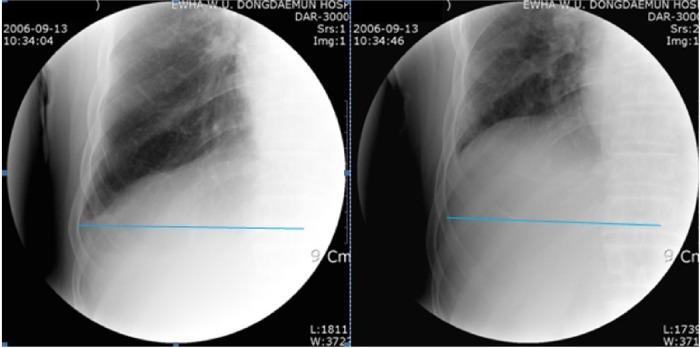
Among 117 patients with COPD receiving pulmonary rehabilitation who underwent the initial fluoroscopy-guided chest X-ray and pulmonary function test, 37 of those patients who underwent both initial and follow-up fluoroscopy and pulmonary function tests were enrolled in this study. After hospital education, participants received pulmonary rehabilitation through regular home-based training for at least 3 months by the same physiatrist. We assessed the changes in diaphragm area with fluoroscopy-guided posteroanterior chest X-rays between pre- and postpulmonary rehabilitation. To minimize radiation hazards for subjects, the exposure time for fluoroscopy to take chest X-rays was limited to less than 5 seconds.
RESULTS
There were significant improvements (2,022.8±1,548.3 mm(2) to 3,010.7±1,495.6 mm(2) and 2,382.4±1,475.9 mm(2) to 3,315.9±1,883.5 mm(2); right side P=0.001 and left side P=0.019, respectively) in diaphragmatic motion area during full inspiration and expiration in both lungs after pulmonary rehabilitation. Pulmonary function tests showed no statistically significant difference between pre- and postpulmonary rehabilitation.
CONCLUSION
The study suggests that the strategy to assess diaphragm movement using fluoroscopy is a relatively effective tool for the evaluation of pulmonary rehabilitation in COPD patients in terms of cost and time savings compared with computed tomography or magnetic resonance imaging.
背景
膈肌是主要的吸气肌。本研究的目的是使用荧光透视引导的胸部X线检查,评估慢性阻塞性肺疾病(COPD)患者肺康复前后膈肌运动的改善情况。
患者与方法
在117例接受肺康复的COPD患者中,这些患者均接受了初始荧光透视引导的胸部X线检查和肺功能测试,其中37例同时接受了初始和随访荧光透视及肺功能测试的患者被纳入本研究。经过医院教育后,参与者由同一位物理治疗师通过定期的家庭训练接受至少3个月的肺康复。我们通过荧光透视引导的前后位胸部X线检查评估肺康复前后膈肌面积的变化。为了将受试者的辐射危害降至最低,荧光透视拍摄胸部X线的曝光时间限制在5秒以内。
结果
肺康复后,双肺在完全吸气和呼气时的膈肌运动面积均有显著改善(右侧从2,022.8±1,548.3平方毫米改善至3,010.7±1,495.6平方毫米,左侧从2,382.4±1,475.9平方毫米改善至3,315.9±1,883.5平方毫米;右侧P = 0.001,左侧P = 0.019)。肺功能测试显示肺康复前后无统计学显著差异。
结论
该研究表明,与计算机断层扫描或磁共振成像相比,使用荧光透视评估膈肌运动的策略在评估COPD患者的肺康复方面是一种相对有效的工具,在成本和时间节省方面具有优势。

 Zotero 插件