
一项由初级护理护士实施的针对老年人的步行干预措施:PACE(计步器加速计咨询评估)-Lift群组随机对照试验。
A primary care nurse-delivered walking intervention in older adults: PACE (pedometer accelerometer consultation evaluation)-Lift cluster randomised controlled trial.
作者信息
Harris Tess, Kerry Sally M, Victor Christina R, Ekelund Ulf, Woodcock Alison, Iliffe Steve, Whincup Peter H, Beighton Carole, Ussher Michael, Limb Elizabeth S, David Lee, Brewin Debbie, Adams Fredrika, Rogers Annabelle, Cook Derek G
机构信息
Population Health Research Institute, St George's University of London, London, United Kingdom.
Pragmatic Clinical Trials Unit, Queen Mary's University of London, London, United Kingdom.
出版信息
PLoS Med. 2015 Feb 17;12(2):e1001783. doi: 10.1371/journal.pmed.1001783. eCollection 2015 Feb.
BACKGROUND
Brisk walking in older people can increase step-counts and moderate to vigorous intensity physical activity (MVPA) in ≥10-minute bouts, as advised in World Health Organization guidelines. Previous interventions have reported step-count increases, but not change in objectively measured MVPA in older people. We assessed whether a primary care nurse-delivered complex intervention increased objectively measured step-counts and MVPA.
METHODS AND FINDINGS
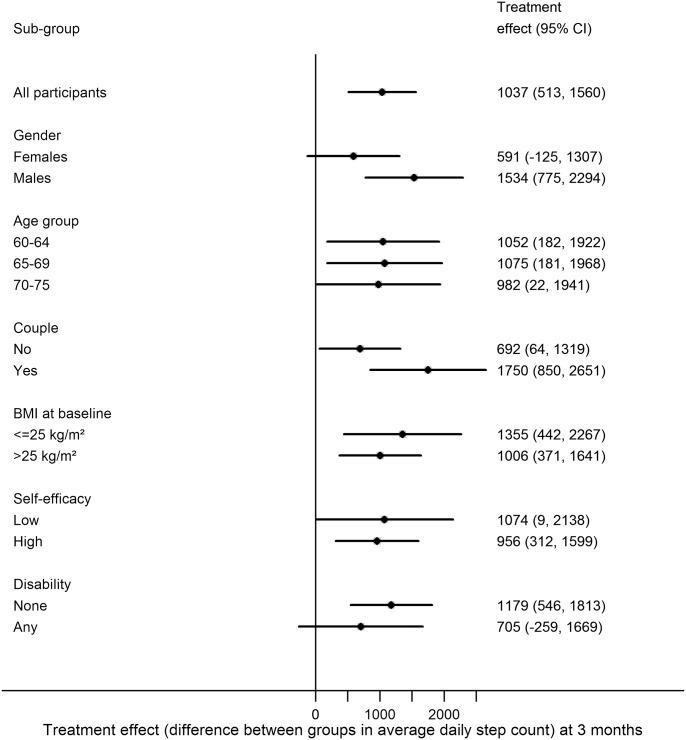
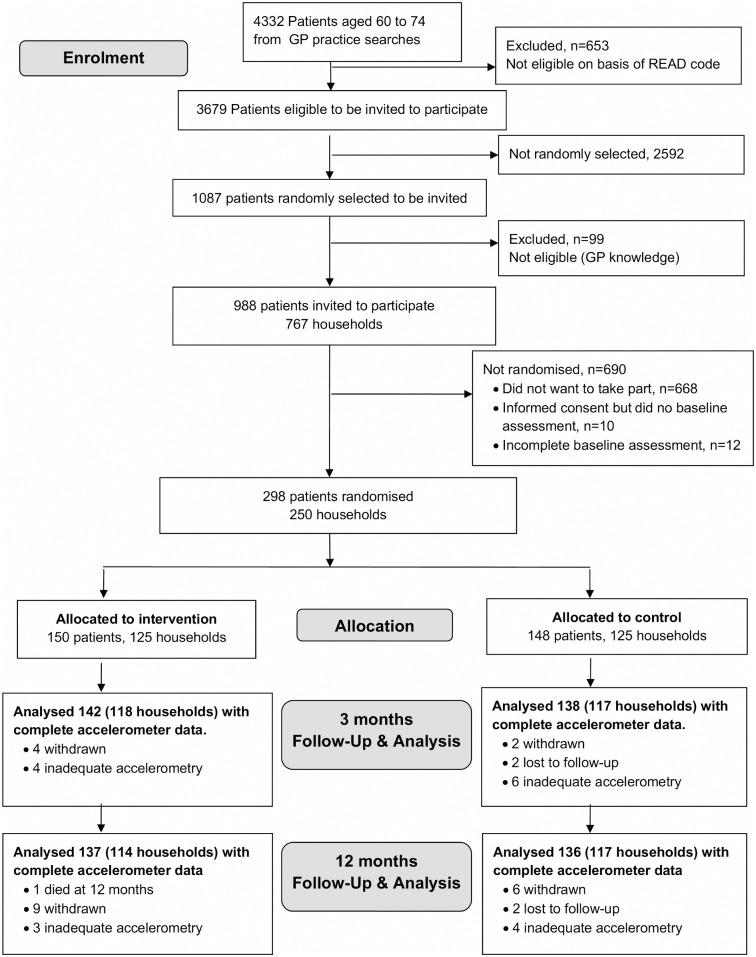
A total of 988 60-75 year olds, able to increase walking and randomly selected from three UK family practices, were invited to participate in a parallel two-arm cluster randomised trial; randomisation was by household. Two-hundred-ninety-eight people from 250 households were randomised between 2011 and 2012; 150 individuals to the intervention group, 148 to the usual care control group. Intervention participants received four primary care nurse physical activity (PA) consultations over 3 months, incorporating behaviour change techniques, pedometer step-count and accelerometer PA intensity feedback, and an individual PA diary and plan. Assessors were not blinded to group status, but statistical analyses were conducted blind. The primary outcome was change in accelerometry assessed average daily step-counts between baseline and 3 months, with change at 12 months a secondary outcome. Other secondary outcomes were change from baseline in time in MVPA weekly in ≥10-minute bouts, accelerometer counts, and counts/minute at 3 months and 12 months. Other outcomes were adverse events, anthropometric measures, mood, and pain. Qualitative evaluations of intervention participants and practice nurses assessed the intervention's acceptability. At 3 months, eight participants had withdrawn or were lost to follow-up, 280 (94%) individuals provided primary outcome data. At 3 months changes in both average daily step-counts and weekly MVPA in ≥10-minute bouts were significantly higher in the intervention than control group: by 1,037 (95% CI 513-1,560) steps/day and 63 (95% CI 40-87) minutes/week, respectively. At 12 months corresponding differences were 609 (95% CI 104-1,115) steps/day and 40 (95% CI 17-63) minutes/week. Counts and counts/minute showed similar effects to steps and MVPA. Adverse events, anthropometry, mood, and pain were similar in the two groups. Participants and practice nurses found the intervention acceptable and enjoyable.
CONCLUSIONS
The PACE-Lift trial increased both step-counts and objectively measured MVPA in ≥10-minute bouts in 60-75 year olds at 3 and 12 months, with no effect on adverse events. To our knowledge, this is the first trial in this age group to demonstrate objective MVPA increases and highlights the value of individualised support incorporating objective PA assessment in a primary care setting.
TRIAL REGISTRATION
Controlled-Trials.com ISRCTN42122561.
背景
按照世界卫生组织指南的建议,老年人快走可增加步数,并在≥10分钟的时段内进行中等至剧烈强度的身体活动(MVPA)。以往的干预措施报告了步数增加情况,但未提及老年人客观测量的MVPA变化。我们评估了一项由初级保健护士实施的综合干预措施是否能增加客观测量的步数和MVPA。
方法与结果
从英国三家全科医疗诊所中随机选取了988名60 - 75岁、能够增加步行量的老年人,邀请他们参加一项平行双臂整群随机试验;按家庭进行随机分组。2011年至2012年期间,来自250个家庭的298人被随机分组;150人进入干预组,148人进入常规护理对照组。干预组参与者在3个月内接受了4次初级保健护士的身体活动(PA)咨询,其中包括行为改变技巧、计步器步数和加速度计PA强度反馈,以及一份个人PA日记和计划。评估人员知晓分组情况,但统计分析是在盲态下进行的。主要结局是加速度计评估的基线至3个月期间平均每日步数的变化,12个月时的变化为次要结局。其他次要结局包括基线至3个月和12个月时,每周≥10分钟时段内MVPA时间的变化、加速度计计数以及每分钟计数。其他结局包括不良事件、人体测量指标、情绪和疼痛。对干预组参与者和执业护士的定性评估评估了干预措施的可接受性。3个月时,8名参与者退出或失访,280名(9
 Zotero 插件