
一种用于单克隆抗体高通量表征的疏水相互作用色谱替代分析方法。
An alternative assay to hydrophobic interaction chromatography for high-throughput characterization of monoclonal antibodies.
作者信息
Estep Patricia, Caffry Isabelle, Yu Yao, Sun Tingwan, Cao Yuan, Lynaugh Heather, Jain Tushar, Vásquez Maximiliano, Tessier Peter M, Xu Yingda
机构信息
a Protein Analytics; Adimab ; Lebanon , NH , USA.
出版信息
MAbs. 2015;7(3):553-61. doi: 10.1080/19420862.2015.1016694.
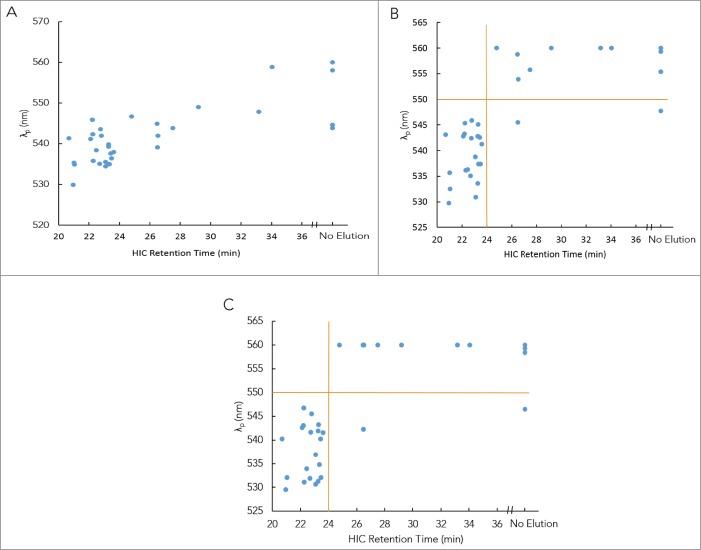
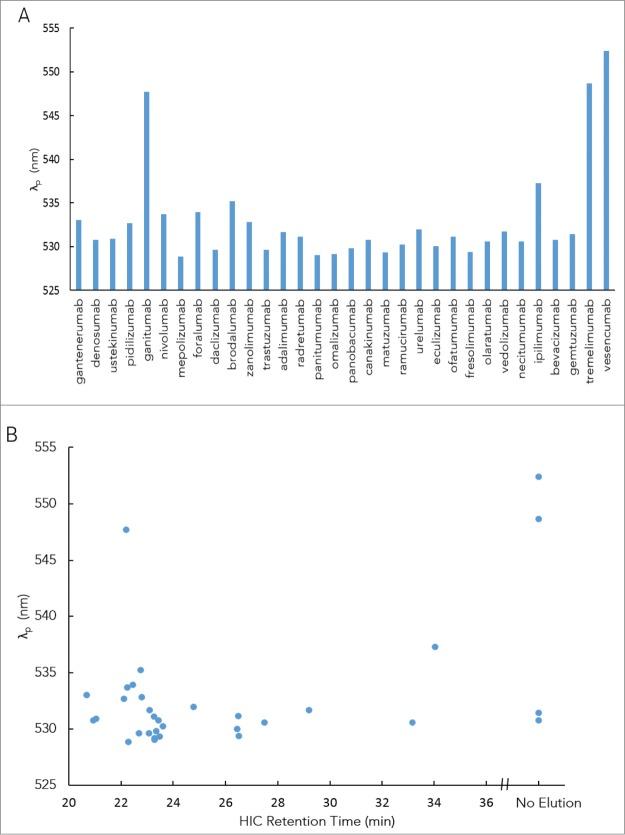
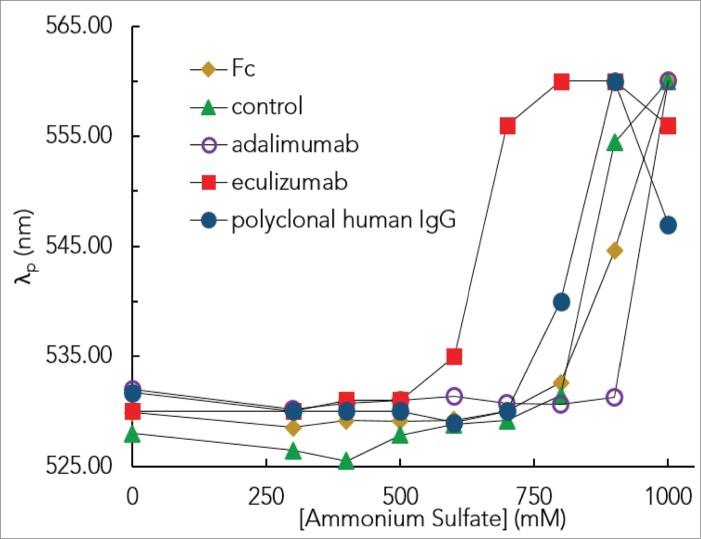
The effectiveness of therapeutic monoclonal antibodies (mAbs) is governed not only by their bioactivity, but also by their biophysical properties. Assays for rapidly evaluating the biophysical properties of mAbs are valuable for identifying those most likely to exhibit superior properties such as high solubility, low viscosity and slow serum clearance. Analytical hydrophobic interaction chromatography (HIC), which is performed at high salt concentrations to enhance hydrophobic interactions, is an attractive assay for identifying mAbs with low hydrophobicity. However, this assay is low throughput and thus not amenable to processing the large numbers of mAbs that are commonly generated during antibody discovery. Therefore, we investigated whether an alternative, higher throughput, assay could be developed that is based on evaluating antibody self-association at high salt concentrations using affinity-capture self-interaction nanoparticle spectroscopy (AC-SINS). Our approach is to coat gold nanoparticles with polyclonal anti-human antibodies, use these conjugates to immobilize human mAbs, and evaluate mAb self-interactions by measuring the plasmon wavelengths of the antibody conjugates as a function of ammonium sulfate concentration. We find that hydrophobic mAbs, as identified by HIC, generally show significant self-association at low to moderate ammonium sulfate concentrations, while hydrophilic mAbs typically show self-association only at high ammonium sulfate concentrations. The correlation between AC-SINS and HIC measurements suggests that our assay, which can evaluate tens to hundreds of mAbs in a parallel manner and requires only small (microgram) amounts of antibody, will enable early identification of mAb candidates with low hydrophobicity and improved biophysical properties.
治疗性单克隆抗体(mAb)的有效性不仅取决于其生物活性,还取决于其生物物理性质。快速评估mAb生物物理性质的分析方法对于鉴定那些最有可能展现出诸如高溶解度、低粘度和缓慢血清清除率等优异性质的mAb具有重要价值。分析型疏水相互作用色谱(HIC)在高盐浓度下进行以增强疏水相互作用,是一种用于鉴定低疏水性mAb的有吸引力的分析方法。然而,该分析方法通量较低,因此不适用于处理抗体发现过程中通常产生的大量mAb。因此,我们研究是否可以开发一种基于使用亲和捕获自相互作用纳米颗粒光谱(AC-SINS)在高盐浓度下评估抗体自缔合的替代的、高通量的分析方法。我们的方法是用多克隆抗人抗体包被金纳米颗粒,使用这些缀合物固定人mAb,并通过测量抗体缀合物的等离子体波长作为硫酸铵浓度的函数来评估mAb的自相互作用。我们发现,通过HIC鉴定的疏水性mAb通常在低至中等硫酸铵浓度下显示出显著的自缔合,而亲水性mAb通常仅在高硫酸铵浓度下显示出自缔合。AC-SINS与HIC测量之间的相关性表明,我们的分析方法能够以平行方式评估数十至数百个mAb,并且仅需要少量(微克)抗体,将能够早期鉴定出具有低疏水性和改善的生物物理性质的mAb候选物。


 Zotero 插件