
肺癌与二氧化氮暴露及交通因素:一项系统评价与荟萃分析
Lung Cancer and Exposure to Nitrogen Dioxide and Traffic: A Systematic Review and Meta-Analysis.
作者信息
Hamra Ghassan B, Laden Francine, Cohen Aaron J, Raaschou-Nielsen Ole, Brauer Michael, Loomis Dana
机构信息
Department of Environmental and Occupational Health, Drexel University School of Public Health, Philadelphia, Pennsylvania, USA.
出版信息
Environ Health Perspect. 2015 Nov;123(11):1107-12. doi: 10.1289/ehp.1408882. Epub 2015 Apr 14.
BACKGROUND AND OBJECTIVE
Exposure to traffic-related air pollutants is an important public health issue. Here, we present a systematic review and meta-analysis of research examining the relationship of measures of nitrogen oxides (NOx) and of various measures of traffic-related air pollution exposure with lung cancer.
METHODS
We conducted random-effects meta-analyses of studies examining exposure to nitrogen dioxide (NO2) and NOx and its association with lung cancer. We identified 20 studies that met inclusion criteria and provided information necessary to estimate the change in lung cancer per 10-μg/m3 increase in exposure to measured NO2. Further, we qualitatively assessed the evidence of association between distance to roadways and traffic volume associated with lung cancer.
RESULTS
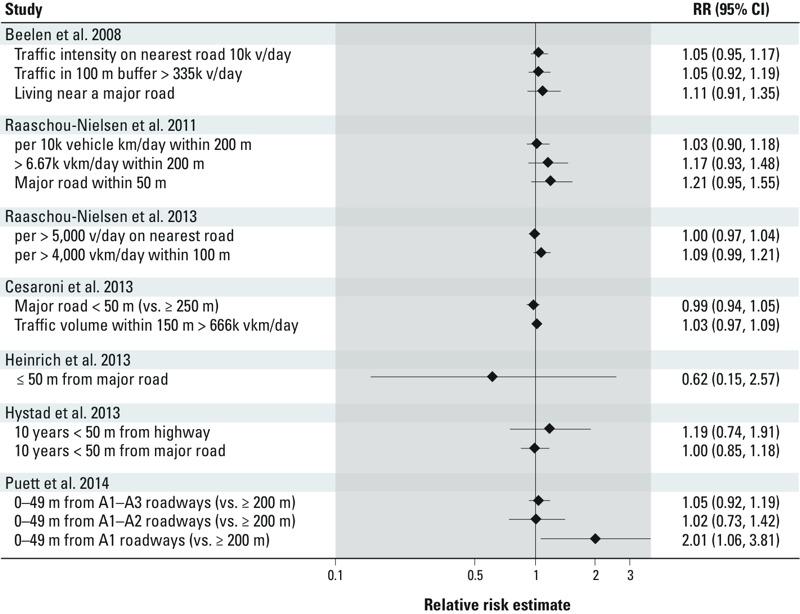
The meta-estimate for the change in lung cancer associated with a 10-μg/m3 increase in exposure to NO2 was 4% (95% CI: 1%, 8%). The meta-estimate for change in lung cancer associated with a 10-μg/m3 increase in NOx was similar and slightly more precise, 3% (95% CI: 1%, 5%). The NO2 meta-estimate was robust to different confounding adjustment sets as well as the exposure assessment techniques used. Trim-and-fill analyses suggest that if publication bias exists, the overall meta-estimate is biased away from the null. Forest plots for measures of traffic volume and distance to roadways largely suggest a modest increase in lung cancer risk.
CONCLUSION
We found consistent evidence of a relationship between NO2, as a proxy for traffic-sourced air pollution exposure, with lung cancer. Studies of lung cancer related to residential proximity to roadways and NOx also suggest increased risk, which may be attributable partly to air pollution exposure. The International Agency for Research on Cancer recently classified outdoor air pollution and particulate matter as carcinogenic (Group 1). These meta-analyses support this conclusion, drawing particular attention to traffic-sourced air pollution.
CITATION
Hamra GB, Laden F, Cohen AJ, Raaschou-Nielsen O, Brauer M, Loomis D. 2015. Lung cancer and exposure to nitrogen dioxide and traffic: a systematic review and meta-analysis. Environ Health Perspect 123:1107-1112; http://dx.doi.org/10.1289/ehp.1408882.
背景与目的
暴露于与交通相关的空气污染物是一个重要的公共卫生问题。在此,我们对研究氮氧化物(NOx)测量值以及各种与交通相关的空气污染暴露测量值与肺癌关系的研究进行系统综述和荟萃分析。
方法
我们对研究二氧化氮(NO2)暴露及其与肺癌关联的研究进行随机效应荟萃分析。我们确定了20项符合纳入标准的研究,并提供了估计每10μg/m³测量的NO2暴露增加导致的肺癌变化所需的信息。此外,我们定性评估了与肺癌相关的到道路的距离和交通流量之间关联的证据。
结果
与每10μg/m³的NO2暴露增加相关的肺癌变化的荟萃估计值为4%(95%置信区间:1%,8%)。与每10μg/m³的NOx增加相关的肺癌变化的荟萃估计值相似且稍精确一些,为3%(95%置信区间:1%,5%)。NO2的荟萃估计值对于不同的混杂因素调整集以及所使用的暴露评估技术具有稳健性。修剪填充分析表明,如果存在发表偏倚,总体荟萃估计值会偏离无效值。交通流量测量值和到道路距离的森林图在很大程度上表明肺癌风险有适度增加。
结论
我们发现有一致的证据表明,作为交通源空气污染暴露替代指标的NO2与肺癌之间存在关联。与居住在道路附近和NOx相关的肺癌研究也表明风险增加,这可能部分归因于空气污染暴露。国际癌症研究机构最近将室外空气污染和颗粒物归类为致癌物(第1组)。这些荟萃分析支持这一结论,尤其关注交通源空气污染。
引用
Hamra GB, Laden F, Cohen AJ, Raaschou-Nielsen O, Brauer M, Loomis D. 2015. Lung cancer and exposure to nitrogen dioxide and traffic: a systematic review and meta-analysis. Environ Health Perspect 123:1107-1112; http://dx.doi.org/10.1289/ehp.1408882.


 Zotero 插件