
普拉梭菌可预防慢性低度炎症小鼠模型中的生理损伤。
Faecalibacterium prausnitzii prevents physiological damages in a chronic low-grade inflammation murine model.
作者信息
Martín Rebeca, Miquel Sylvie, Chain Florian, Natividad Jane M, Jury Jennifer, Lu Jun, Sokol Harry, Theodorou Vassilia, Bercik Premysl, Verdu Elena F, Langella Philippe, Bermúdez-Humarán Luis G
机构信息
INRA, Commensal and Probiotics-Host Interactions Laboratory, UMR 1319 Micalis, F-78350, Jouy-en-Josas, France.
AgroParisTech, UMR1319 Micalis, F-78350, Jouy-en-Josas, France.
出版信息
BMC Microbiol. 2015 Mar 21;15:67. doi: 10.1186/s12866-015-0400-1.
BACKGROUND
The human gut houses one of the most complex and abundant ecosystems composed of up to 10(13)-10(14) microorganisms. The importance of this intestinal microbiota is highlighted when a disruption of the intestinal ecosystem equilibrium appears (a phenomenon called dysbiosis) leading to an illness status, such as inflammatory bowel diseases (IBD). Indeed, the reduction of the commensal bacterium Faecalibacterium prausnitzii (one of the most prevalent intestinal bacterial species in healthy adults) has been correlated with several diseases, including IBD, and most importantly, it has been shown that this bacterium has anti-inflammatory and protective effects in pre-clinical models of colitis. Some dysbiosis disorders are characterized by functional and physiological alterations. Here, we report the beneficial effects of F. prausnitzii in the physiological changes induced by a chronic low-grade inflammation in a murine model. Chronic low-grade inflammation and gut dysfunction were induced in mice by two episodes of dinitro-benzene sulfonic acid (DNBS) instillations. Markers of inflammation, gut permeability, colonic serotonin and cytokine levels were studied. The effects of F. prausnitzii strain A2-165 and its culture supernatant (SN) were then investigated.
RESULTS
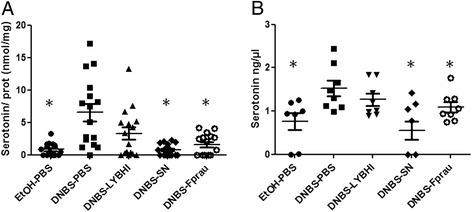
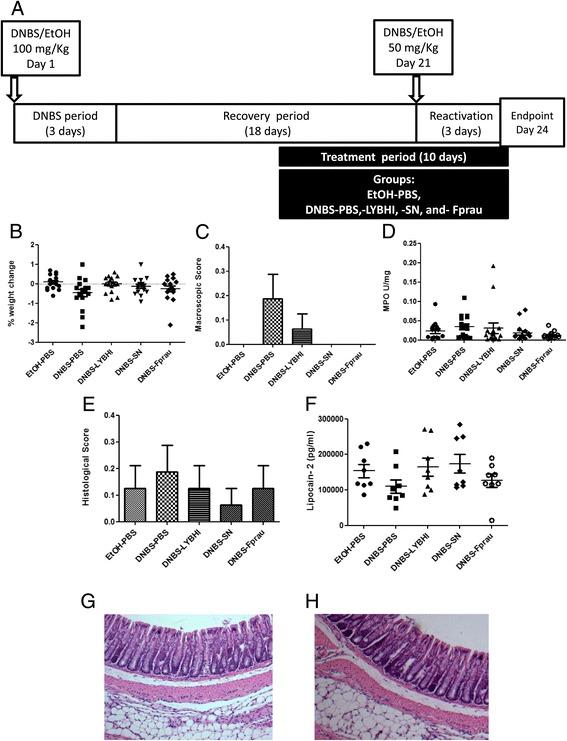
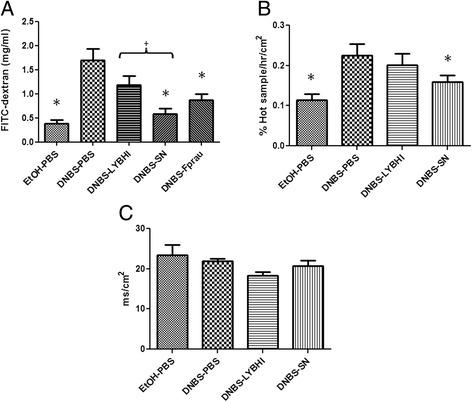
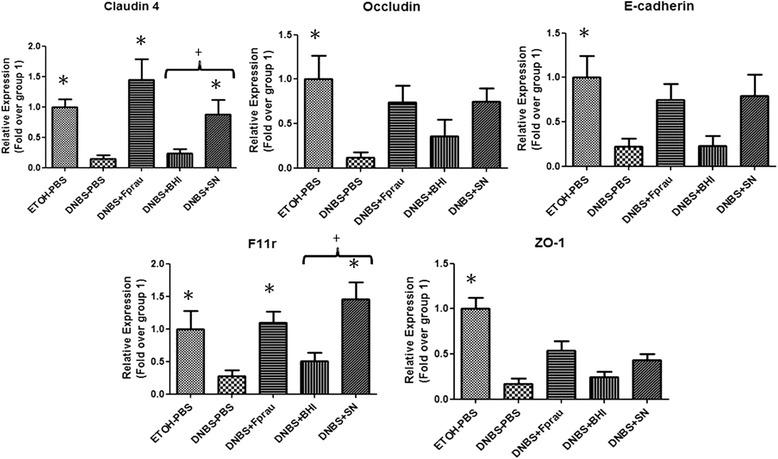
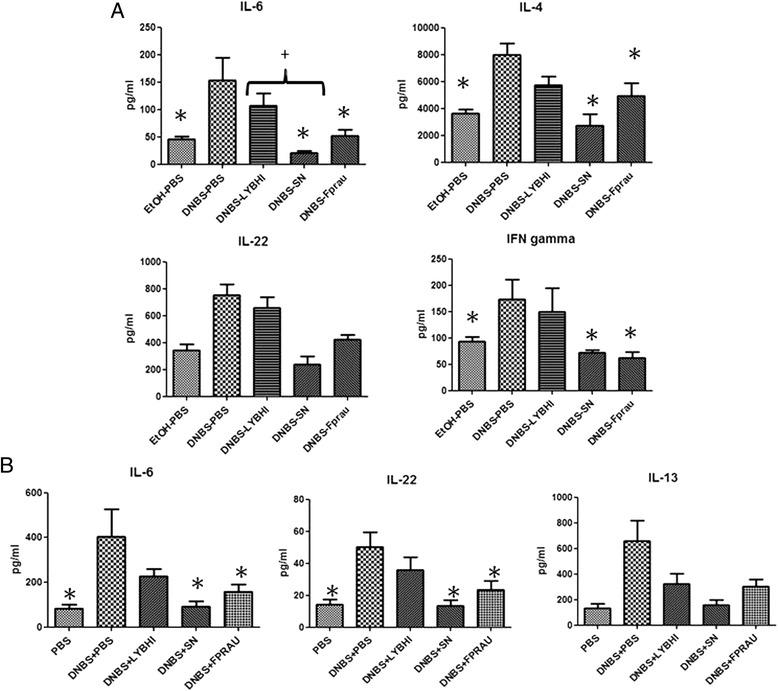
No significant differences were observed in classical inflammation markers confirming that inflammation was subclinical. However, gut permeability, colonic serotonin levels and the colonic levels of the cytokines IL-6, INF-γ, IL-4 and IL-22 were higher in DNBS-treated than in untreated mice. Importantly, mice treated with either F. prausnitzii or its SN exhibited significant decreases in intestinal permeability, tissue cytokines and serotonin levels.
CONCLUSIONS
Our results show that F. prausnitzii and its SN had beneficial effects on intestinal epithelial barrier impairment in a chronic low-grade inflammation model. These observations confirm the potential of this bacterium as a novel probiotic treatment in the management of gut dysfunction and low-grade inflammation.
背景
人类肠道是最复杂且微生物数量最多的生态系统之一,其中微生物数量多达10¹³ - 10¹⁴个。当肠道生态系统平衡被打破(一种称为生态失调的现象)并导致疾病状态,如炎症性肠病(IBD)时,这种肠道微生物群的重要性就凸显出来。事实上,共生菌普拉梭菌(健康成年人中最普遍的肠道细菌种类之一)数量的减少与多种疾病相关,包括IBD,最重要的是,在结肠炎的临床前模型中已表明该细菌具有抗炎和保护作用。一些生态失调疾病的特征是功能和生理改变。在此,我们报告了普拉梭菌在小鼠模型中由慢性低度炎症诱导的生理变化中的有益作用。通过两次二硝基苯磺酸(DNBS)灌注在小鼠中诱导慢性低度炎症和肠道功能障碍。研究了炎症、肠道通透性、结肠5-羟色胺和细胞因子水平的标志物。然后研究了普拉梭菌A2-165菌株及其培养上清液(SN)的作用。
结果
在经典炎症标志物方面未观察到显著差异,证实炎症处于亚临床状态。然而,DNBS处理的小鼠的肠道通透性、结肠5-羟色胺水平以及细胞因子IL-6、INF-γ、IL-4和IL-22的结肠水平高于未处理的小鼠。重要的是,用普拉梭菌或其SN处理的小鼠在肠道通透性、组织细胞因子和5-羟色胺水平方面均有显著降低。
结论
我们的结果表明,普拉梭菌及其SN在慢性低度炎症模型中对肠道上皮屏障损伤具有有益作用。这些观察结果证实了这种细菌作为治疗肠道功能障碍和低度炎症的新型益生菌的潜力。
 Zotero 插件