
高危患者围手术期心血管监测:12项共识
Perioperative cardiovascular monitoring of high-risk patients: a consensus of 12.
作者信息
Vincent Jean-Louis, Pelosi Paolo, Pearse Rupert, Payen Didier, Perel Azriel, Hoeft Andreas, Romagnoli Stefano, Ranieri V Marco, Ichai Carole, Forget Patrice, Della Rocca Giorgio, Rhodes Andrew
机构信息
Department of Intensive Care, Erasme Hospital, Université Libre de Bruxelles, 808 route de Lennik, 1070, Brussels, Belgium.
AOU IRCCS San Martino-IST, Department of Surgical Sciences and Integrated Diagnostics, University of Genoa, Largo Rosanna Benzi 8, 16132, Genoa, Italy.
出版信息
Crit Care. 2015 May 8;19(1):224. doi: 10.1186/s13054-015-0932-7.
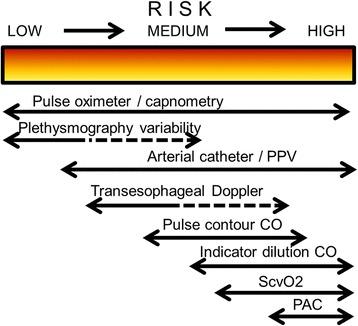
A significant number of surgical patients are at risk of intra- or post-operative complications or both, which are associated with increased lengths of stay, costs, and mortality. Reducing these risks is important for the individual patient but also for health-care planners and managers. Insufficient tissue perfusion and cellular oxygenation due to hypovolemia, heart dysfunction or both is one of the leading causes of perioperative complications. Adequate perioperative management guided by effective and timely hemodynamic monitoring can help reduce the risk of complications and thus potentially improve outcomes. In this review, we describe the various available hemodynamic monitoring systems and how they can best be used to guide cardiovascular and fluid management in the perioperative period in high-risk surgical patients.
相当多的外科手术患者面临术中或术后并发症的风险,或两者皆有,这些并发症与住院时间延长、费用增加和死亡率上升相关。降低这些风险不仅对个体患者很重要,对医疗保健规划者和管理者也很重要。由于血容量不足、心脏功能障碍或两者兼而有之导致的组织灌注不足和细胞氧合不足是围手术期并发症的主要原因之一。在有效及时的血流动力学监测指导下进行充分的围手术期管理有助于降低并发症风险,从而有可能改善治疗结果。在本综述中,我们描述了各种可用的血流动力学监测系统,以及如何最好地利用它们来指导高危手术患者围手术期的心血管和液体管理。


 Zotero 插件