
在长寿的glp-1突变体以及在 dauer 形成有缺陷的突变体中,Δ4-和Δ7-达法胆酸浓度均未显著增加。
No Significant Increase in the Δ4- and Δ7-Dafachronic Acid Concentration in the Long-Lived glp-1 Mutant, nor in the Mutants Defective in Dauer Formation.
作者信息
Li Tie-Mei, Liu Weilong, Lu Shan, Zhang Yan-Ping, Jia Le-Mei, Chen Jie, Li Xiangke, Lei Xiaoguang, Dong Meng-Qiu
机构信息
National Institute of Biological Sciences, Beijing, Beijing 102206, China.
National Institute of Biological Sciences, Beijing, Beijing 102206, China Beijing National Laboratory for Molecular Sciences, Key Laboratory of Bioorganic Chemistry and Molecular Engineering of Ministry of Education, Department of Chemical Biology, College of Chemistry and Molecular Engineering, Synthetic and Functional Biomolecules Center, and Peking-Tsinghua Center for Life Sciences, Peking University, Beijing 100871, China.
出版信息
G3 (Bethesda). 2015 May 12;5(7):1473-9. doi: 10.1534/g3.115.018812.
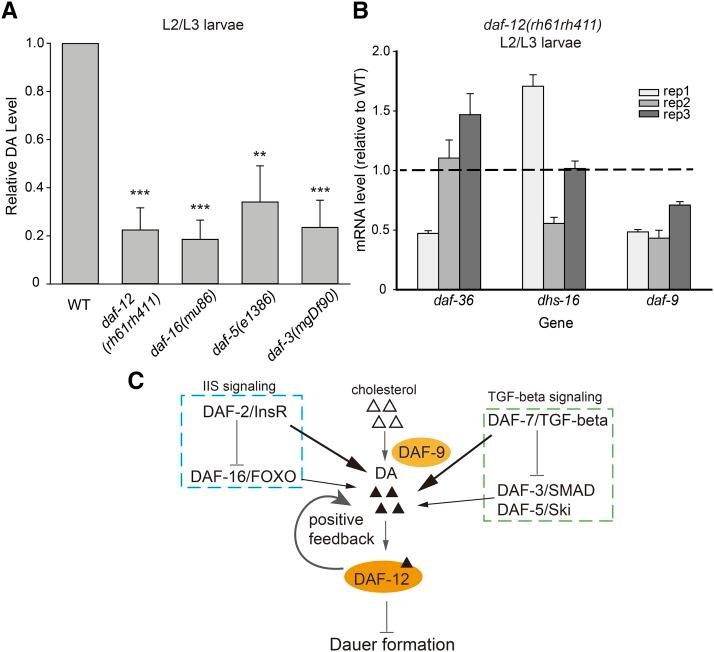
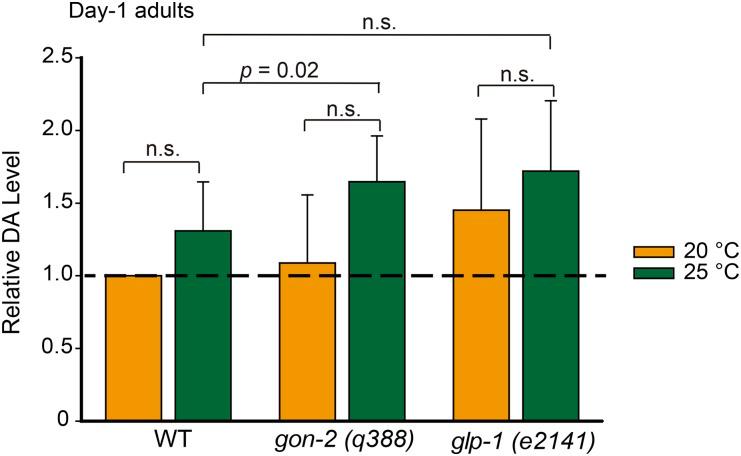
The steroid hormone dafachronic acid (DA) regulates dauer formation and lifespan in Caenorhabditis elegans by binding to the nuclear receptor DAF-12. However, little is known about how DA concentrations change under various physiologic conditions and about how DA/DAF-12 signaling interacts with other signaling pathways that also regulate dauer formation and lifespan. Using a sensitive bioanalytical method, we quantified the endogenous DA concentrations in a long-lived germline-less glp-1 mutant and in the Dauer formation-defective (Daf-d) mutants daf-12, daf-16, daf-5, and daf-3. We found that the DA concentration in the glp-1 mutant was similar to that in the wild type (WT). This result is contrary to the long-held belief that germline loss-induced longevity involves increased DA production and suggests instead that this type of longevity involves an enhanced response to DA. We also found evidence suggesting that increased DA sensitivity underlies lifespan extension triggered by exogenous DA. At the L2/L3 stage, the DA concentration in a daf-12 null mutant decreased to 22% of the WT level. This finding is consistent with the previously proposed positive feedback regulation between DAF-12 and DA production. Surprisingly, the DA concentrations in the daf-16, daf-5, and daf-3 mutants were only 19-34% of the WT level at the L2/L3 stage, slightly greater than those in the Dauer formation-constitutive (Daf-c) mutants at the pre-dauer stage (4-15% of the WT L2 control). Our experimental evidence suggested that the positive feedback between DA and DAF-12 was partially induced in the three Daf-d mutants.
类固醇激素25-去氢胆固醇酸(DA)通过与核受体DAF-12结合来调节秀丽隐杆线虫的滞育形成和寿命。然而,对于DA浓度在各种生理条件下如何变化,以及DA/DAF-12信号通路如何与其他也调节滞育形成和寿命的信号通路相互作用,我们知之甚少。我们使用一种灵敏的生物分析方法,对长寿的无生殖系glp-1突变体以及滞育形成缺陷(Daf-d)突变体daf-12、daf-16、daf-5和daf-3中的内源性DA浓度进行了定量。我们发现glp-1突变体中的DA浓度与野生型(WT)相似。这一结果与长期以来认为生殖系缺失诱导的长寿涉及DA产量增加的观点相反,反而表明这种类型的长寿涉及对DA的反应增强。我们还发现有证据表明,DA敏感性增加是外源性DA触发寿命延长的基础。在L2/L3阶段,daf-12基因敲除突变体中的DA浓度降至WT水平的22%。这一发现与先前提出的DAF-12与DA产生之间的正反馈调节一致。令人惊讶的是,在L2/L3阶段,daf-16、daf-5和daf-3突变体中的DA浓度仅为WT水平的19%-34%,略高于滞育形成组成型(Daf-c)突变体在滞育前期的浓度(WT L2对照的4%-15%)。我们的实验证据表明,DA和DAF-12之间的正反馈在这三个Daf-d突变体中部分被诱导。

 Zotero 插件