
细胞接种密度是共聚物支架诱导骨再生的关键决定因素。
Cell seeding density is a critical determinant for copolymer scaffolds-induced bone regeneration.
作者信息
Yassin Mohammed A, Leknes Knut N, Pedersen Torbjorn O, Xing Zhe, Sun Yang, Lie Stein A, Finne-Wistrand Anna, Mustafa Kamal
机构信息
Faculty of Medicine and Dentistry, Department of Clinical Dentistry, Center for Clinical Dental Research, University of Bergen, Årstadveien 19, N-5009, Bergen, Norway.
Department of Fibre and Polymer Technology, School of Chemical Science and Engineering, KTH Royal Institute of Technology, Teknikringen 42, SE-100 44, Stockholm, Sweden.
出版信息
J Biomed Mater Res A. 2015 Nov;103(11):3649-58. doi: 10.1002/jbm.a.35505. Epub 2015 Sep 4.
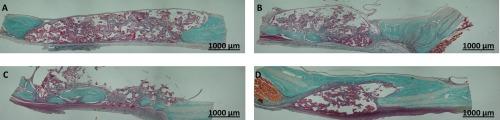
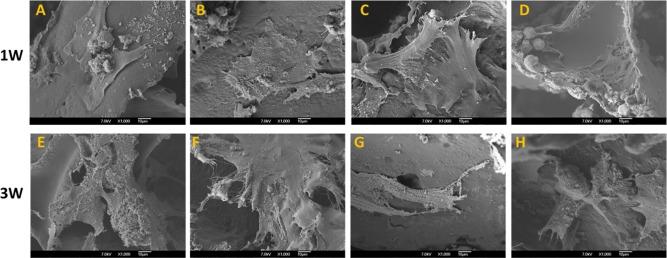
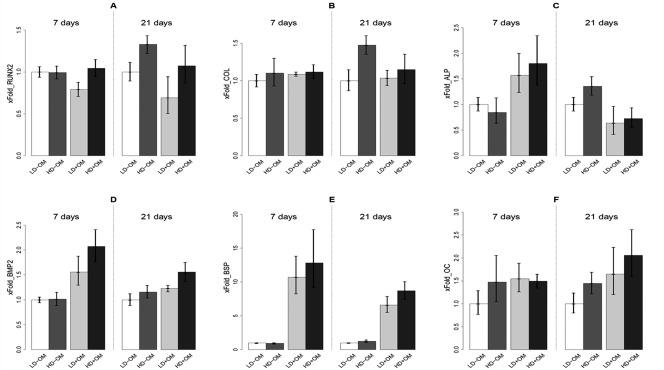
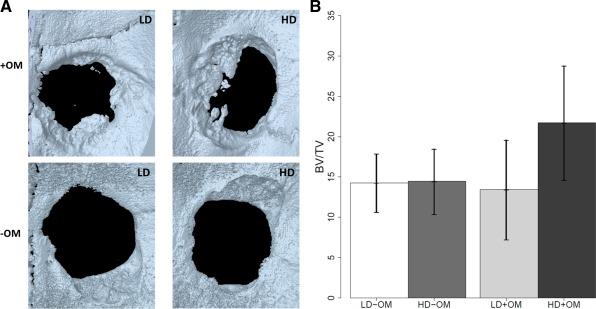
Constructs intended for bone tissue engineering (TE) are influenced by the initial cell seeding density. Therefore, the objective of this study was to determine the effect of bone marrow stromal stem cells (BMSCs) density loaded onto copolymer scaffolds on bone regeneration. BMSCs were harvested from rat's bone marrow and cultured in media with or without osteogenic supplements. Cells were seeded onto poly(l-lactide-co-ε-caprolactone) [poly(LLA-co-CL)] scaffolds at two different densities: low density (1 × 10(6) cells/scaffold) or high density (2 × 10(6) cells/scaffold) using spinner modified flasks and examined after 1 and 3 weeks. Initial attachment and spread of BMSC onto the scaffolds was recorded by scanning electron microscopy. Cell proliferation was assessed by DNA quantification and cell differentiation by quantitative real-time reverse transcriptase-polymerized chain reaction analysis (qRT-PCR). Five-millimeter rat calvarial defects (24 defects in 12 rats) were implanted with scaffolds seeded with either low or high density expanded with or without osteogenic supplements. Osteogenic supplements significantly increased cell proliferation (p < 0.001). Scaffolds seeded at high cell density exhibited higher mRNA expressions of Runx2 p = 0.001, Col1 p = 0.001, BMP2 p < 0.001, BSP p < 0.001, and OC p = 0.013. More bone was formed in response to high cell seeding density (p = 0.023) and high seeding density with osteogenic medium (p = 0.038). Poly (LLA-co-CL) scaffolds could be appropriate candidates for bone TE. The optimal number of cells to be loaded onto scaffolds is critical for promoting Extracellular matrix synthesis and bone formation. Cell seeding density and osteogenic supplements may have a synergistic effect on the induction of new bone.
用于骨组织工程(TE)的构建体受初始细胞接种密度的影响。因此,本研究的目的是确定负载于共聚物支架上的骨髓间充质干细胞(BMSC)密度对骨再生的影响。从大鼠骨髓中获取BMSC,并在添加或不添加成骨补充剂的培养基中培养。使用旋转改良培养瓶将细胞以两种不同密度接种到聚(L-丙交酯-共-ε-己内酯)[聚(LLA-共-CL)]支架上:低密度(1×10⁶个细胞/支架)或高密度(2×10⁶个细胞/支架),并在1周和3周后进行检查。通过扫描电子显微镜记录BMSC在支架上的初始附着和铺展情况。通过DNA定量评估细胞增殖,并通过定量实时逆转录聚合酶链反应分析(qRT-PCR)评估细胞分化。将5毫米的大鼠颅骨缺损(12只大鼠中的24个缺损)植入接种有低密度或高密度且添加或不添加成骨补充剂的支架。成骨补充剂显著增加细胞增殖(p < 0.001)。接种高密度细胞的支架显示出更高的Runx2(p = 0.001)、Col1(p = 0.001)、BMP2(p < 0.001)、BSP(p < 0.001)和OC(p = 0.013)的mRNA表达。响应于高细胞接种密度(p = 0.023)和添加成骨培养基的高接种密度(p = 0.038)形成了更多的骨。聚(LLA-共-CL)支架可能是骨TE的合适候选材料。负载到支架上的最佳细胞数量对于促进细胞外基质合成和骨形成至关重要。细胞接种密度和成骨补充剂可能对新骨诱导具有协同作用。

 Zotero 插件