
局部晚期乳腺癌(LLABC)女性患者血液和肿瘤中的自然杀伤(NK)细胞特征及其对新辅助化疗(NAC)后肿瘤病理完全缓解(PCR)的贡献:NAC和手术对血液特征的差异恢复作用
Natural killer (NK) cell profiles in blood and tumour in women with large and locally advanced breast cancer (LLABC) and their contribution to a pathological complete response (PCR) in the tumour following neoadjuvant chemotherapy (NAC): differential restoration of blood profiles by NAC and surgery.
作者信息
Verma Chandan, Kaewkangsadan Viriya, Eremin Jennifer M, Cowley Gerard P, Ilyas Mohammad, El-Sheemy Mohamed A, Eremin Oleg
机构信息
Division of Surgery, Faculty of Medicine and Health Sciences, University of Nottingham, E Floor West Block, Queens Medical Centre, Derby Road, Nottingham, NG7 2UH, UK.
Lincoln Breast Unit, Research and Development Department, Lincoln County Hospital, Greetwell Road, Lincoln, LN2 5QY, UK.
出版信息
J Transl Med. 2015 Jun 4;13:180. doi: 10.1186/s12967-015-0535-8.
BACKGROUND
NK cells contribute to tumour surveillance, inhibition of growth and dissemination by cytotoxicity, secretion of cytokines and interaction with immune cells. Their precise role in human breast cancer is unclear and the effect of therapy poorly studied. The purpose of our study was to characterise NK cells in women with large (≥3 cm) and locally advanced (T3-4, N1-2, M0) breast cancers (LLABCs) undergoing neoadjuvant chemotherapy (NAC) and surgery, and to ascertain their possible contribution to a pathological complete response (pCR).
METHODS
Women with LLABCs (n = 25) and healthy female donors [HFDs (n = 10)] were studied. Pathological responses in the breast were assessed using established criteria. Blood samples were collected pre and post NAC and surgery. Flow cytometry and labelled monoclonal antibodies established absolute numbers (AbNs) and percentages (%) of NK cells, and expressing granzyme B/perforin and NKG2D. In vitro NK cytotoxicity was assessed and NK cells and cytokines (IL-2, INF-γ, TGF-β) documented in tumours using immunohistochemical techniques. Data was analysed by SPSS.
RESULTS
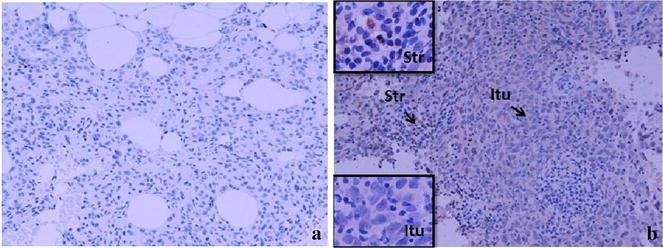
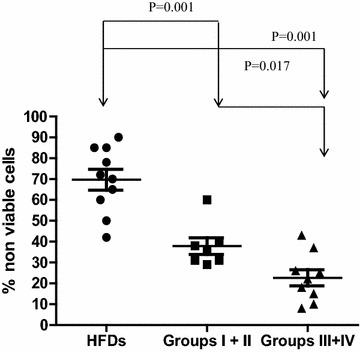
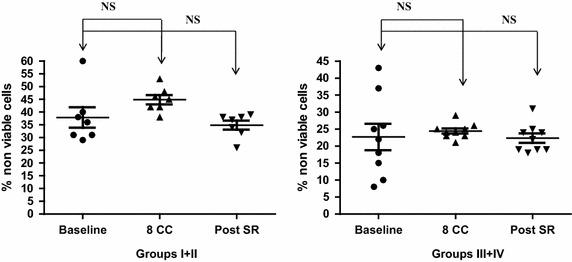
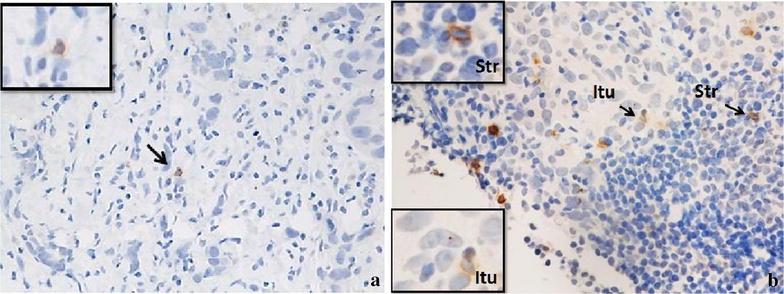
Women with LLABCs had significantly reduced AbNs (160.00 ± 40.00 cells/µl) but not % of NK cells, compared with HFDs (NK: 266.78 ± 55.00 cells/µl; p = 0.020). NAC enhanced the AbN (p = 0.001) and % (p = 0.006) of NK cells in patients with good pathological responses. Granzyme B(+)/perforin(+) cells were significantly reduced (43.41 ± 4.00%), compared with HFDs (60.26 ± 7.00%; p = 0.003). NAC increased the % in good (p = 0.006) and poor (p = 0.005) pathological responders. Pretreatment NK cytotoxicity was significantly reduced in good (37.80 ± 8.05%) and poor (22.80 ± 7.97%) responders (p = 0.001) but remained unchanged following NAC. NK-NKG2D(+) cells were unaltered and unaffected by NAC; NKG2D expression was increased in patients with a pCR (p = 0.001). Surgery following NAC was not beneficial, except in those with a pCR. Tumour-infiltrating NK cells were infrequent but increased peritumourally (p = 0.005) showing a significant correlation (p = 0.004) between CD56(+) cells and grade of response. Tumour cytokines had no effect.
CONCLUSION
Women with LLABCs have inhibited blood innate immunity, variably reversed by NAC (especially with tumour pCRs), which returned to pretreatment levels following surgery. These and in situ tumour findings suggest a role for NK cells in NAC-induced breast pCR.
背景
自然杀伤(NK)细胞通过细胞毒性、细胞因子分泌以及与免疫细胞的相互作用,参与肿瘤监测、抑制肿瘤生长和扩散。它们在人类乳腺癌中的具体作用尚不清楚,且对其治疗效果的研究较少。我们研究的目的是对接受新辅助化疗(NAC)和手术的大体积(≥3 cm)局部晚期(T3 - 4,N1 - 2,M0)乳腺癌(LLABC)女性患者的NK细胞进行特征分析,并确定它们对病理完全缓解(pCR)的可能贡献。
方法
对25例LLABC女性患者和10例健康女性供体(HFD)进行研究。采用既定标准评估乳腺的病理反应。在NAC及手术前后采集血样。通过流式细胞术和标记单克隆抗体确定NK细胞的绝对数量(AbN)和百分比(%),以及表达颗粒酶B/穿孔素和NKG2D的情况。评估体外NK细胞毒性,并使用免疫组织化学技术记录肿瘤中的NK细胞和细胞因子(IL - 2、INF - γ、TGF - β)。数据采用SPSS进行分析。
结果
与HFD相比,LLABC女性患者的AbN显著降低(160.00 ± 40.00个细胞/μl),但NK细胞百分比无差异(HFD:266.78 ± 55.00个细胞/μl;p = 0.020)。NAC使病理反应良好的患者的NK细胞AbN(p = 0.001)和百分比(p = 0.006)增加。与HFD相比,颗粒酶B(+)/穿孔素(+)细胞显著减少(43.41 ± 4.00%)(60.26 ± 7.00%;p = 0.003)。NAC使病理反应良好(p = 0.006)和不良(p = 0.005)的患者的百分比增加。预处理时,病理反应良好(37.80 ± 8.05%)和不良(22.80 ± 7.97%)的患者的NK细胞毒性显著降低(p = 0.001),但NAC后保持不变。NK - NKG2D(+)细胞未改变且不受NAC影响;pCR患者中NKG2D表达增加(p = 0.001)。NAC后手术并无益处,pCR患者除外。肿瘤浸润性NK细胞较少见,但瘤周增加(p = 0.005),CD56(+)细胞与反应程度之间存在显著相关性(p = 0.004)。肿瘤细胞因子无影响。
结论
LLABC女性患者的血液固有免疫受到抑制,NAC可不同程度地逆转(尤其是肿瘤pCR患者),术后又恢复至预处理水平。这些及肿瘤原位发现提示NK细胞在NAC诱导的乳腺pCR中发挥作用。




 Zotero 插件