
噬菌体T4 DNA的共价修饰抑制CRISPR-Cas9。
Covalent Modification of Bacteriophage T4 DNA Inhibits CRISPR-Cas9.
作者信息
Bryson Alexandra L, Hwang Young, Sherrill-Mix Scott, Wu Gary D, Lewis James D, Black Lindsay, Clark Tyson A, Bushman Frederic D
机构信息
Department of Microbiology, University of Pennsylvania School of Medicine, Philadelphia, Pennsylvania, USA.
Division of Gastroenterology, University of Pennsylvania School of Medicine, Philadelphia, Pennsylvania, USA.
出版信息
mBio. 2015 Jun 16;6(3):e00648. doi: 10.1128/mBio.00648-15.
UNLABELLED
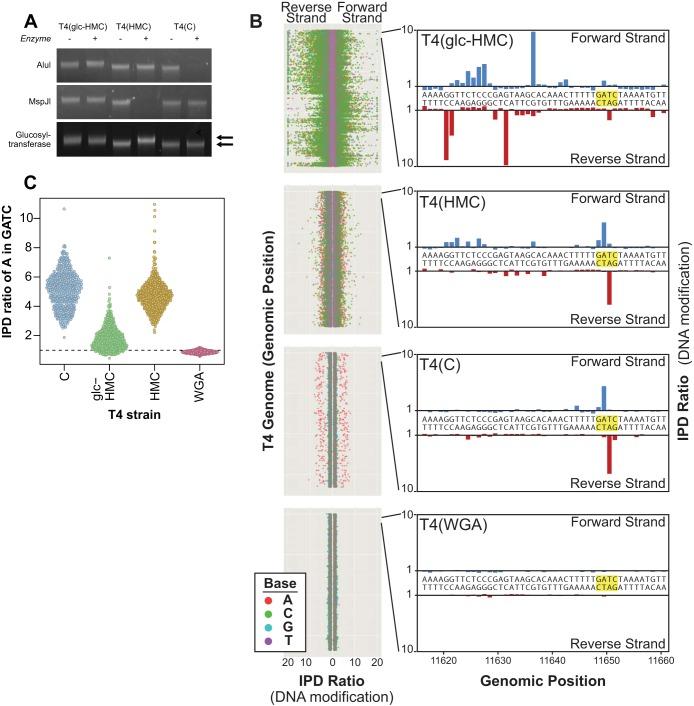
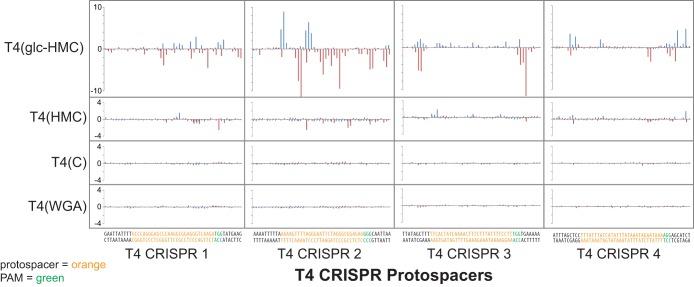
The genomic DNAs of tailed bacteriophages are commonly modified by the attachment of chemical groups. Some forms of DNA modification are known to protect phage DNA from cleavage by restriction enzymes, but others are of unknown function. Recently, the CRISPR-Cas nuclease complexes were shown to mediate bacterial adaptive immunity by RNA-guided target recognition, raising the question of whether phage DNA modifications may also block attack by CRISPR-Cas9. We investigated phage T4 as a model system, where cytosine is replaced with glucosyl-hydroxymethylcytosine (glc-HMC). We first quantified the extent and distribution of covalent modifications in T4 DNA by single-molecule DNA sequencing and enzymatic probing. We then designed CRISPR spacer sequences targeting T4 and found that wild-type T4 containing glc-HMC was insensitive to attack by CRISPR-Cas9 but mutants with unmodified cytosine were sensitive. Phage with HMC showed only intermediate sensitivity. While this work was in progress, another group reported examples of heavily engineered CRISRP-Cas9 complexes that could, in fact, overcome the effects of T4 DNA modification, indicating that modifications can inhibit but do not always fully block attack.
IMPORTANCE
Bacteria were recently found to have a form of adaptive immunity, the CRISPR-Cas systems, which use nucleic acid pairing to recognize and cleave genomic DNA of invaders such as bacteriophage. Historic work with tailed phages has shown that phage DNA is often modified by covalent attachment of large chemical groups. Here we demonstrate that DNA modification in phage T4 inhibits attack by the CRISPR-Cas9 system. This finding provides insight into mechanisms of host-virus competition and also a new set of tools that may be useful in modulating the activity of CRISPR-Cas9 in genome engineering applications.
未标记
有尾噬菌体的基因组DNA通常会通过化学基团的附着而被修饰。已知某些形式的DNA修饰可保护噬菌体DNA不被限制酶切割,但其他修饰的功能尚不清楚。最近,CRISPR-Cas核酸酶复合物被证明可通过RNA引导的靶标识别介导细菌的适应性免疫,这就引发了一个问题,即噬菌体DNA修饰是否也能阻止CRISPR-Cas9的攻击。我们以噬菌体T4为模型系统进行了研究,其中胞嘧啶被葡糖基羟甲基胞嘧啶(glc-HMC)取代。我们首先通过单分子DNA测序和酶促探测来量化T4 DNA中共价修饰的程度和分布。然后,我们设计了靶向T4的CRISPR间隔序列,发现含有glc-HMC的野生型T4对CRISPR-Cas9的攻击不敏感,但胞嘧啶未修饰的突变体则敏感。含有HMC的噬菌体仅表现出中等敏感性。在这项工作进行期间,另一组报道了经过大量改造的CRISRP-Cas9复合物的例子,这些复合物实际上可以克服T4 DNA修饰的影响,这表明修饰可以抑制但并不总是能完全阻止攻击。
重要性
最近发现细菌有一种适应性免疫形式,即CRISPR-Cas系统,它利用核酸配对来识别和切割噬菌体等入侵者的基因组DNA。对有尾噬菌体的历史研究表明,噬菌体DNA经常通过大化学基团的共价附着而被修饰。在这里,我们证明噬菌体T4中的DNA修饰可抑制CRISPR-Cas9系统的攻击。这一发现为宿主-病毒竞争机制提供了见解,也为可能有助于在基因组工程应用中调节CRISPR-Cas9活性的一组新工具提供了依据。


 Zotero 插件