
以蜗牛般的速度移动:秀丽隐杆线虫可能的无脊椎动物传播媒介。
Travelling at a slug's pace: possible invertebrate vectors of Caenorhabditis nematodes.
作者信息
Petersen Carola, Hermann Ruben Joseph, Barg Mike-Christoph, Schalkowski Rebecca, Dirksen Philipp, Barbosa Camilo, Schulenburg Hinrich
机构信息
Department of Evolutionary Ecology and Genetics, Zoological Institute Christian-Albrechts University, Am Botanischen Garten 1-9, 24118, Kiel, Germany.
出版信息
BMC Ecol. 2015 Jul 13;15:19. doi: 10.1186/s12898-015-0050-z.
BACKGROUND
How do very small animals with limited long-distance dispersal abilities move between locations, especially if they prefer ephemeral micro-habitats that are only available for short periods of time? The free-living model nematode Caenorhabditis elegans and several congeneric taxa appear to be common in such short-lived environments, for example decomposing fruits or other rotting plant material. Dispersal is usually assumed to depend on animal vectors, yet all current data is based on only a limited number of studies. In our project we performed three comprehensive field surveys on possible invertebrate vectors in North German locations containing populations of C. elegans and two related species, especially C. remanei, and combined these screens with an experimental analysis of persistence in one of the vector taxa.
RESULTS
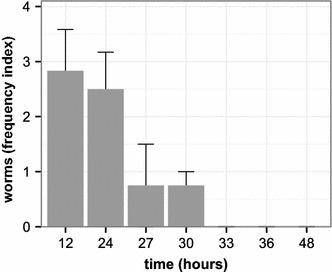
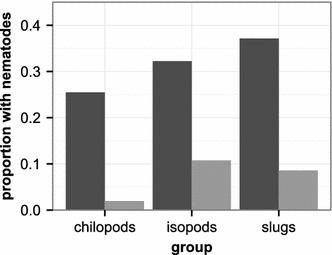
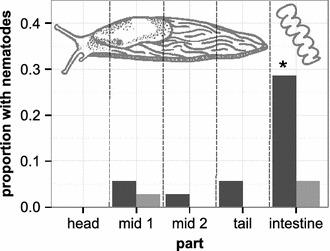
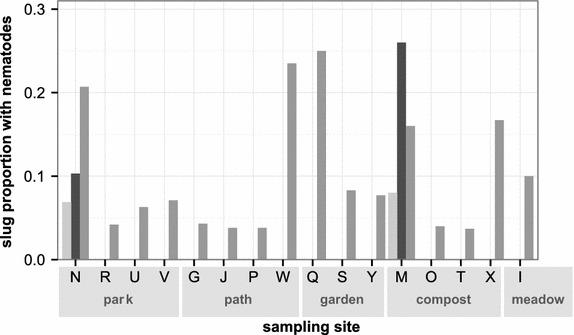
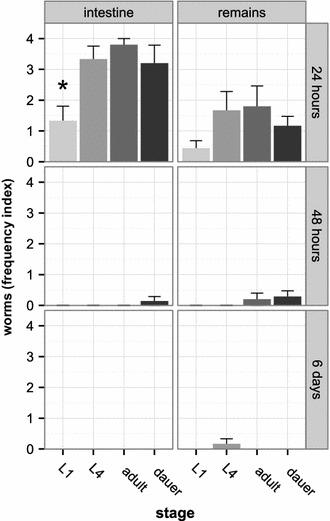
Our field survey revealed that Caenorhabditis nematodes are commonly found in slugs, isopods, and chilopods, but are not present in the remaining taxonomic groups examined. Surprisingly, the nematodes were frequently isolated from the intestines of slugs, even if slugs were not collected in close association with suitable substrates for Caenorhabditis proliferation. This suggests that the nematodes are able to enter the slug intestines and persist for certain periods of time. Our experimental analysis confirmed the ability of C. elegans to invade slug intestines and subsequently be excreted alive with the slug feces, although only for short time periods under laboratory conditions.
CONCLUSIONS
We conclude that three invertebrate taxonomic groups represent potential vectors of Caenorhabditis nematodes. The nematodes appear to have evolved specific adaptations to enter and persist in the harsh environment of slug intestines, possibly indicating first steps towards a parasitic life-style.
背景
具有有限长距离扩散能力的极小的动物如何在不同地点之间移动,尤其是如果它们偏好仅在短时间内可用的短暂微生境呢?自由生活的模式线虫秀丽隐杆线虫和几个同属类群似乎在这种短暂存在的环境中很常见,例如腐烂的果实或其他腐烂的植物材料。通常认为扩散依赖于动物媒介,但目前所有数据仅基于有限数量的研究。在我们的项目中,我们对德国北部含有秀丽隐杆线虫和两个相关物种(尤其是雷氏隐杆线虫)种群的地点的可能无脊椎动物媒介进行了三次全面的实地调查,并将这些筛选与对其中一个媒介类群持久性的实验分析相结合。
结果
我们的实地调查显示,在蛞蝓、等足类动物和唇足类动物中普遍发现了隐杆线虫属线虫,但在所检查的其余分类群中不存在。令人惊讶的是,即使蛞蝓不是与适合秀丽隐杆线虫增殖的底物紧密相关收集的,线虫也经常从蛞蝓的肠道中分离出来。这表明线虫能够进入蛞蝓肠道并在一定时间内持续存在。我们的实验分析证实了秀丽隐杆线虫侵入蛞蝓肠道并随后随蛞蝓粪便存活排出的能力,尽管在实验室条件下仅能存活短时间。
结论
我们得出结论,三个无脊椎动物分类群代表了隐杆线虫属线虫的潜在媒介。线虫似乎已经进化出特定的适应性,以进入并在蛞蝓肠道的恶劣环境中持续存在,这可能表明向寄生生活方式迈出了第一步。
 Zotero 插件