
疟疾高流行国家不同地区间恶性疟原虫选择的基因组特征比较。
Comparison of genomic signatures of selection on Plasmodium falciparum between different regions of a country with high malaria endemicity.
作者信息
Duffy Craig W, Assefa Samuel A, Abugri James, Amoako Nicholas, Owusu-Agyei Seth, Anyorigiya Thomas, MacInnis Bronwyn, Kwiatkowski Dominic P, Conway David J, Awandare Gordon A
机构信息
Pathogen Molecular Biology Department, London School of Hygiene and Tropical Medicine, London, WC1E 7HT, UK.
West African Centre for Cell Biology of Infectious Pathogens (WACCBIP), Department of Biochemistry, Cell and Molecular Biology, University of Ghana, Box LG 54, Volta Road, Legon, Accra, Ghana.
出版信息
BMC Genomics. 2015 Jul 16;16(1):527. doi: 10.1186/s12864-015-1746-3.
BACKGROUND
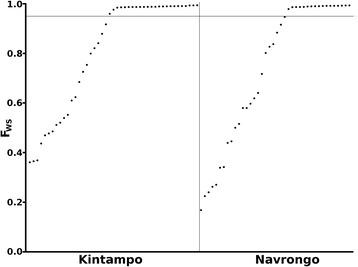
Genome wide sequence analyses of malaria parasites from widely separated areas of the world have identified contrasting population structures and signatures of selection. To compare relatively closely situated but ecologically contrasting regions within an endemic African country, population samples of Plasmodium falciparum clinical isolates were collected in Ghana from Kintampo in the central forest-savannah area, and Navrongo in a drier savannah area ~350 km to the north with more seasonally-restricted transmission. Parasite DNA was sequenced and paired-end reads mapped to the P. falciparum reference genome.
RESULTS
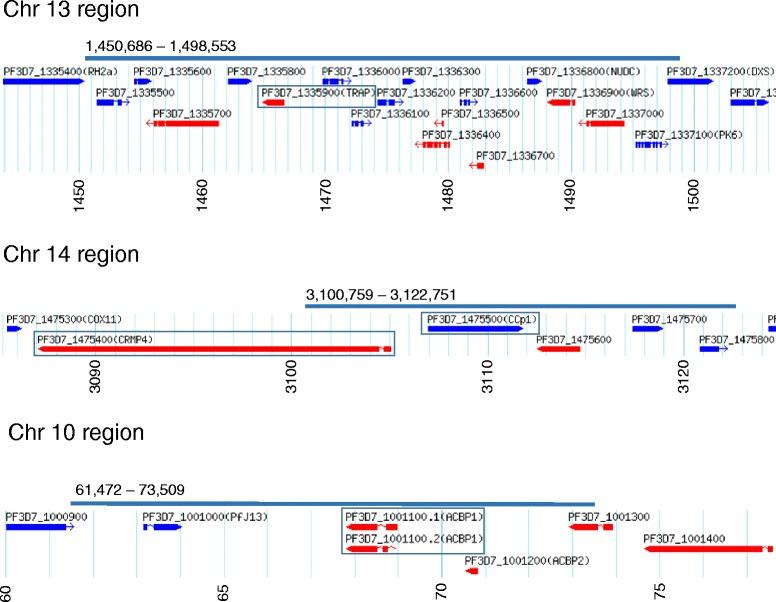
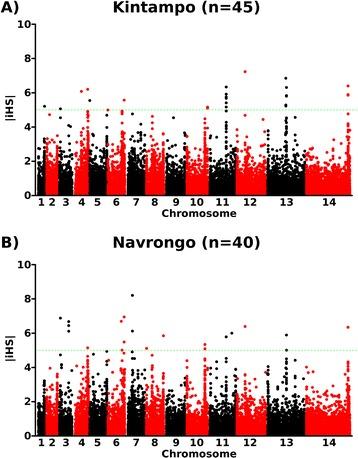
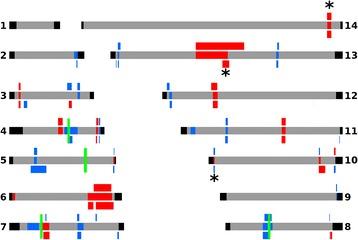
High coverage genome wide sequence data for 85 different clinical isolates enabled analysis of 121,712 single nucleotide polymorphisms (SNPs). The local populations had similar proportions of mixed genotype infections, similar SNP allele frequency distributions, and eleven chromosomal regions had elevated integrated haplotype scores (|iHS|) in both. A between-population Rsb metric comparing extended haplotype homozygosity indicated a stronger signal within Kintampo for one of these regions (on chromosome 14) and in Navrongo for two of these regions (on chromosomes 10 and 13). At least one gene in each of these identified regions is a potential target of locally varying selection. The candidates include genes involved in parasite development in mosquitoes, members of variant-expressed multigene families, and a leading vaccine-candidate target of immunity.
CONCLUSIONS
Against a background of very similar population structure and selection signatures in the P. falciparum populations of Ghana, three narrow genomic regions showed evidence indicating local differences in historical timing or intensity of selection. Sampling of closely situated populations across heterogeneous environments has potential to refine the mapping of important loci under temporally or spatially varying selection.
背景
对来自世界广泛分隔地区的疟原虫进行全基因组序列分析,已确定了不同的种群结构和选择特征。为了比较一个非洲疟疾流行国家内位置相对较近但生态环境不同的地区,在加纳从中央森林 - 草原地区的金坦波以及北部约350公里处较干燥的草原地区纳夫龙戈收集了恶性疟原虫临床分离株的种群样本,该地区传播季节性更强。对寄生虫DNA进行测序,并将双末端读数映射到恶性疟原虫参考基因组。
结果
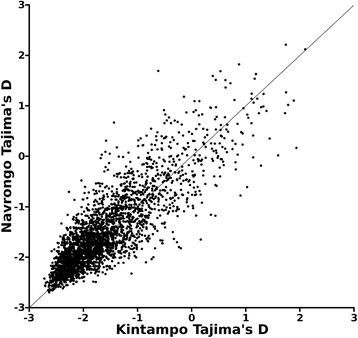
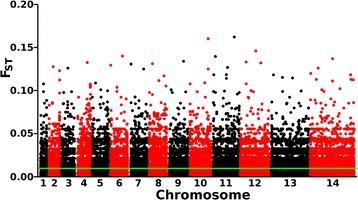
85种不同临床分离株的高覆盖全基因组序列数据,使得能够分析121,712个单核苷酸多态性(SNP)。当地种群具有相似比例的混合基因型感染、相似的SNP等位基因频率分布,并且在两个地区中11个染色体区域的综合单倍型得分(|iHS|)均有所升高。比较扩展单倍型纯合性的种群间Rsb指标表明,其中一个区域(位于14号染色体上)在金坦波内信号更强,另外两个区域(位于10号和13号染色体上)在纳夫龙戈内信号更强。在这些确定的区域中,每个区域至少有一个基因是局部不同选择的潜在靶点。候选基因包括参与疟原虫在蚊子体内发育的基因、可变表达多基因家族的成员以及一个主要的免疫疫苗候选靶点。
结论
在加纳恶性疟原虫种群中非常相似的种群结构和选择特征背景下,三个狭窄的基因组区域显示出证据,表明在选择的历史时间或强度上存在局部差异。在异质环境中对位置相近的种群进行采样,有可能完善在时间或空间上变化的选择作用下重要基因座的定位。


 Zotero 插件