
吸烟及降低吸烟率的经济影响:证据综述
The Economic Impact of Smoking and of Reducing Smoking Prevalence: Review of Evidence.
作者信息
Ekpu Victor U, Brown Abraham K
机构信息
Adam Smith Business School (Economics Division), University of Glasgow, Glasgow, UK.
Nottingham Business School (Marketing Division), Nottingham Trent University, Nottingham, UK.
出版信息
Tob Use Insights. 2015 Jul 14;8:1-35. doi: 10.4137/TUI.S15628. eCollection 2015.
BACKGROUND
Tobacco smoking is the cause of many preventable diseases and premature deaths in the UK and around the world. It poses enormous health- and non-health-related costs to the affected individuals, employers, and the society at large. The World Health Organization (WHO) estimates that, globally, smoking causes over US$500 billion in economic damage each year.
OBJECTIVES
This paper examines global and UK evidence on the economic impact of smoking prevalence and evaluates the effectiveness and cost effectiveness of smoking cessation measures.
STUDY SELECTION
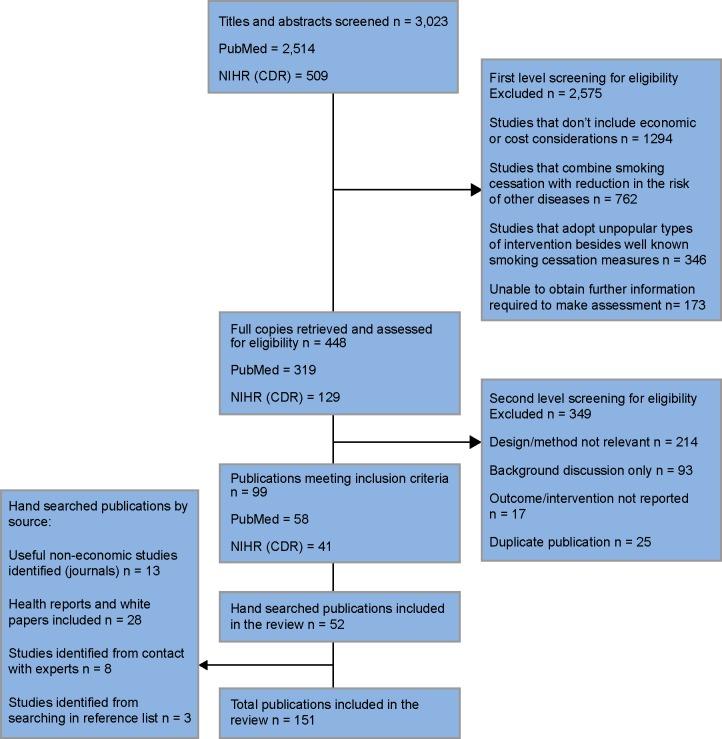
SEARCH METHODS We used two major health care/economic research databases, namely PubMed and the National Institute for Health Research (NIHR) database that contains the British National Health Service (NHS) Economic Evaluation Database; Cochrane Library of systematic reviews in health care and health policy; and other health-care-related bibliographic sources. We also performed hand searching of relevant articles, health reports, and white papers issued by government bodies, international health organizations, and health intervention campaign agencies. SELECTION CRITERIA The paper includes cost-effectiveness studies from medical journals, health reports, and white papers published between 1992 and July 2014, but included only eight relevant studies before 1992. Most of the papers reviewed reported outcomes on smoking prevalence, as well as the direct and indirect costs of smoking and the costs and benefits of smoking cessation interventions. We excluded papers that merely described the effectiveness of an intervention without including economic or cost considerations. We also excluded papers that combine smoking cessation with the reduction in the risk of other diseases. DATA COLLECTION AND ANALYSIS The included studies were assessed against criteria indicated in the Cochrane Reviewers Handbook version 5.0.0. OUTCOMES ASSESSED IN THE REVIEWPrimary outcomes of the selected studies are smoking prevalence, direct and indirect costs of smoking, and the costs and benefits of smoking cessation interventions (eg, "cost per quitter", "cost per life year saved", "cost per quality-adjusted life year gained," "present value" or "net benefits" from smoking cessation, and "cost savings" from personal health care expenditure).
MAIN RESULTS
The main findings of this study are as follows: The costs of smoking can be classified into direct, indirect, and intangible costs. About 15% of the aggregate health care expenditure in high-income countries can be attributed to smoking. In the US, the proportion of health care expenditure attributable to smoking ranges between 6% and 18% across different states. In the UK, the direct costs of smoking to the NHS have been estimated at between £2.7 billion and £5.2 billion, which is equivalent to around 5% of the total NHS budget each year. The economic burden of smoking estimated in terms of GDP reveals that smoking accounts for approximately 0.7% of China's GDP and approximately 1% of US GDP. As part of the indirect (non-health-related) costs of smoking, the total productivity losses caused by smoking each year in the US have been estimated at US$151 billion.The costs of smoking notwithstanding, it produces some potential economic benefits. The economic activities generated from the production and consumption of tobacco provides economic stimulus. It also produces huge tax revenues for most governments, especially in high-income countries, as well as employment in the tobacco industry. Income from the tobacco industry accounts for up to 7.4% of centrally collected government revenue in China. Smoking also yields cost savings in pension payments from the premature death of smokers.Smoking cessation measures could range from pharmacological treatment interventions to policy-based measures, community-based interventions, telecoms, media, and technology (TMT)-based interventions, school-based interventions, and workplace interventions.The cost per life year saved from the use of pharmacological treatment interventions ranged between US$128 and US$1,450 and up to US$4,400 per quality-adjusted life years (QALYs) saved. The use of pharmacotherapies such as varenicline, NRT, and Bupropion, when combined with GP counseling or other behavioral treatment interventions (such as proactive telephone counseling and Web-based delivery), is both clinically effective and cost effective to primary health care providers.Price-based policy measures such as increase in tobacco taxes are unarguably the most effective means of reducing the consumption of tobacco. A 10% tax-induced cigarette price increase anywhere in the world reduces smoking prevalence by between 4% and 8%. Net public benefits from tobacco tax, however, remain positive only when tax rates are between 42.9% and 91.1%. The cost effectiveness ratio of implementing non-price-based smoking cessation legislations (such as smoking restrictions in work places, public places, bans on tobacco advertisement, and raising the legal age of smokers) range from US$2 to US$112 per life year gained (LYG) while reducing smoking prevalence by up to 30%-82% in the long term (over a 50-year period).Smoking cessation classes are known to be most effective among community-based measures, as they could lead to a quit rate of up to 35%, but they usually incur higher costs than other measures such as self-help quit-smoking kits. On average, community pharmacist-based smoking cessation programs yield cost savings to the health system of between US$500 and US$614 per LYG.Advertising media, telecommunications, and other technology-based interventions (such as TV, radio, print, telephone, the Internet, PC, and other electronic media) usually have positive synergistic effects in reducing smoking prevalence especially when combined to deliver smoking cessation messages and counseling support. However, the outcomes on the cost effectiveness of TMT-based measures have been inconsistent, and this made it difficult to attribute results to specific media. The differences in reported cost effectiveness may be partly attributed to varying methodological approaches including varying parametric inputs, differences in national contexts, differences in advertising campaigns tested on different media, and disparate levels of resourcing between campaigns. Due to its universal reach and low implementation costs, online campaign appears to be substantially more cost effective than other media, though it may not be as effective in reducing smoking prevalence.School-based smoking prevalence programs tend to reduce short-term smoking prevalence by between 30% and 70%. Total intervention costs could range from US$16,400 to US$580,000 depending on the scale and scope of intervention. The cost effectiveness of school-based programs show that one could expect a saving of approximately between US$2,000 and US$20,000 per QALY saved due to averted smoking after 2-4 years of follow-up.Workplace-based interventions could represent a sound economic investment to both employers and the society at large, achieving a benefit-cost ratio of up to 8.75 and generating 12-month employer cost savings of between $150 and $540 per nonsmoking employee. Implementing smoke-free workplaces would also produce myriads of new quitters and reduce the amount of cigarette consumption, leading to cost savings in direct medical costs to primary health care providers. Workplace interventions are, however, likely to yield far greater economic benefits over the long term, as reduced prevalence will lead to a healthier and more productive workforce.
CONCLUSIONS
We conclude that the direct costs and externalities to society of smoking far outweigh any benefits that might be accruable at least when considered from the perspective of socially desirable outcomes (ie, in terms of a healthy population and a productive workforce). There are enormous differences in the application and economic measurement of smoking cessation measures across various types of interventions, methodologies, countries, economic settings, and health care systems, and these may have affected the comparability of the results of the studies reviewed. However, on the balance of probabilities, most of the cessation measures reviewed have not only proved effective but also cost effective in delivering the much desired cost savings and net gains to individuals and primary health care providers.
背景
在英国及全球范围内,吸烟是许多可预防疾病和过早死亡的原因。它给受影响的个人、雇主以及整个社会带来了巨大的健康和非健康相关成本。世界卫生组织(WHO)估计,在全球范围内,吸烟每年造成超过5000亿美元的经济损失。
目的
本文研究全球及英国关于吸烟流行率经济影响的证据,并评估戒烟措施的有效性和成本效益。
研究选择
搜索方法 我们使用了两个主要的医疗保健/经济研究数据库,即PubMed和包含英国国家医疗服务体系(NHS)经济评估数据库的国家卫生研究院(NIHR)数据库;医疗保健和卫生政策系统评价的Cochrane图书馆;以及其他与医疗保健相关的文献来源。我们还对手动检索政府机构、国际卫生组织和健康干预运动机构发布的相关文章、健康报告和白皮书。选择标准 本文纳入了1992年至2014年7月期间医学期刊、健康报告和白皮书中的成本效益研究,但1992年之前仅纳入了八项相关研究。大多数综述论文报告了吸烟流行率、吸烟的直接和间接成本以及戒烟干预措施的成本和效益等结果。我们排除了仅描述干预措施有效性而未包括经济或成本考虑因素的论文。我们还排除了将戒烟与降低其他疾病风险相结合的论文。数据收集与分析 纳入的研究根据Cochrane系统评价员手册5.0.0版中指出的标准进行评估。综述中评估的结果 所选研究的主要结果是吸烟流行率、吸烟的直接和间接成本以及戒烟干预措施的成本和效益(例如,“每位戒烟者的成本”、“每挽救生命年的成本”、“每获得质量调整生命年的成本”、“戒烟的现值”或“净效益”以及个人医疗保健支出的“成本节约”)。
主要结果
本研究的主要发现如下:吸烟成本可分为直接成本、间接成本和无形成本。在高收入国家,约15%的医疗保健总支出可归因于吸烟。在美国,不同州吸烟导致的医疗保健支出比例在6%至18%之间。在英国,吸烟给NHS带来的直接成本估计在27亿至52亿英镑之间,约占NHS每年总预算的5%。以GDP衡量的吸烟经济负担表明,吸烟约占中国GDP的0.7%,约占美国GDP的1%。作为吸烟间接(非健康相关)成本的一部分,美国每年因吸烟造成的总生产力损失估计为1510亿美元。尽管吸烟有成本,但它也产生了一些潜在的经济效益。烟草生产和消费产生的经济活动提供了经济刺激。它还为大多数政府,特别是高收入国家的政府带来了巨额税收收入,以及烟草行业的就业机会。烟草行业的收入在中国中央政府税收中占比高达7.4%。吸烟还因吸烟者过早死亡而在养老金支付方面产生成本节约。戒烟措施的范围可以从药物治疗干预到基于政策的措施、基于社区的干预、电信、媒体和技术(TMT)干预、基于学校的干预和工作场所干预。使用药物治疗干预措施每挽救一个生命年的成本在128美元至1450美元之间,每获得一个质量调整生命年(QALY)的成本高达4400美元。使用伐尼克兰、NRT和安非他酮等药物疗法,再结合全科医生咨询或其他行为治疗干预措施(如主动电话咨询和基于网络的服务),对初级卫生保健提供者来说在临床上既有效又具有成本效益。提高烟草税等基于价格的政策措施无疑是减少烟草消费最有效的手段。在世界任何地方,因税收导致香烟价格上涨10%,吸烟流行率可降低4%至8%。然而,只有当税率在42.9%至91.1%之间时,烟草税的净公共效益才保持为正。实施非价格型戒烟立法(如工作场所、公共场所吸烟限制、禁止烟草广告以及提高吸烟者法定年龄)的成本效益比为每获得一个生命年(LYG)2美元至112美元,同时从长期来看(50年期间)可将吸烟流行率降低30% - 82%。已知戒烟课程在基于社区的措施中最有效,因为它们可导致高达35%的戒烟率,但它们通常比其他措施(如自助戒烟工具包)成本更高。平均而言,基于社区药剂师的戒烟计划可为卫生系统带来每LYG 500美元至614美元的成本节约。广告媒体、电信和其他基于技术的干预措施(如电视、广播、印刷品、电话、互联网、个人电脑和其他电子媒体)在降低吸烟流行率方面通常具有积极的协同效应,特别是当结合起来传递戒烟信息和咨询支持时。然而,基于TMT措施的成本效益结果并不一致,这使得难以将结果归因于特定媒体。报告的成本效益差异可能部分归因于不同的方法学方法,包括不同的参数输入、国家背景差异、在不同媒体上测试的广告活动差异以及活动之间的资源配置水平差异。由于其广泛覆盖和低实施成本,在线活动似乎比其他媒体在成本效益上要高得多,尽管它在降低吸烟流行率方面可能不那么有效。基于学校的吸烟流行率计划往往能在短期内将吸烟流行率降低30%至70%。总干预成本可能在16400美元至580000美元之间,具体取决于干预的规模和范围。基于学校计划的成本效益表明,经过2至4年的随访,由于避免吸烟,每获得一个QALY可节省约2000美元至20000美元。基于工作场所的干预措施对雇主和整个社会来说可能是一项合理的经济投资,效益成本比高达8.75,每位非吸烟员工可为雇主节省12个月的成本150美元至540美元。实施无烟工作场所还将产生大量新的戒烟者并减少香烟消费量,从而为初级卫生保健提供者节省直接医疗成本。然而,从长期来看,工作场所干预措施可能会带来更大的经济效益,因为吸烟流行率的降低将带来更健康、生产力更高的劳动力。
结论
我们得出结论,吸烟对社会的直接成本和外部性远远超过任何可能产生的益处,至少从社会期望的结果(即健康的人口和高生产力的劳动力)角度考虑是这样。在各种类型的干预措施、方法学、国家、经济环境和医疗保健系统中,戒烟措施的应用和经济衡量存在巨大差异,这些差异可能影响了所审查研究结果的可比性。然而,根据可能性的权衡,大多数所审查的戒烟措施不仅已证明有效,而且在为个人和初级卫生保健提供者带来预期的成本节约和净收益方面具有成本效益。

 Zotero 插件