
对1型糖尿病患者进行全基因组DNA甲基化分析,确定了与增殖性糖尿病视网膜病变相关的表观遗传修饰。
Genome-wide analysis of DNA methylation in subjects with type 1 diabetes identifies epigenetic modifications associated with proliferative diabetic retinopathy.
作者信息
Agardh Elisabet, Lundstig Annika, Perfilyev Alexander, Volkov Petr, Freiburghaus Tove, Lindholm Eero, Rönn Tina, Agardh Carl-David, Ling Charlotte
机构信息
Department of Clinical Sciences, Ophthalmology, Lund University, Scania University Hospital, 205 02, Malmö, Sweden.
Department of Clinical Sciences, Epigenetics and Diabetes Unit, Lund University Diabetes Centre, CRC, Scania University Hospital, 205 02, Malmö, Sweden.
出版信息
BMC Med. 2015 Aug 6;13:182. doi: 10.1186/s12916-015-0421-5.
BACKGROUND
Epigenetic variation has been linked to several human diseases. Proliferative diabetic retinopathy (PDR) is a major cause of vision loss in subjects with diabetes. However, studies examining the association between PDR and the genome-wide DNA methylation pattern are lacking. Our aim was to identify epigenetic modifications that associate with and predict PDR in subjects with type 1 diabetes (T1D).
METHODS
DNA methylation was analyzed genome-wide in 485,577 sites in blood from cases with PDR (n = 28), controls (n = 30), and in a prospective cohort (n = 7). False discovery rate analysis was used to correct the data for multiple testing. Study participants with T1D diagnosed before 30 years of age and insulin treatment within 1 year from diagnosis were selected based on 1) subjects classified as having PDR (cases) and 2) subjects with T1D who had had diabetes for at least 10 years when blood DNA was sampled and classified as having no/mild diabetic retinopathy also after an 8.7-year follow-up (controls). DNA methylation was also analyzed in a prospective cohort including seven subjects with T1D who had no/mild diabetic retinopathy when blood samples were taken, but who developed PDR within 6.3 years (converters). The retinopathy level was classified by fundus photography.
RESULTS
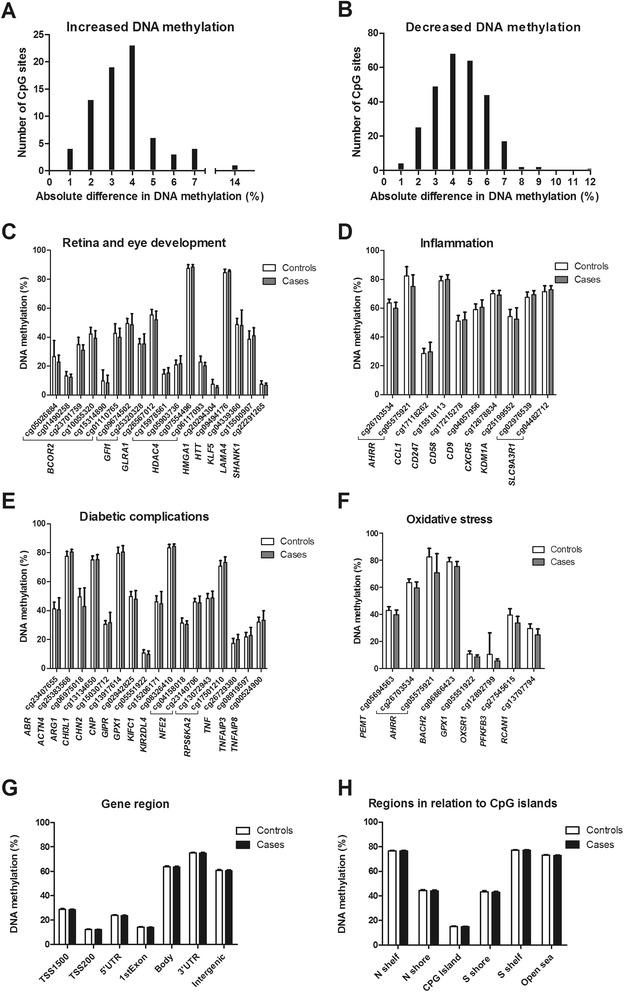
We identified differential DNA methylation of 349 CpG sites representing 233 unique genes including TNF, CHI3L1 (also known as YKL-40), CHN2, GIPR, GLRA1, GPX1, AHRR, and BCOR in cases with PDR compared with controls. The majority of these sites (79 %) showed decreased DNA methylation in cases with PDR. The Natural Killer cell-mediated cytotoxicity pathway was found to be significantly (P = 0.006) enriched among differentially methylated genes in cases with PDR. We also identified differential DNA methylation of 28 CpG sites representing 17 genes (e.g. AHRR, GIPR, GLRA1, and BCOR) with P <0.05 in the prospective cohort, which is more than expected by chance (P = 0.0096).
CONCLUSIONS
Subjects with T1D and PDR exhibit altered DNA methylation patterns in blood. Some of these epigenetic changes may predict the development of PDR, suggesting that DNA methylation may be used as a prospective marker of PDR.
背景
表观遗传变异与多种人类疾病相关。增殖性糖尿病视网膜病变(PDR)是糖尿病患者视力丧失的主要原因。然而,缺乏关于PDR与全基因组DNA甲基化模式之间关联的研究。我们的目的是确定与1型糖尿病(T1D)患者的PDR相关并可预测PDR的表观遗传修饰。
方法
对PDR患者(n = 28)、对照者(n = 30)的血液以及一个前瞻性队列(n = 7)中的485,577个位点进行全基因组DNA甲基化分析。采用错误发现率分析对多重检验的数据进行校正。入选30岁前诊断为T1D且诊断后1年内接受胰岛素治疗的研究参与者,基于1)被分类为患有PDR的受试者(病例)和2)在采集血液DNA时患有糖尿病至少10年且在8.7年随访后也被分类为无/轻度糖尿病视网膜病变的T1D受试者(对照)。还对一个前瞻性队列进行了DNA甲基化分析,该队列包括7名T1D受试者,他们在采集血样时无/轻度糖尿病视网膜病变,但在6.3年内发展为PDR(转变者)。通过眼底摄影对视网膜病变程度进行分类。
结果
与对照相比,我们在PDR患者中鉴定出349个CpG位点的DNA甲基化差异,这些位点代表233个独特基因,包括TNF、CHI3L1(也称为YKL - 40)、CHN2、GIPR、GLRA1、GPX1、AHRR和BCOR。这些位点中的大多数(79%)在PDR患者中显示DNA甲基化降低。发现自然杀伤细胞介导的细胞毒性途径在PDR患者的差异甲基化基因中显著富集(P = 0.006)。我们还在前瞻性队列中鉴定出28个CpG位点的DNA甲基化差异,这些位点代表17个基因(如AHRR、GIPR、GLRA1和BCOR),P <0.05,这比偶然预期的更多(P = 0.0096)。
结论
患有T1D和PDR的受试者血液中的DNA甲基化模式发生改变。其中一些表观遗传变化可能预测PDR的发展,表明DNA甲基化可用作PDR的前瞻性标志物。
 Zotero 插件