
概率分类任务中试验顺序对从奖励与惩罚中学习的影响:实验与计算分析
The influence of trial order on learning from reward vs. punishment in a probabilistic categorization task: experimental and computational analyses.
作者信息
Moustafa Ahmed A, Gluck Mark A, Herzallah Mohammad M, Myers Catherine E
机构信息
School of Social Sciences and Psychology and Marcs Institute for Brain and Behaviour, University of Western Sydney Sydney, NSW, Australia ; Department of Veterans Affairs, New Jersey Health Care System East Orange, NJ, USA.
Center for Molecular and Behavioral Neuroscience, Rutgers University Newark, NJ, USA.
出版信息
Front Behav Neurosci. 2015 Jul 24;9:153. doi: 10.3389/fnbeh.2015.00153. eCollection 2015.
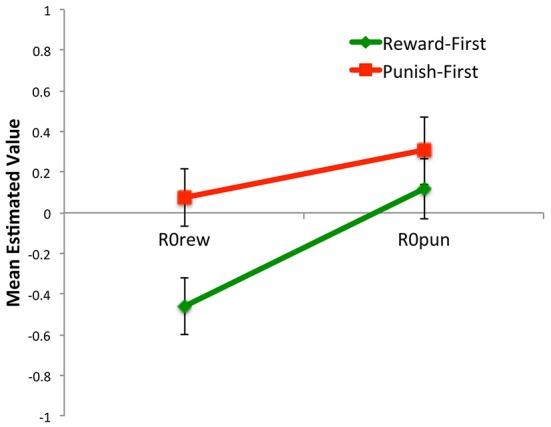
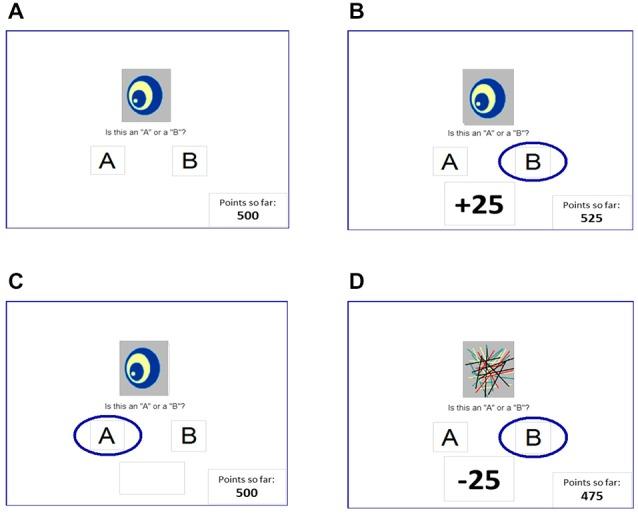
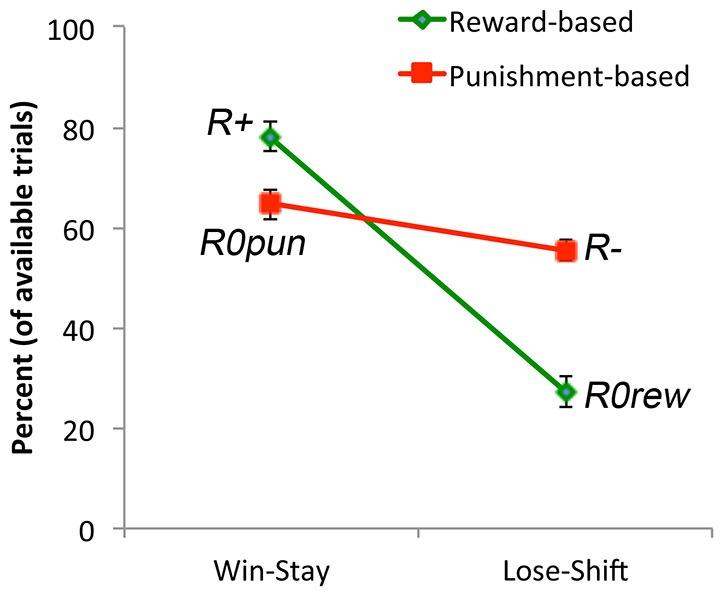
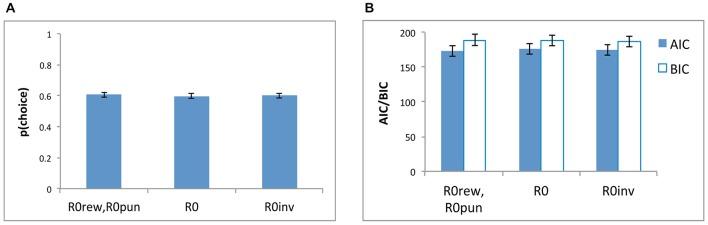
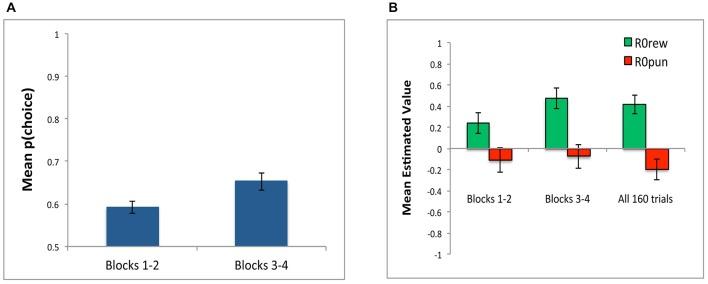
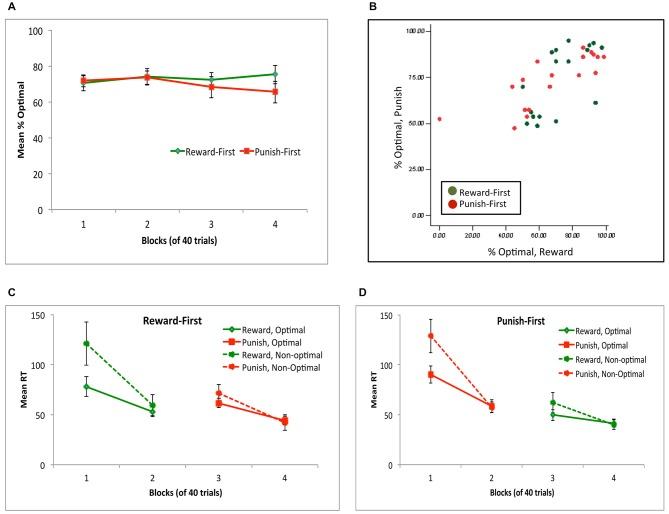
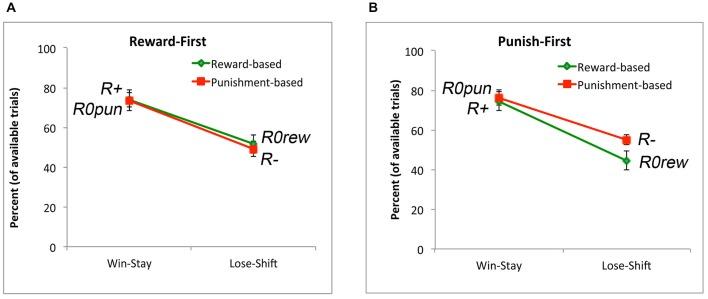
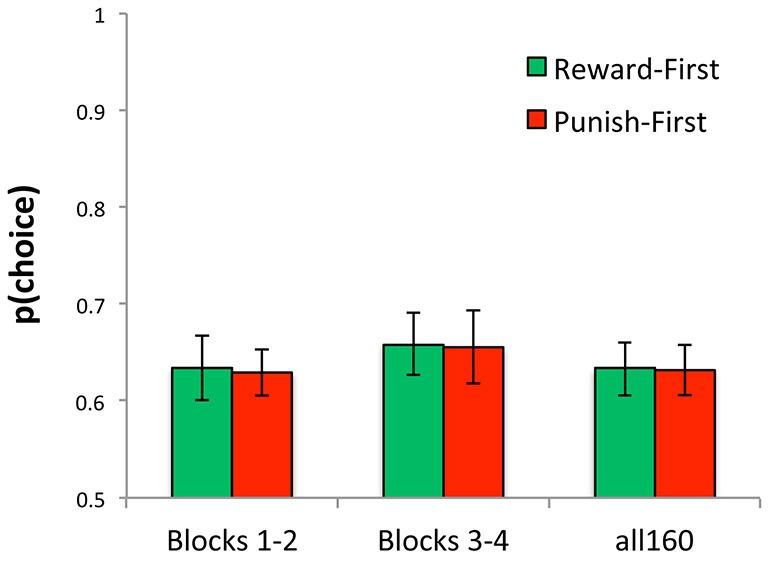
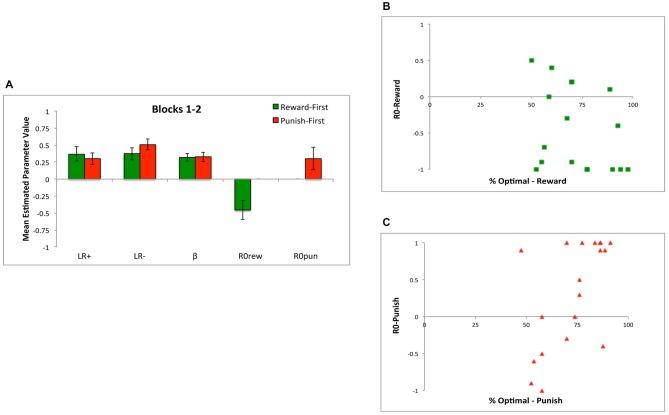
Previous research has shown that trial ordering affects cognitive performance, but this has not been tested using category-learning tasks that differentiate learning from reward and punishment. Here, we tested two groups of healthy young adults using a probabilistic category learning task of reward and punishment in which there are two types of trials (reward, punishment) and three possible outcomes: (1) positive feedback for correct responses in reward trials; (2) negative feedback for incorrect responses in punishment trials; and (3) no feedback for incorrect answers in reward trials and correct answers in punishment trials. Hence, trials without feedback are ambiguous, and may represent either successful avoidance of punishment or failure to obtain reward. In Experiment 1, the first group of subjects received an intermixed task in which reward and punishment trials were presented in the same block, as a standard baseline task. In Experiment 2, a second group completed the separated task, in which reward and punishment trials were presented in separate blocks. Additionally, in order to understand the mechanisms underlying performance in the experimental conditions, we fit individual data using a Q-learning model. Results from Experiment 1 show that subjects who completed the intermixed task paradoxically valued the no-feedback outcome as a reinforcer when it occurred on reinforcement-based trials, and as a punisher when it occurred on punishment-based trials. This is supported by patterns of empirical responding, where subjects showed more win-stay behavior following an explicit reward than following an omission of punishment, and more lose-shift behavior following an explicit punisher than following an omission of reward. In Experiment 2, results showed similar performance whether subjects received reward-based or punishment-based trials first. However, when the Q-learning model was applied to these data, there were differences between subjects in the reward-first and punishment-first conditions on the relative weighting of neutral feedback. Specifically, early training on reward-based trials led to omission of reward being treated as similar to punishment, but prior training on punishment-based trials led to omission of reward being treated more neutrally. This suggests that early training on one type of trials, specifically reward-based trials, can create a bias in how neutral feedback is processed, relative to those receiving early punishment-based training or training that mixes positive and negative outcomes.
先前的研究表明,试验顺序会影响认知表现,但尚未使用区分学习与奖惩的类别学习任务对此进行测试。在此,我们使用一种奖惩概率类别学习任务对两组健康的年轻成年人进行了测试,该任务中有两种类型的试验(奖励、惩罚)以及三种可能的结果:(1)奖励试验中正确反应的积极反馈;(2)惩罚试验中错误反应的消极反馈;(3)奖励试验中错误答案以及惩罚试验中正确答案的无反馈。因此,无反馈的试验具有模糊性,可能代表成功避免惩罚或未能获得奖励。在实验1中,第一组受试者接受了一种混合任务,其中奖励和惩罚试验在同一块中呈现,作为标准基线任务。在实验2中,第二组完成了分离任务,其中奖励和惩罚试验在单独的块中呈现。此外,为了理解实验条件下表现的潜在机制,我们使用Q学习模型拟合个体数据。实验1的结果表明,完成混合任务的受试者自相矛盾地将无反馈结果在基于强化的试验中出现时视为强化物,而在基于惩罚的试验中出现时视为惩罚物。这得到了经验性反应模式的支持,即受试者在明确奖励后比在未受惩罚后表现出更多的赢留行为,在明确惩罚后比在未获奖励后表现出更多的输移行为。在实验2中,结果表明无论受试者先接受基于奖励还是基于惩罚的试验,表现都相似。然而,当将Q学习模型应用于这些数据时,在奖励优先和惩罚优先条件下,受试者在中性反馈的相对权重方面存在差异。具体而言,基于奖励试验的早期训练导致未获奖励被视为与惩罚相似,但基于惩罚试验的先前训练导致未获奖励被更中性地对待。这表明相对于接受早期基于惩罚的训练或混合了积极和消极结果的训练的受试者,一种类型试验(特别是基于奖励的试验)的早期训练会在处理中性反馈的方式上产生偏差。



 Zotero 插件