
醛脱氢酶7A1识别底物的结构基础
Structural Basis of Substrate Recognition by Aldehyde Dehydrogenase 7A1.
作者信息
Luo Min, Tanner John J
机构信息
Department of Chemistry, University of Missouri-Columbia , Columbia, Missouri 65211, United States.
Department of Biochemistry, University of Missouri-Columbia , Columbia, Missouri 65211, United States.
出版信息
Biochemistry. 2015 Sep 8;54(35):5513-22. doi: 10.1021/acs.biochem.5b00754. Epub 2015 Aug 19.
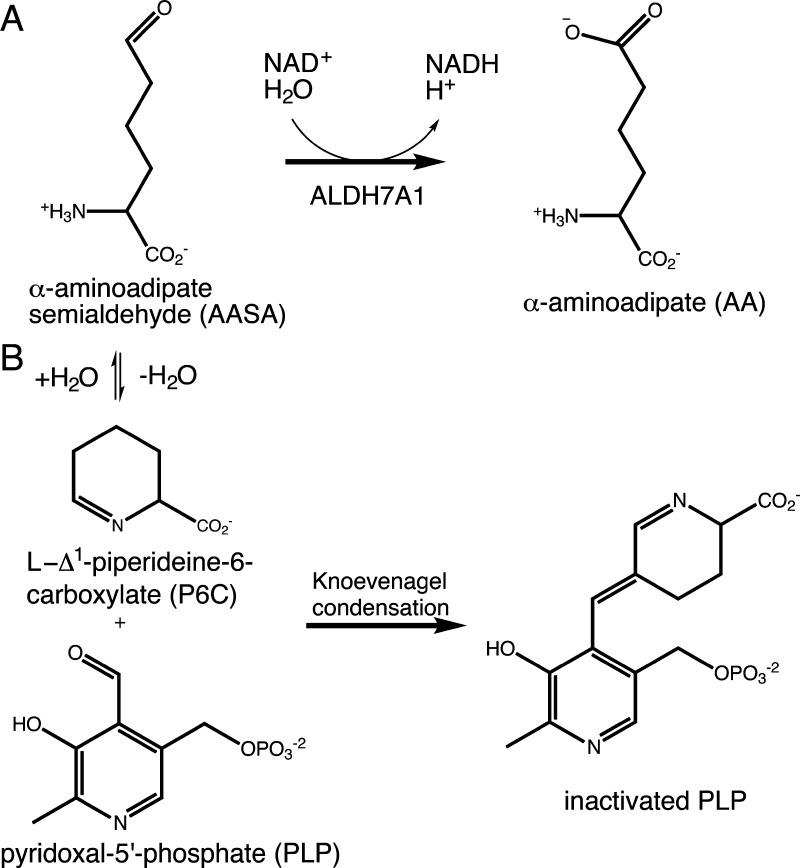
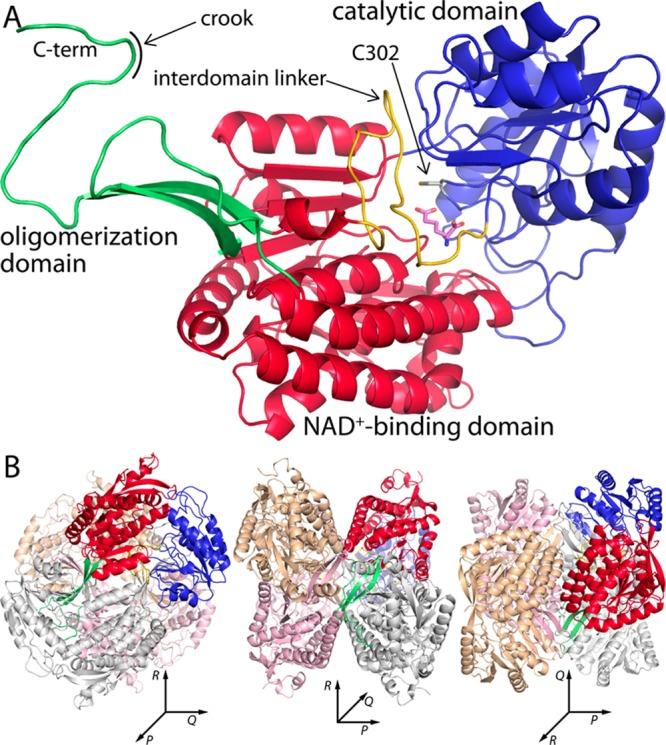
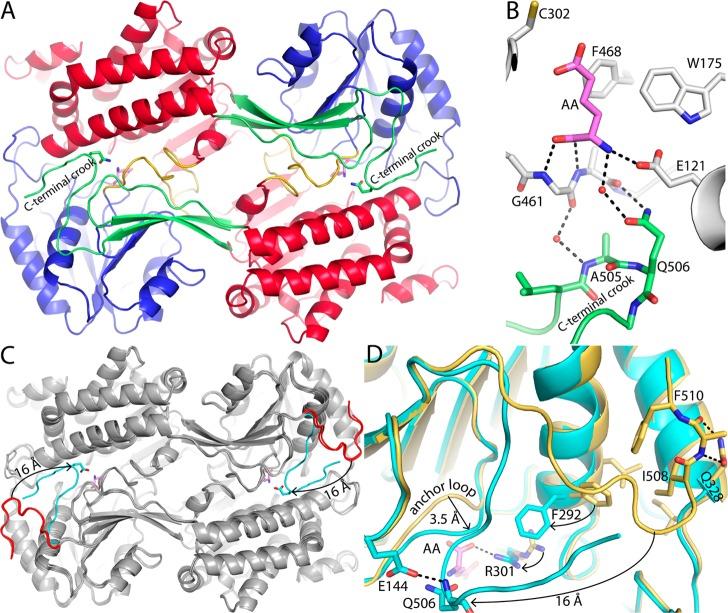
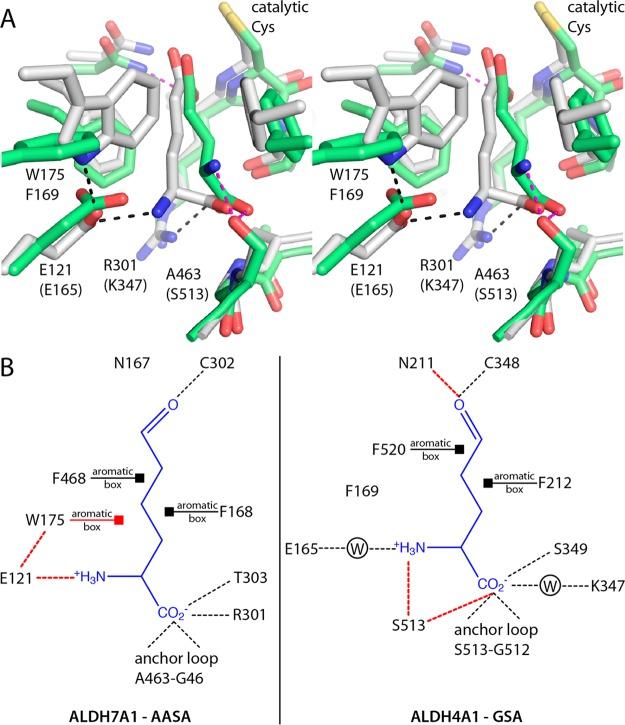
Aldehyde dehydrogenase 7A1 (ALDH7A1) is part of lysine catabolism and catalyzes the NAD(+)-dependent oxidation of α-aminoadipate semialdehyde to α-aminoadipate. Herein, we describe a structural study of human ALDH7A1 focused on substrate recognition. Five crystal structures and small-angle X-ray scattering data are reported, including the first crystal structure of any ALDH7 family member complexed with α-aminoadipate. The product binds with the ε-carboxylate in the oxyanion hole, the aliphatic chain packed into an aromatic box, and the distal end of the product anchored by electrostatic interactions with five conserved residues. This binding mode resembles that of glutamate bound to the proline catabolic enzyme ALDH4A1. Analysis of ALDH7A1 and ALDH4A1 structures suggests key interactions that underlie substrate discrimination. Structures of apo ALDH7A1 reveal dramatic conformational differences from the product complex. Product binding is associated with a 16 Å movement of the C-terminus into the active site, which stabilizes the active conformation of the aldehyde substrate anchor loop. The fact that the C-terminus is part of the active site was hitherto unknown. Interestingly, the C-terminus and aldehyde anchor loop are disordered in a new tetragonal crystal form of the apoenzyme, implying that these parts of the enzyme are highly flexible. Our results suggest that the active site of ALDH7A1 is disassembled when the aldehyde site is vacant, and the C-terminus is a mobile element that forms quaternary structural interactions that aid aldehyde binding. These results are relevant to the c.1512delG genetic deletion associated with pyridoxine-dependent epilepsy, which alters the C-terminus of ALDH7A1.
醛脱氢酶7A1(ALDH7A1)是赖氨酸分解代谢的一部分,催化α-氨基己二酸半醛依赖NAD(+)氧化为α-氨基己二酸。在此,我们描述了一项针对人ALDH7A1的结构研究,重点是底物识别。报告了五个晶体结构和小角X射线散射数据,包括任何ALDH7家族成员与α-氨基己二酸复合的首个晶体结构。产物与氧阴离子孔中的ε-羧酸盐结合,脂肪链堆积在芳香盒中,产物的远端通过与五个保守残基的静电相互作用锚定。这种结合模式类似于谷氨酸与脯氨酸分解代谢酶ALDH4A1的结合模式。对ALDH7A1和ALDH4A1结构的分析表明了底物区分的关键相互作用。无配体ALDH7A1的结构显示出与产物复合物显著的构象差异。产物结合伴随着C末端向活性位点移动16 Å,这稳定了醛底物锚定环的活性构象。C末端是活性位点的一部分这一事实迄今未知。有趣的是,在脱辅基酶的一种新的四方晶体形式中,C末端和醛锚定环是无序的,这意味着酶的这些部分具有高度灵活性。我们的结果表明,当醛位点为空时,ALDH7A1的活性位点会解体,C末端是一个可移动的元件,形成有助于醛结合的四级结构相互作用。这些结果与与吡哆醇依赖性癫痫相关的c.1512delG基因缺失有关,该缺失改变了ALDH7A1的C末端。




 Zotero 插件