
在3T场强下进行T1映射和T2映射以量化再灌注ST段抬高型心肌梗死患者的危险区域。
T1 mapping and T2 mapping at 3T for quantifying the area-at-risk in reperfused STEMI patients.
作者信息
Bulluck Heerajnarain, White Steven K, Rosmini Stefania, Bhuva Anish, Treibel Thomas A, Fontana Marianna, Abdel-Gadir Amna, Herrey Anna, Manisty Charlotte, Wan Simon M Y, Groves Ashley, Menezes Leon, Moon James C, Hausenloy Derek J
机构信息
The Hatter Cardiovascular Institute, Institute of Cardiovascular Science, University College London, London, WC1E 6HX, UK.
The National Institute of Health Research University College London Hospitals Biomedical Research Centre, London, UK.
出版信息
J Cardiovasc Magn Reson. 2015 Aug 12;17(1):73. doi: 10.1186/s12968-015-0173-6.
BACKGROUND
Whether T1-mapping cardiovascular magnetic resonance (CMR) can accurately quantify the area-at-risk (AAR) as delineated by T2 mapping and assess myocardial salvage at 3T in reperfused ST-segment elevation myocardial infarction (STEMI) patients is not known and was investigated in this study.
METHODS
18 STEMI patients underwent CMR at 3T (Siemens Bio-graph mMR) at a median of 5 (4-6) days post primary percutaneous coronary intervention using native T1 (MOLLI) and T2 mapping (WIP #699; Siemens Healthcare, UK). Matching short-axis T1 and T2 maps covering the entire left ventricle (LV) were assessed by two independent observers using manual, Otsu and 2 standard deviation thresholds. Inter- and intra-observer variability, correlation and agreement between the T1 and T2 mapping techniques on a per-slice and per patient basis were assessed.
RESULTS
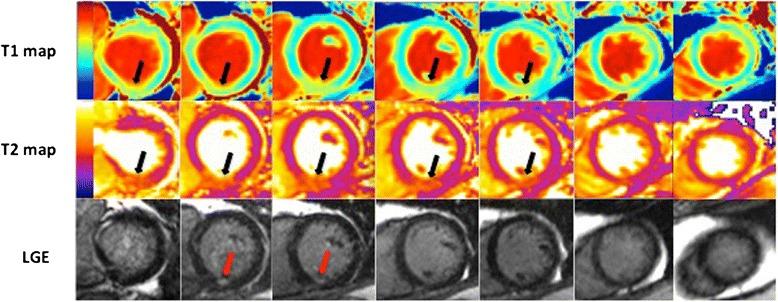
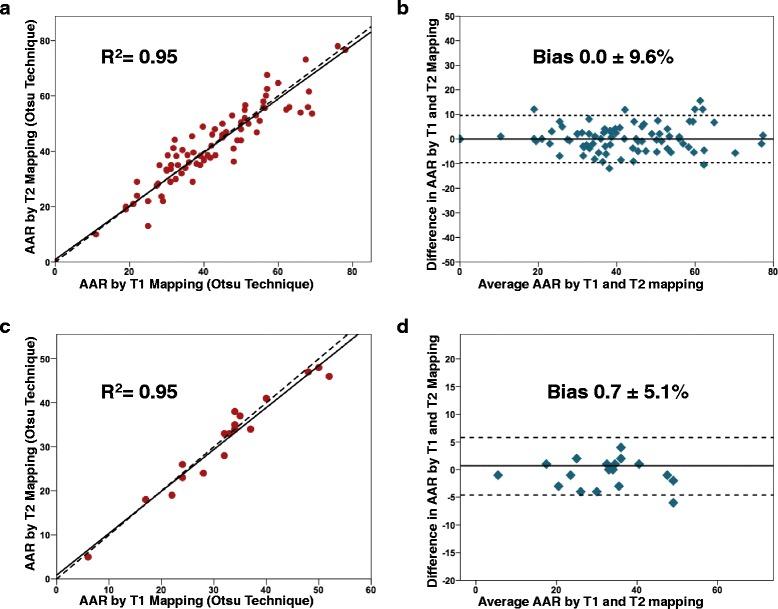
A total of 125 matching T1 and T2 mapping short-axis slices were available for analysis from 18 patients. The acquisition times were identical for the T1 maps and T2 maps. 18 slices were excluded due to suboptimal image quality. Both mapping sequences were equally prone to susceptibility artifacts in the lateral wall and were equally likely to be affected by microvascular obstruction requiring manual correction. The Otsu thresholding technique performed best in terms of inter- and intra-observer variability for both T1 and T2 mapping CMR. The mean myocardial infarct size was 18.8 ± 9.4 % of the LV. There was no difference in either the mean AAR (32.3 ± 11.5 % of the LV versus 31.6 ± 11.2 % of the LV, P = 0.25) or myocardial salvage index (0.40 ± 0.26 versus 0.39 ± 0.27, P = 0.20) between the T1 and T2 mapping techniques. On a per-slice analysis, there was an excellent correlation between T1 mapping and T2 mapping in the quantification of the AAR with an R(2) of 0.95 (P < 0.001), with no bias (mean ± 2SD: bias 0.0 ± 9.6 %). On a per-patient analysis, the correlation and agreement remained excellent with no bias (R(2) 0.95, P < 0.0001, bias 0.7 ± 5.1 %).
CONCLUSIONS
T1 mapping CMR at 3T performed as well as T2 mapping in quantifying the AAR and assessing myocardial salvage in reperfused STEMI patients, thereby providing an alternative CMR measure of the the AAR.
背景
在再灌注的ST段抬高型心肌梗死(STEMI)患者中,T1映射心血管磁共振(CMR)能否准确量化T2映射所划定的梗死相关面积(AAR)并在3T场强下评估心肌挽救情况尚不清楚,本研究对此进行了调查。
方法
18例STEMI患者在初次经皮冠状动脉介入治疗后中位时间5(4 - 6)天接受3T(西门子Bio-graph mMR)CMR检查,采用天然T1(MOLLI)和T2映射(WIP #699;英国西门子医疗)。由两名独立观察者使用手动、大津法和2倍标准差阈值评估覆盖整个左心室(LV)的匹配短轴T1和T2图像。评估了观察者间和观察者内的变异性、T1和T2映射技术在每层和每位患者基础上的相关性和一致性。
结果
18例患者共有125个匹配的T1和T2映射短轴层面可供分析。T1图像和T2图像的采集时间相同。因图像质量欠佳排除18个层面。两种映射序列在侧壁同样容易出现磁化率伪影,并且同样可能受到微血管阻塞影响而需要手动校正。就T1和T2映射CMR的观察者间和观察者内变异性而言,大津法阈值技术表现最佳。平均心肌梗死面积为左心室的18.8±9.4%。T1和T2映射技术在平均AAR(左心室的32.3±11.5%对左心室的31.6±11.2%,P = 0.25)或心肌挽救指数(0.40±0.26对0.39±0.27,P = 0.20)方面均无差异。在每层分析中,T1映射和T2映射在AAR量化方面具有极好的相关性,R²为0.95(P < 0.001),无偏差(均值±2SD:偏差0.0±9.6%)。在每位患者分析中,相关性和一致性仍然极好,无偏差(R² 0.95,P < 0.0001,偏差0.7±5.1%)。
结论
3T场强下的T1映射CMR在量化AAR和评估再灌注STEMI患者的心肌挽救情况方面与T2映射表现相当,从而为AAR提供了一种替代性的CMR测量方法。



 Zotero 插件