
肠道微生物群与乳糜泻:病因、后果还是共同进化?
Intestinal Microbiota and Celiac Disease: Cause, Consequence or Co-Evolution?
作者信息
Cenit María Carmen, Olivares Marta, Codoñer-Franch Pilar, Sanz Yolanda
机构信息
Microbial Ecology, Nutrition & Health Research Group, Institute of Agrochemistry and Food Technology, National Research Council (IATA-CSIC), Avda. Agustín Escardino, 7, 46980 Paterna, Valencia, Spain.
Department of Pediatrics, Dr. Peset University Hospital, Avda. Gaspar Aguilar, 80, 46017 Valencia, Spain.
出版信息
Nutrients. 2015 Aug 17;7(8):6900-23. doi: 10.3390/nu7085314.
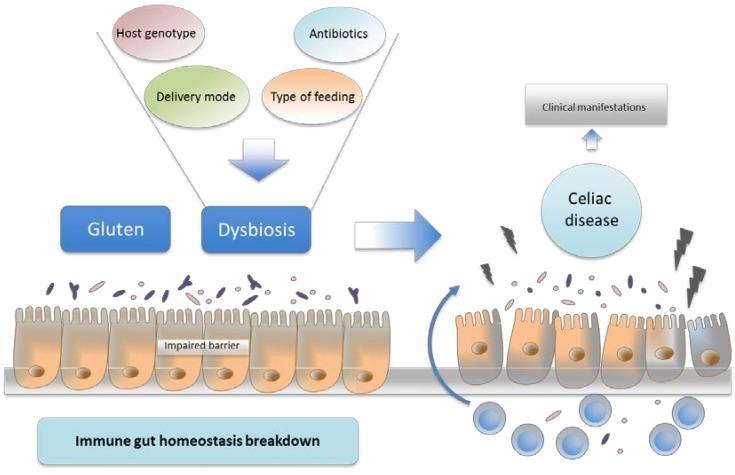
It is widely recognized that the intestinal microbiota plays a role in the initiation and perpetuation of intestinal inflammation in numerous chronic conditions. Most studies report intestinal dysbiosis in celiac disease (CD) patients, untreated and treated with a gluten-free diet (GFD), compared to healthy controls. CD patients with gastrointestinal symptoms are also known to have a different microbiota compared to patients with dermatitis herpetiformis and controls, suggesting that the microbiota is involved in disease manifestation. Furthermore, a dysbiotic microbiota seems to be associated with persistent gastrointestinal symptoms in treated CD patients, suggesting its pathogenic implication in these particular cases. GFD per se influences gut microbiota composition, and thus constitutes an inevitable confounding factor in studies conducted in CD patients. To improve our understanding of whether intestinal dysbiosis is the cause or consequence of disease, prospective studies in healthy infants at family risk of CD are underway. These studies have revealed that the CD host genotype selects for the early colonizers of the infant's gut, which together with environmental factors (e.g., breast-feeding, antibiotics, etc.) could influence the development of oral tolerance to gluten. Indeed, some CD genes and/or their altered expression play a role in bacterial colonization and sensing. In turn, intestinal dysbiosis could promote an abnormal response to gluten or other environmental CD-promoting factors (e.g., infections) in predisposed individuals. Here, we review the current knowledge of host-microbe interactions and how host genetics/epigenetics and environmental factors shape gut microbiota and may influence disease risk. We also summarize the current knowledge about the potential mechanisms of action of the intestinal microbiota and specific components that affect CD pathogenesis.
人们普遍认识到,肠道微生物群在多种慢性疾病的肠道炎症发生和持续发展中发挥作用。与健康对照相比,大多数研究报告了乳糜泻(CD)患者(未治疗以及采用无麸质饮食 [GFD] 治疗)存在肠道生态失调。已知有胃肠道症状的 CD 患者与疱疹样皮炎患者及对照相比,其微生物群也有所不同,这表明微生物群参与了疾病表现。此外,失调的微生物群似乎与接受治疗的 CD 患者持续存在的胃肠道症状相关,提示其在这些特定病例中的致病作用。GFD 本身会影响肠道微生物群的组成,因此在 CD 患者中进行的研究中构成了一个不可避免的混杂因素。为了更好地理解肠道生态失调是疾病的原因还是结果,针对有 CD 家族风险的健康婴儿的前瞻性研究正在进行中。这些研究表明,CD 宿主基因型决定了婴儿肠道的早期定植菌,这些定植菌与环境因素(如母乳喂养、抗生素等)共同影响对麸质的口服耐受性的发展。事实上,一些 CD 基因和/或其表达改变在细菌定植和感知中起作用。反过来,肠道生态失调可能会促进易感个体对麸质或其他促进 CD 的环境因素(如感染)产生异常反应。在此,我们综述了宿主 - 微生物相互作用的现有知识,以及宿主遗传学/表观遗传学和环境因素如何塑造肠道微生物群并可能影响疾病风险。我们还总结了关于肠道微生物群及其影响 CD 发病机制的特定成分的潜在作用机制的现有知识。

 Zotero 插件