
漆黄素,一种植物化学物质,可增强索拉非尼诱导的细胞凋亡,并抑制植入BRAF突变黑色素瘤细胞的无胸腺裸鼠的肿瘤生长。
Fisetin, a phytochemical, potentiates sorafenib-induced apoptosis and abrogates tumor growth in athymic nude mice implanted with BRAF-mutated melanoma cells.
作者信息
Pal Harish Chandra, Baxter Ronald D, Hunt Katherine M, Agarwal Jyoti, Elmets Craig A, Athar Mohammad, Afaq Farrukh
机构信息
Department of Dermatology, University of Alabama at Birmingham, Birmingham, AL, USA.
Comprehensive Cancer Center, University of Alabama at Birmingham, Birmingham, AL, USA.
出版信息
Oncotarget. 2015 Sep 29;6(29):28296-311. doi: 10.18632/oncotarget.5064.
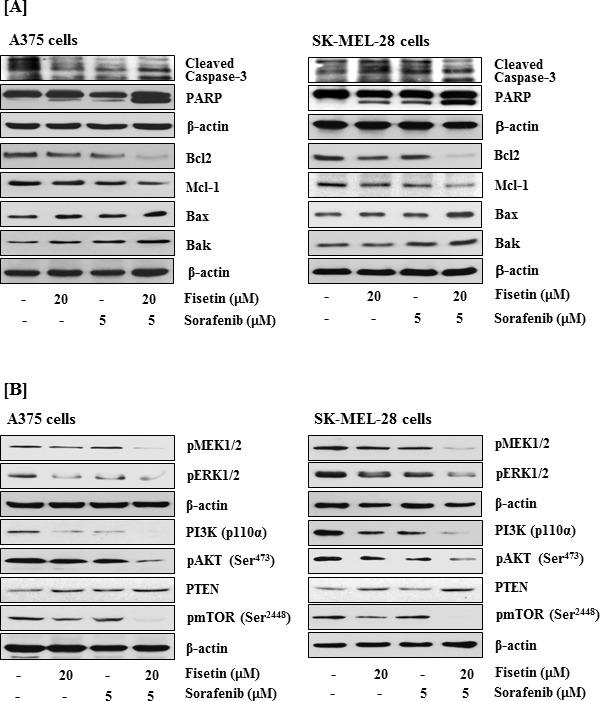
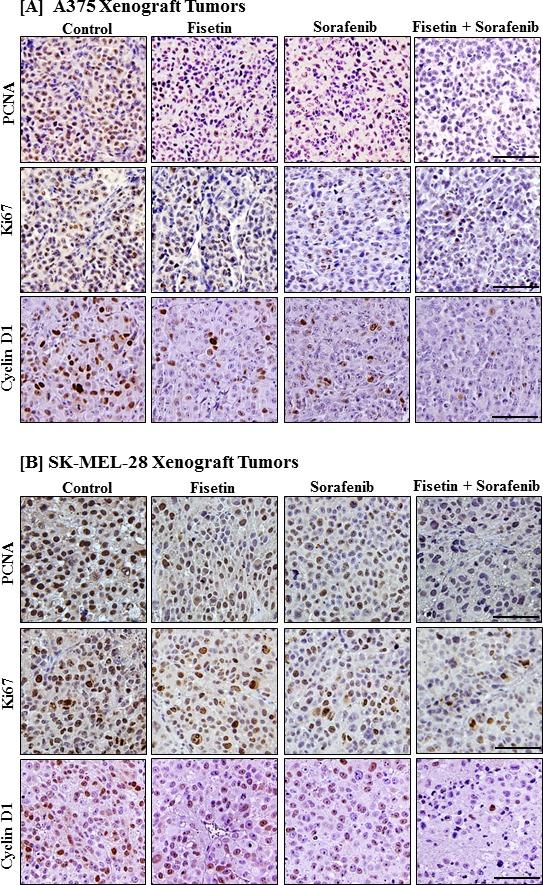
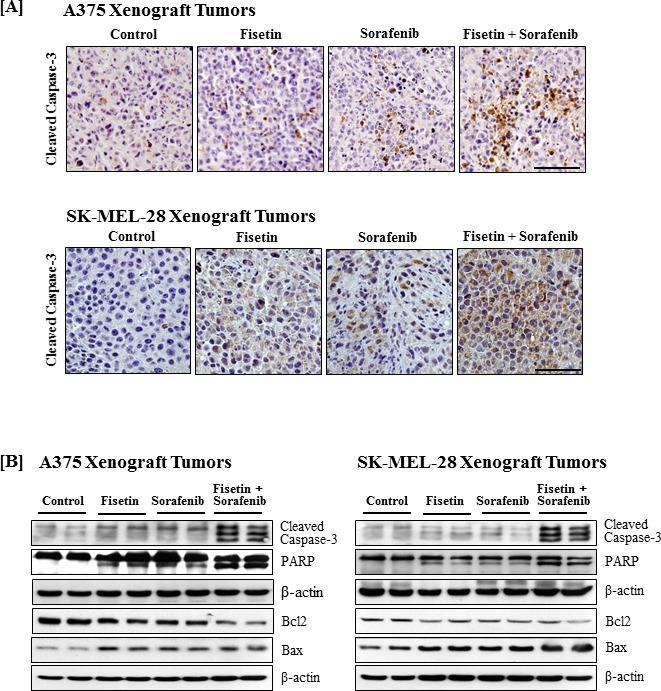
Melanoma is the most deadly form of cutaneous malignancy, and its incidence rates are rising worldwide. In melanoma, constitutive activation of the BRAF/MEK/ERK (MAPK) and PI3K/AKT/mTOR (PI3K) signaling pathways plays a pivotal role in cell proliferation, survival and tumorigenesis. A combination of compounds that lead to an optimal blockade of these critical signaling pathways may provide an effective strategy for prevention and treatment of melanoma. The phytochemical fisetin is known to possess anti-proliferative and pro-apoptotic activities. We found that fisetin treatment inhibited PI3K signaling pathway in melanoma cells. Therefore, we investigated the effect of fisetin and sorafenib (an RAF inhibitor) alone and in combination on cell proliferation, apoptosis and tumor growth. Combination treatment (fisetin + sorafenib) more effectively reduced the growth of BRAF-mutated human melanoma cells at lower doses when compared to individual agents. In addition, combination treatment resulted in enhanced (i) apoptosis, (ii) cleavage of caspase-3 and PARP, (iii) expression of Bax and Bak, (iv) inhibition of Bcl2 and Mcl-1, and (v) inhibition of expression of PI3K, phosphorylation of MEK1/2, ERK1/2, AKT and mTOR. In athymic nude mice subcutaneously implanted with melanoma cells (A375 and SK-MEL-28), we found that combination therapy resulted in greater reduction of tumor growth when compared to individual agents. Furthermore, combination therapy was more effective than monotherapy in: (i) inhibition of proliferation and angiogenesis, (ii) induction of apoptosis, and (iii) inhibition of the MAPK and PI3K pathways in xenograft tumors. These data suggest that simultaneous inhibition of both these signaling pathways using combination of fisetin and sorafenib may serve as a therapeutic option for the management of melanoma.
黑色素瘤是皮肤恶性肿瘤中最致命的一种,其发病率在全球范围内呈上升趋势。在黑色素瘤中,BRAF/MEK/ERK(丝裂原活化蛋白激酶,MAPK)和PI3K/AKT/mTOR(PI3K)信号通路的组成性激活在细胞增殖、存活和肿瘤发生中起关键作用。联合使用能最佳阻断这些关键信号通路的化合物组合可能为黑色素瘤的预防和治疗提供一种有效策略。植物化学物质非瑟酮已知具有抗增殖和促凋亡活性。我们发现非瑟酮处理可抑制黑色素瘤细胞中的PI3K信号通路。因此,我们研究了非瑟酮和索拉非尼(一种RAF抑制剂)单独及联合使用对细胞增殖、凋亡和肿瘤生长的影响。与单独用药相比,联合治疗(非瑟酮+索拉非尼)在较低剂量时能更有效地降低BRAF突变的人黑色素瘤细胞的生长。此外,联合治疗导致(i)凋亡增强,(ii)半胱天冬酶-3和聚(ADP-核糖)聚合酶的切割,(iii)Bax和Bak的表达,(iv)Bcl2和Mcl-1的抑制,以及(v)PI3K表达的抑制、MEK1/2、ERK1/2、AKT和mTOR的磷酸化。在皮下植入黑色素瘤细胞(A375和SK-MEL-28)的无胸腺裸鼠中,我们发现联合治疗与单独用药相比能更大程度地抑制肿瘤生长。此外,联合治疗在以下方面比单一疗法更有效:(i)抑制增殖和血管生成,(ii)诱导凋亡,以及(iii)抑制异种移植肿瘤中的MAPK和PI3K通路。这些数据表明,使用非瑟酮和索拉非尼联合同时抑制这两种信号通路可能是黑色素瘤治疗的一种选择。



 Zotero 插件