
基于整合转录组学鉴定卵巢癌细胞中紫杉醇耐药基因的隐匿驱动因素:雄激素受体分析
Integrative transcriptomics-based identification of cryptic drivers of taxol-resistance genes in ovarian carcinoma cells: Analysis of the androgen receptor.
作者信息
Sun Nian-Kang, Huang Shang-Lang, Lu Hsing-Pang, Chang Ting-Chang, Chao Chuck C-K
机构信息
Department of Biochemistry and Molecular Biology, College of Medicine, Chang Gung University, Taoyuan, Taiwan, Republic of China.
Division of Biomedical Sciences, Chang Gung University of Science and Technology, Taoyuan, Taiwan, Republic of China.
出版信息
Oncotarget. 2015 Sep 29;6(29):27065-82. doi: 10.18632/oncotarget.4824.
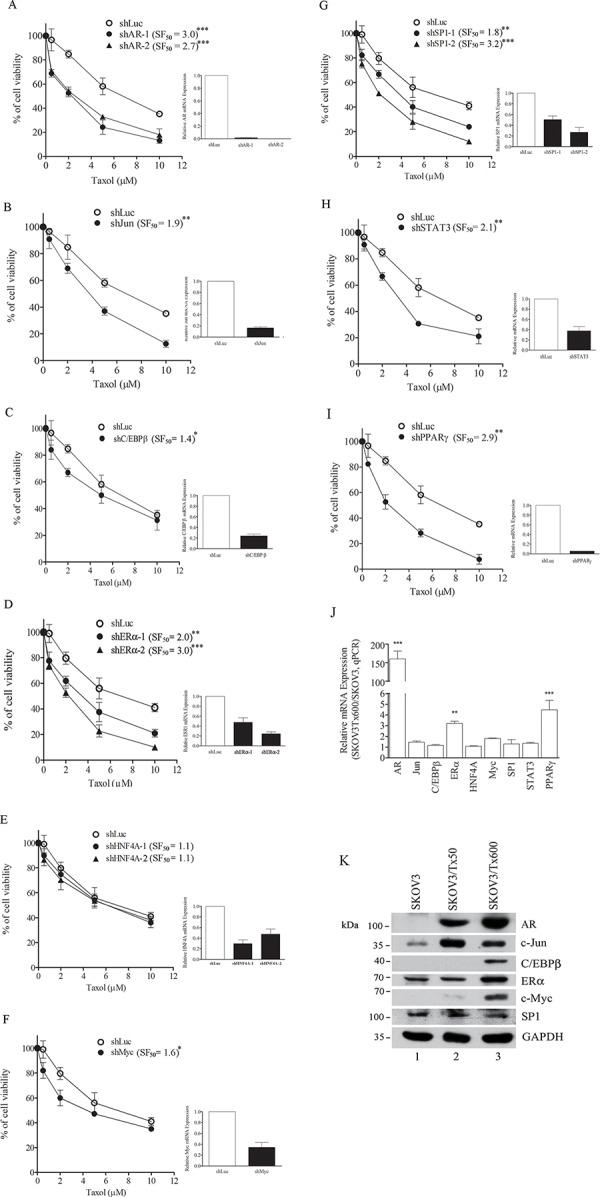
A systematic analysis of the genes involved in taxol resistance (txr) has never been performed. In the present study, we created txr ovarian carcinoma cell lines to identify the genes involved in chemoresistance. Transcriptome analysis revealed 1,194 overexpressed genes in txr cells. Among the upregulated genes, more than 12 cryptic transcription factors were identified using MetaCore analysis (including AR, C/EBPβ, ERα, HNF4α, c-Jun/AP-1, c-Myc, and SP-1). Notably, individual silencing of these transcription factors (except HNF4`)sensitized txr cells to taxol. The androgen receptor (AR) and its target genes were selected for further analysis. Silencing AR using RNA interference produced a 3-fold sensitization to taxol in txr cells, a response similar to that produced by silencing abcb1. AR silencing also downregulated the expression of prominent txr gene candidates (including abcb1, abcb6, abcg2, bmp5, fat3, fgfr2, h1f0, srcrb4d, and tmprss15). In contrast, AR activation using the agonist DHT upregulated expression of the target genes. Individually silencing seven out of nine (78%) AR-regulated txr genes sensitized txr cells to taxol. Inhibition of AKT and JNK cellular kinases using chemical inhibitors caused a dramatic suppression of AR expression. These results indicate that the AR represents a critical driver of gene expression involved in txr.
从未对参与紫杉醇耐药性(txr)的基因进行过系统分析。在本研究中,我们创建了txr卵巢癌细胞系以鉴定参与化疗耐药性的基因。转录组分析揭示了txr细胞中有1194个过表达基因。在这些上调基因中,使用MetaCore分析鉴定出12种以上潜在转录因子(包括AR、C/EBPβ、ERα、HNF4α、c-Jun/AP-1、c-Myc和SP-1)。值得注意的是,单独沉默这些转录因子(HNF4`除外)可使txr细胞对紫杉醇敏感。选择雄激素受体(AR)及其靶基因进行进一步分析。使用RNA干扰沉默AR可使txr细胞对紫杉醇的敏感性提高3倍,这一反应与沉默abcb1所产生的反应相似。AR沉默还下调了主要txr基因候选物(包括abcb1、abcb6、abcg2、bmp5、fat3、fgfr2、h1f0、srcrb4d和tmprss15)的表达。相反,使用激动剂双氢睾酮激活AR可上调靶基因的表达。单独沉默9个AR调控的txr基因中的7个(78%)可使txr细胞对紫杉醇敏感。使用化学抑制剂抑制AKT和JNK细胞激酶可显著抑制AR表达。这些结果表明,AR是参与txr的基因表达的关键驱动因素。




 Zotero 插件